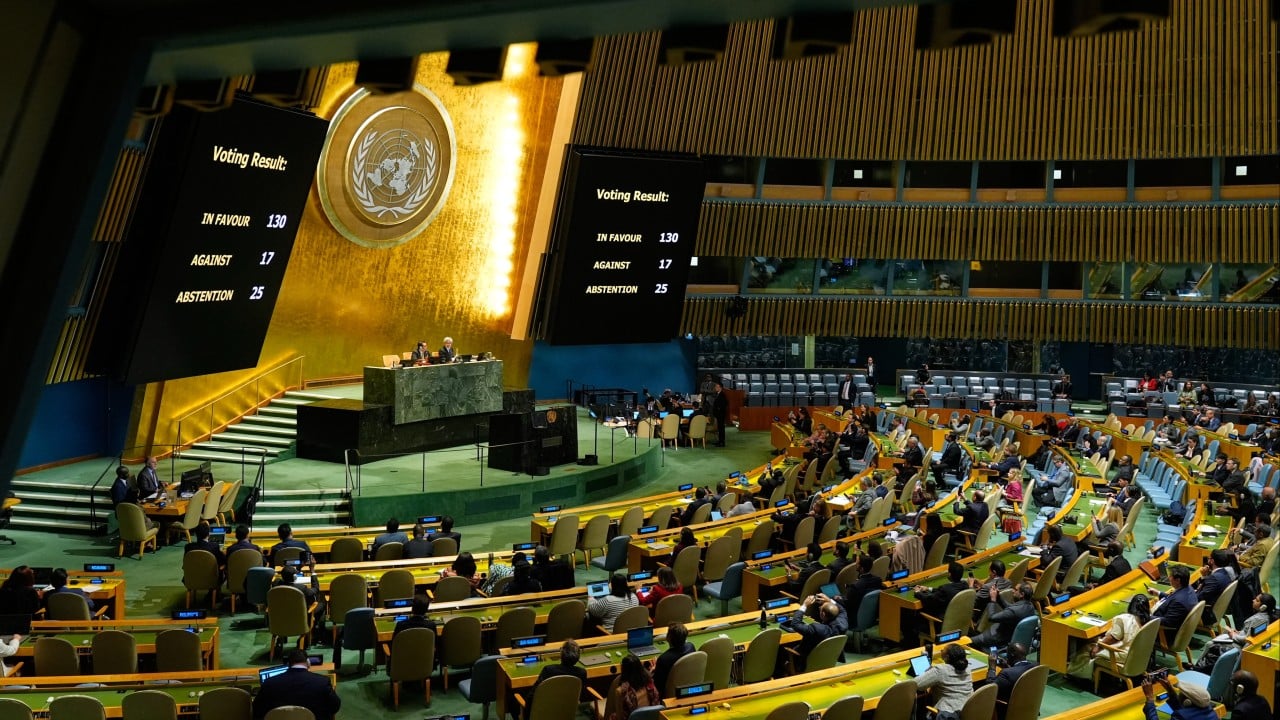
Multilateral diplomatic consensus is rarely a static asset; it is a depreciating instrument that requires continuous maintenance against bilateral coercion. For over three decades, the United Nations General Assembly (UNGA) resolution calling for the end of the United States economic, commercial, and financial embargo against Cuba functioned as one of the most predictable rituals in international relations. However, when a hegemonic power shifts from passive tolerance of symbolic condemnation to active diplomatic enforcement, the voting bloc fractures. The erosion of backing for the anti-embargo resolution under the Trump administration demonstrates a fundamental principle of international political economy: symbolic multilateralism collapses when the transactional cost of opposing a superpower exceeds the reputational benefit of adhering to international norms.
To understand this shift, one must separate the legal architecture of the embargo from the diplomatic theater of the General Assembly. The embargo is not a single executive order that can be dismantled by a simple diplomatic concession; it is a codified web of statutory restrictions—primarily the Trading with the Enemy Act of 1917, the Foreign Assistance Act of 1961, the Cuban Democracy Act of 1992, and the Helms-Burton Act of 1996. Because these laws anchor the sanctions in domestic US legislation, the annual UNGA vote carries zero binding legal weight. Its sole function is normative signaling—isolating Washington diplomatically and validating Havana’s narrative that its economic stagnation is externally induced.
The Mechanics of Diplomatic Coercion
When the United States transitioned from treating the UNGA vote as an unavoidable annual annoyance to treating it as a metric of bilateral loyalty, the underlying incentive structure for smaller nations changed immediately. Standard diplomatic reporting often frames this shift vaguely as "increased pressure." In operational terms, this pressure operates through three distinct mechanisms of statecraft:
- Issue Linkage and Aid Conditionality: Smaller developing nations rely heavily on US bilateral assistance, multilateral development bank voting shares, and preferential trade agreements. By explicitly linking a nation's UNGA voting record to its standing in Washington, the US State Department converts a low-cost symbolic vote into a high-stakes budgetary risk. When a finance minister weighs a abstract vote for Cuban sovereignty against concrete funding for domestic infrastructure or security cooperation, the rational actor defects from the multilateral consensus.
- Extraterritorial Enforcement via Title III: The activation of Title III of the Helms-Burton Act fundamentally altered the risk calculus for third-party states, particularly European and Latin American allies. Title III allows US nationals to sue foreign companies in US courts if those companies "traffic" in property confiscated by the Cuban government after 1959. This moves the conflict out of the diplomatic arena and into the balance sheets of private multinational corporations. Governments whose domestic firms face existential litigation risk in the US market lose the political appetite to champion Havana’s cause at the UN.
- Diplomatic Re-categorization and Security Framing: By re-designating Cuba as a State Sponsor of Terrorism and emphasizing its intelligence and security ties to Venezuela, Russia, and China, Washington reframed the embargo. The issue shifted from a Cold War relic about bilateral property disputes to an active national security containment strategy. Allies aligned with the US security umbrella face intense pressure not to undercut Washington on matters defined as core hemispheric defense.
The Vulnerability of the UNGA Voting Bloc
The historical supermajorities supporting Cuba at the UN—often exceeding 180 votes in favor with only the US and Israel opposed—created an optical illusion of unbreakable solidarity. In reality, that consensus was wide but shallow.
- The Free-Rider Dynamic: For decades, voting against the US embargo was a zero-cost way for nations to signal independence from American hegemony and curry favor with the Non-Aligned Movement. Because Washington rarely retaliated for these votes, countries could vote against the US in New York on Tuesday and negotiate trade deals in Washington on Wednesday.
- The Fragility of Abstentions: When coercive diplomacy is applied, states rarely flip directly from a "Yes" vote to a "No" vote, as doing so incurs severe domestic and regional political costs. Instead, they migrate to abstention or strategic absence. In multilateral arithmetic, an abstention achieves the exact same operational goal for the coercing power as a "No" vote: it visually degrades the unanimity of the condemnation and signals that the coalition is fracturing.
This explains why the erosion of support manifests primarily through an uptick in abstentions and shifting regional alignments—particularly within Latin America, where conservative governments elected on anti-socialist platforms found ideological alignment with Washington's maximum-pressure campaign.
Economic Asymmetry and the Cost Function of Sanctions
Analyzing the UN vote without examining the underlying economic reality in Cuba obscures why the diplomatic battle became so acute. The effectiveness of the US embargo relies on extreme economic asymmetry. The United States represents the world's largest consumer market and controls the primary global reserve currency, while Cuba operates a centrally planned, import-dependent economy with severe liquidity constraints.
The cost function of the embargo is not merely the direct prohibition of US-Cuba trade; it is the chilling effect on global financial intermediaries. Because international banks clear dollar transactions through the US financial system, the risk of massive fines from the Office of Foreign Assets Control (OFAC) forces global institutions to over-comply. They sever correspondent banking relationships with Cuban entities entirely rather than incur the compliance costs of vetting legal humanitarian transactions.
Consequently, Havana’s diplomatic offensive at the UN is an economic survival mechanism. Cuba uses the General Assembly to maintain international legitimacy, which in turn provides political cover for foreign governments to subsidize credit lines and state-backed investments on the island. When US pressure erodes that UN backing, it simultaneously signals to international creditors and investors that Cuba’s political risk profile is deteriorating.
The Limitations of Maximum-Pressure Diplomacy
While aggressive diplomatic coercion successfully fractures UN voting blocs in the short term, the strategy contains structural limitations that prevent it from achieving its stated political objectives:
- Diminishing Marginal Returns on Sanctions: Once an economy is largely severed from the US financial system and secondary sanctions have deterred risk-averse multinational corporations, additional diplomatic pressure yields minimal incremental economic damage. The remaining actors engaging with Cuba—primarily state-backed entities from rival powers—are insulated from US market pressures and motivated by geopolitical rather than commercial returns.
- Geopolitical Vacuum Filling: Pushing Havana into deeper isolation does not force regime collapse; it accelerates strategic realignment. As Western European and Latin American firms retreat under the threat of Title III litigation and OFAC penalties, Cuba deepens its dependency on Russia and China. This creates a strategic paradox for Washington: a policy designed to secure hemispheric dominance inadvertently invites rival superpowers to establish deeper intelligence, telecommunications, and financial footholds ninety miles from the US coast.
- Erosion of Diplomatic Capital: Coercing allies to abstain on a non-binding resolution consumes finite diplomatic capital. When the US State Department expends political leverage to alter a symbolic vote on Cuba, it has less leverage available to secure allied cooperation on higher-priority issues, such as semiconductor export controls, defense spending targets, or multilateral sanctions against major adversaries.
Strategic Execution in Asymmetric Diplomacy
For policymakers and international strategists operating within this environment, the trajectory of the UN Cuba vote provides a clear operational blueprint. Symbolic multilateral victories cannot withstand targeted bilateral economic coercion.
To counter this dynamic, Havana and its remaining allies must abandon the reliance on broad, non-binding General Assembly resolutions, which offer diminishing returns against a resolute Washington. The only viable counter-strategy is legal and financial compartmentalization: establishing non-dollar clearing mechanisms, utilizing sovereign state-backed credit guarantees that bypass private commercial banks, and pursuing targeted legal challenges against extraterritorial statutes within European and international trade courts. Conversely, for Washington to sustain the erosion of the UN consensus without driving Havana entirely into the orbit of rival powers, it must transition from blunt, indiscriminate pressure to calibrated conditionality—tying specific, reversible sanctions relief directly to verifiable economic liberalization within Cuba's emerging private sector. Without this calibration, the diplomatic scoreboard in New York will continue to shift in Washington's favor while the strategic reality in the Caribbean deteriorates.