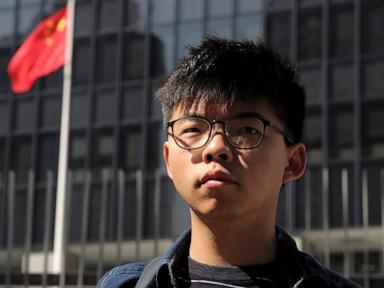
Hong Kong pro-democracy activist Joshua Wong will appear in court on September 2, 2026, to face a plea and sentencing hearing for his second national security case. The charge is conspiracy to collude with foreign forces, a sweeping offense under the 2020 National Security Law that carries a maximum penalty of life imprisonment. Wong is already inside a cell, serving a fifty-six-month sentence for subversion in a separate case involving an unofficial political primary. His return to the dock demonstrates a systematic effort by authorities to ensure prominent dissidents remain permanently neutralized behind bars.
The judicial schedule published by the Hong Kong judiciary confirms that this latest legal proceeding is set for a single day. Yet, the brief duration of the hearing belies the profound shift it represents for the city's legal system. This is no longer about punishing specific acts of dissent. It is a process of rolling prosecutions designed to keep key figures of the 2019 protest movement in a state of perpetual incarceration.
By analyzing the mechanics of this second prosecution, a clear pattern emerges of how authorities use overlapping charges to extend prison sentences indefinitely. The strategy relies on separating a single period of political activism into distinct criminal files, ensuring that as one prison term nears its end, another begins.
The September Verdict and the Trap of Compounding Charges
Wong was arrested for this second national security offense in June 2025 while already serving his sentence at Stanley Prison. The state security apparatus did not bring these charges during his initial high-profile trial alongside forty-six other democrats. Instead, prosecutors held the file back. They waited until the primary election trial concluded before activating the collusion charge.
The indictment covers a narrow window between July 1, 2020, and November 23, 2020. This period directly followed the imposition of the National Security Law by Beijing. Prosecutors allege that during these months, Wong conspired with exiled activist Nathan Law and several unnamed individuals to solicit foreign sanctions, blockades, or other hostile actions against the governments of Hong Kong and mainland China.
The mechanics of the charge are found under Article 29 of the National Security Law. Under this provision, offenses are categorized by severity. If the court deems Wong’s actions to be of a grave nature, the law prescribes a mandatory minimum of ten years, stretching up to life imprisonment. Even if the court rules the offense is of a minor nature, the penalty ranges from three to ten years.
This structural setup removes traditional judicial discretion regarding leniency. Because Wong has spent years in pre-trial detention and maximum-security confinement, his physical appearance has altered significantly. Observers at his initial arraignment noted he was visibly thinner. He merely replied that he understood the charge before being led back to the cells without applying for bail.
The state has also tacked on financial elements to the case. Alongside the collusion charge, national security police accused Wong of dealing with property known or believed to represent the proceeds of an indictable offense. This classic money-laundering framework allows the state to freeze assets, seize remaining funds from defunct political organizations, and cut off the financial oxygen required to sustain any lingering civil society networks.
Shifting the Pillars of the Common Law Court
The transformation of Hong Kong’s judiciary is visible in how these cases are processed. Historically, the city’s common law system operated on a strong presumption of bail. The burden rested entirely on the prosecution to prove that a defendant posed an immediate flight risk or a danger to the public.
The National Security Law inverted this rule. Under Article 42, the judge cannot grant bail unless there are sufficient grounds to believe the suspect will not continue to commit acts endangering national security. This exceptionally high threshold has turned pre-trial detention into a standard tool of state execution. Activists routinely spend two to three years in prison before their trials even begin.
Trial by jury has also been discarded in these proceedings. The Basic Law once guaranteed jury trials for serious criminal offenses in the High Court. Now, national security cases are handled by a panel of three designated jurists chosen directly by the city's Chief Executive. The executive branch effectively curates the judicial roster that decides these political outcomes.
The defense strategies available to figures like Wong have narrowed to almost nothing. Pleading guilty has become the only pragmatic option to secure a standard one-third reduction in sentencing. In the common law tradition, a guilty plea implies contrition and a desire for rehabilitation. In the context of Hong Kong’s current political courtrooms, it is an exercise in damage control.
The primary election trial demonstrated the limits of legal resistance. Activists who chose to contest the subversion charges faced months of grueling trial procedures, only to be found guilty by the handpicked bench. The judicial reasoning applied in those verdicts established that regular political activities, such as organizing a primary to win a legislative majority, could be interpreted as a conspiracy to paralyze the government.
The Transnational Crackdown and the Exile Bounty
The state's case against Wong is inextricably linked to individuals who managed to flee the city before the borders closed on the opposition. Nathan Law, named as a co-conspirator in Wong's new indictment, escaped to the United Kingdom in 2020, where he eventually received political asylum.
The distance has not stopped the Hong Kong government from pursuing him. In 2023, authorities placed a bounty of one million Hong Kong dollars on Law and several other overseas activists. These bounties are accompanied by continuous pressure on the families of exiled dissidents remaining in Hong Kong, who are regularly brought in for questioning by national security police.
The conflict has expanded well beyond the territory's geographical borders. A London court recently sentenced a former British border official and a retired Hong Kong police officer for conducting hostile surveillance against dissidents in the United Kingdom. The prosecution in that case explicitly identified Nathan Law as one of the primary targets of the espionage operation.
This overseas intelligence gathering reveals the true scale of the operation. The administration in Hong Kong is not merely cleaning up domestic dissent. It is actively trying to disrupt the advocacy networks that these exiles have built in London, Washington, and Berlin.
By linking Wong directly to Law in a fresh criminal conspiracy, the prosecution sends a warning to the domestic population. Any communication, past or present, with individuals designated as fugitives can be retroactively framed as a capital offense. The trial in September will rely on evidence gathered from digital devices, public statements, and international media interviews given during that volatile four-month window in 2020.
The Architecture of Perpetual Incarceration
The historical trajectory of Joshua Wong matches the political evolution of Hong Kong over the last fifteen years. He entered public life in 2012 as a fifteen-year-old student leading protests against a mandatory national education curriculum. He succeeded in forcing the government to back down, a rare victory that laid the groundwork for his later leadership during the 2014 Umbrella Movement.
In 2016, Wong co-founded Demosisto, a political party aimed at contesting seats in the Legislative Council and pushing for self-determination. The party represented a generational shift away from the older, more moderate pan-democrats. This group believed that direct, peaceful political participation could preserve the city's autonomy under the "one country, two systems" framework.
That belief is now obsolete. The introduction of the National Security Law on June 30, 2020, prompted Demosisto to disband within hours. The party's leadership recognized that its core platform had been rendered illegal overnight.
The current legal strategy deployed against Wong is an illustration of what legal scholars describe as "attrition by lawfare." By staggered delivery of indictments, the state avoids creating a single, massive political flashpoint while achieving the same structural goal. The public becomes exhausted by the repetitive nature of the hearings, and the international community finds it difficult to maintain focus on individual cases that drag on for years.
The Western response to these developments has settled into a predictable cycle of statements, condemnations, and occasional targeted sanctions. These measures have failed to alter the trajectory of the court cases. The authorities in Beijing and Hong Kong view the total eradication of the political opposition as an absolute necessity for national sovereignty, a goal that overrides any concerns about international reputational damage or the erosion of the city's status as a global financial hub.
When Wong stands before the judge this September, the outcome is functionally predetermined. The only real question is how many years the panel will add to his existing term. By the time this second sentence is handed down, the infrastructure of the old Hong Kong—its independent unions, its adversarial press, and its rowdy legislature—will have been completely replaced by a disciplined, administrative order that tolerates no variance from the official line.