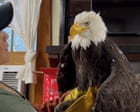
Dawn arrives differently in the San Bernardino Mountains. Before the sun breaks the jagged crest of the evergreens, the air holds a biting, crystalline chill that burns the back of your throat. Up there, sitting six stories above the forest floor in a towering Jeffrey pine, is a massive structure of woven branches. It looks less like a nest and more like a fortress.
For years, millions of people woke up to that view. They did not wake up in the cabin, nor did they hike the steep, unforgiving trails of the valley. They woke up in front of glowing screens in Tokyo, New York, London, and Melbourne. They clicked a link, punched in a password, and stepped directly into the private, unfiltered life of Jackie.
She was not just a bald eagle. She was a global phenomenon.
To understand why hundreds of thousands of people would keep a browser tab open all day just to watch a bird sleep, you have to understand the modern need for quiet witness. We live in a world of manufactured noise, algorithmic outrage, and transient relationships. But Jackie offered something pure. When you watched her preen her feathers, tilt her head toward a sudden gust of wind, or trade incubation duties with her longtime mate, Shadow, time slowed down. You were no longer checking your email. You were simply a creature watching another creature survive.
Then, the silence came.
The livestream did not cut out immediately. Instead, the updates grew sparse. Whispers turned into worried forum posts. Biologists and wildlife enthusiasts noticed the subtle shifts in posture—the slight droop of a wing, the uncharacteristic absence from the nest during prime foraging hours, the vacant stare into a lens that had documented her every triumph and heartbreak for a decade.
She contracted something invisible. A shadow in the blood. A pathogen carried on the wind, or picked up from a careless meal in a changing environment.
Wild birds do not show weakness. Evolution punishes vulnerability with swift finality. So Jackie did what her ancestors had done for millennia: she fought in silence. She stood her ground against fierce winter storms, defended her territory against rival eagles, and endured the heartbreaking loss of past clutches of eggs that failed to hatch. She possessed an ancient, stubborn resilience.
Yet resilience has a biological limit.
When the official news finally broke, it hit like a physical blow. Jackie, the indomitable queen of the Big Bear valley, had died of a mysterious illness.
Think about what happens when an icon of the wild vanishes. The physical nest remains, empty and skeletal against the graying sky. The camera still broadcasts the empty twigs, catching the sunlight as it filters through the pine needles, but the soul of the frame is gone. Viewers around the world stared at their monitors, experiencing a grief that felt entirely irrational to anyone who had never shared that digital vigil. How could people mourn a bird they had never touched?
Because grief does not require physical proximity. It requires investment.
For years, observers watched Jackie navigate the brutal calculus of survival. They watched her tear apart fish brought back by Shadow, feeding their voracious chicks with agonizing tenderness. They watched her weather heatwaves that baked the mountain slopes and blizzards that buried the nest in white. Through high-definition lenses, people thousands of miles away felt the wind off the lake. They felt the weight of the snow.
Her life was an open book written in feathers and instinct.
When an animal like Jackie dies of an undiagnosed or rapidly progressing illness, it serves as a stark reminder of the invisible pressures resting upon our ecosystems. We like to think of nature as a distant painting we can hang on our wall and gaze at through a high-resolution window. We forget that the paint is alive, and that the canvas is fraying.
Consider the compounding stressors facing wildlife in modern habitats. Encroaching human development, shifting climate patterns, rodenticides washing up through the food chain, and novel avian diseases moving faster than wildlife populations can adapt. These are not abstract policy points debated in air-conditioned conference rooms. They are microscopic tragedies playing out in the high branches of Jeffrey pines.
Jackie’s death leaves behind more than an empty nest. It leaves behind a gaping vacancy in the cultural consciousness of the bird-watching community. Shadow has been seen returning to the tree alone, pacing the perimeter of the branches, letting out sharp, plaintive calls that echo across the valley. He does not understand livestream analytics. He only knows that his partner of many years is gone.
The chat rooms are quieter now. The moderators pin a final update to the top of the feed, confirming the worst fears of the community. People post screenshots of their favorite moments—Jackie shaking off rain, Jackie screaming into the sunset, Jackie standing sentinel over fragile, speckled eggs. They share virtual condolences across time zones, bridging oceans with shared sorrow.
We turn to nature to escape ourselves, but moments like this force us to confront our shared fragility. We realize that the wild things we love to watch for entertainment are also the barometers of our shared home.
The camera up in the pine tree is still rolling. The wind still stirs the needles. Down on the lake, the water laps against the rocky shore, indifferent to the grief of millions. But up in the dark timber, the queen is gone, leaving behind only the memory of her fierce, unyielding grace.


