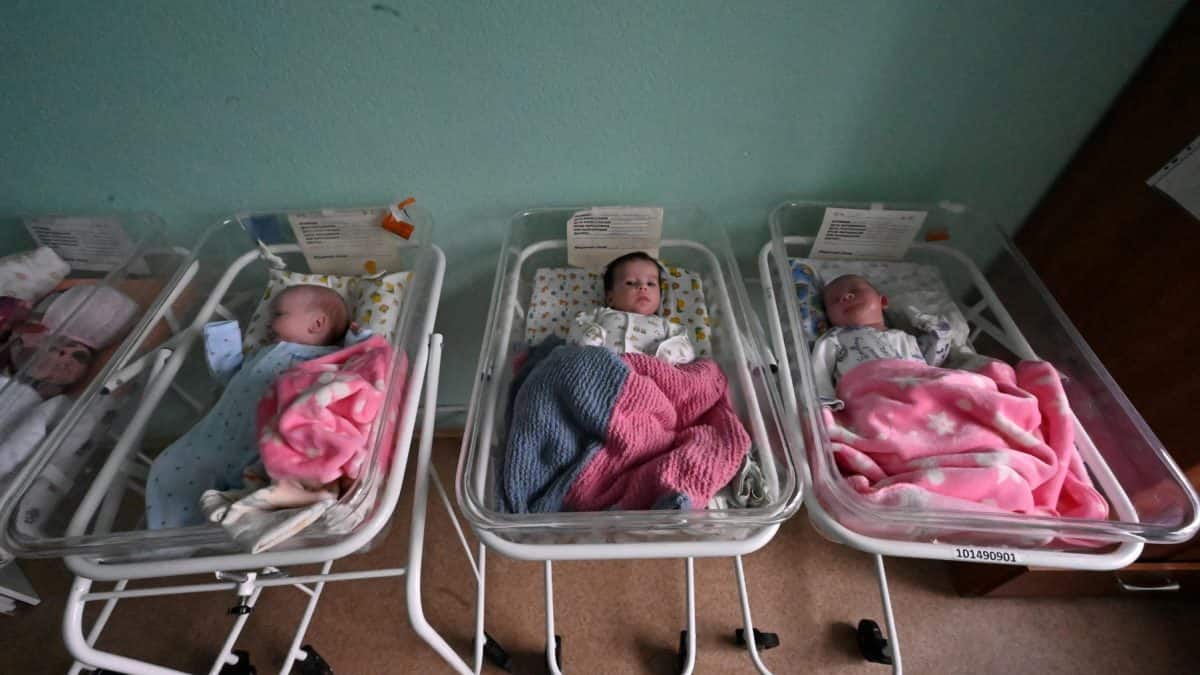
The silence in the maternity ward of a central Ukrainian hospital isn’t the peaceful quiet of sleeping infants. It is the heavy, pressurized silence of a vacuum. Dr. Olena, whose name has been changed for her safety, remembers a time when the hallways echoed with the rhythmic, chaotic music of new life—the sharp cries of newborns, the frantic squeak of rubber soles on linoleum, the hushed, exhausted laughter of fathers.
Now, the floor is mostly shadows.
When the air-raid sirens wail, Olena doesn't just worry about the missiles. She worries about the ghosts. Specifically, the millions of Ukrainians who will never be born because of a war that has entered its fifth grueling year. This isn't just a conflict fought with drones and artillery. It is a demographic winter, a freezing of the future that might prove more devastating than any occupied territory.
Ukraine is currently facing a "catastrophic" birth crisis. The numbers are more than just ink on a page; they are a scream for help. In 2023, the birth rate fell to its lowest point in the nation's 33 years of independence. Roughly 187,000 children were born that year. To put that into perspective, before the full-scale invasion in early 2022, that number was significantly higher. Before the 2014 annexation of Crimea and the Donbas war, it was higher still. Now, the rate has plummeted to roughly 0.7 or 0.8 children per woman.
Demographers will tell you that for a population to remain stable, a nation needs a fertility rate of 2.1. Ukraine is currently operating at less than half of what is required to simply exist.
Consider a hypothetical woman named Anya. She is 29, living in Kyiv. She works in digital marketing and her partner is currently stationed near the eastern front. When they talk over a crackling satellite connection, they don't talk about baby names. They talk about generators. They talk about the cost of flights to Poland. They talk about the terrifying probability that he might never see his child grow up. For Anya, the decision to delay motherhood isn't a "lifestyle choice." It is an act of survival in an environment where the future is a luxury she can no longer afford.
Anya represents the invisible stake of this war. Every month that passes without a pregnancy is a month that shortens the long-term survival of the Ukrainian state. It is a slow-motion collapse.
The problem is three-pronged. First, there is the immediate, visceral fear of the war itself. It is hard to think about prenatal vitamins when you are sleeping in a bathtub to avoid glass shards from a Shahed drone. Second, there is the mass exodus of millions of women of childbearing age who have fled to Europe. They are building lives in Berlin, Warsaw, and London. They are learning new languages. Their children are starting school in foreign systems. The longer the war drags on, the more likely these "temporary" refugees are to become permanent residents of other nations.
Third, and perhaps most hauntingly, there is the physical loss of young men. Thousands of potential fathers are dying in trenches or returning home with injuries that make starting a family a secondary concern to basic rehabilitation.
But why should the rest of the world care?
Imagine a nation where the average age creeps upward like a tide that won't recede. When the war eventually ends—and it will—Ukraine will be a country of veterans and pensioners. Who will rebuild the bridges? Who will staff the tech startups that were once the pride of Eastern Europe? Who will pay the taxes required to sustain a massive healthcare system for an aging population?
This isn't a problem that can be solved with a simple government subsidy. You can’t just offer a "baby bonus" and expect a generation to bring children into a world of blackouts and ballistic threats. It requires a fundamental restoration of hope.
The human heart is resilient, but it is also practical. It seeks a nest that is safe. Right now, the nest is on fire.
We often think of wars in terms of maps—territory gained, territory lost. We see the red lines moving back and forth across a digital screen. But the most important map is the one we rarely see: the genetic map of a country. Every year this war continues, a hole is torn in that map. It is a hole that cannot be patched with foreign aid or F-16s. You cannot manufacture a 20-year-old in a factory. You cannot import a generation’s worth of shared culture and memory.
The "baby crisis" is the ultimate weapon of attrition. It is a silent invasion of the future.
Dr. Olena stands at the window of her ward, watching the sun set over a city that is partially dark. She thinks about the women she treats. They are brave. They are fierce. Some are still choosing to have children, a defiant act of hope that borders on the miraculous. These women are the real frontline, carrying the weight of a nation’s survival in their very bodies.
But they shouldn't have to be heroes just to be mothers.
The tragedy of the empty crib isn’t just about the absence of a child. It is about the absence of what that child represents: the belief that tomorrow will be better than today. When a nation stops having children, it is a sign that it has stopped believing in its own story.
Ukraine is fighting with everything it has to ensure that its story continues. But as the shells continue to fall, and the young continue to flee or fall, the ink is running dry. The true cost of this war won't be calculated in billions of dollars or destroyed tanks. It will be measured in the silence of the playgrounds twenty years from now.
It will be measured by the names never whispered in the dark, the first steps never taken on Ukrainian soil, and the ghosts that inhabit the halls of hospitals like Olena’s, where the only thing being born is a profound, echoing grief.
As the moon rises over the Dnipro River, casting a silver light on a landscape scarred by trenches and debris, the quiet remains. It is a heavy, expectant quiet. It is the sound of a heartbeat that is slowing down, waiting for a reason to beat fast again.