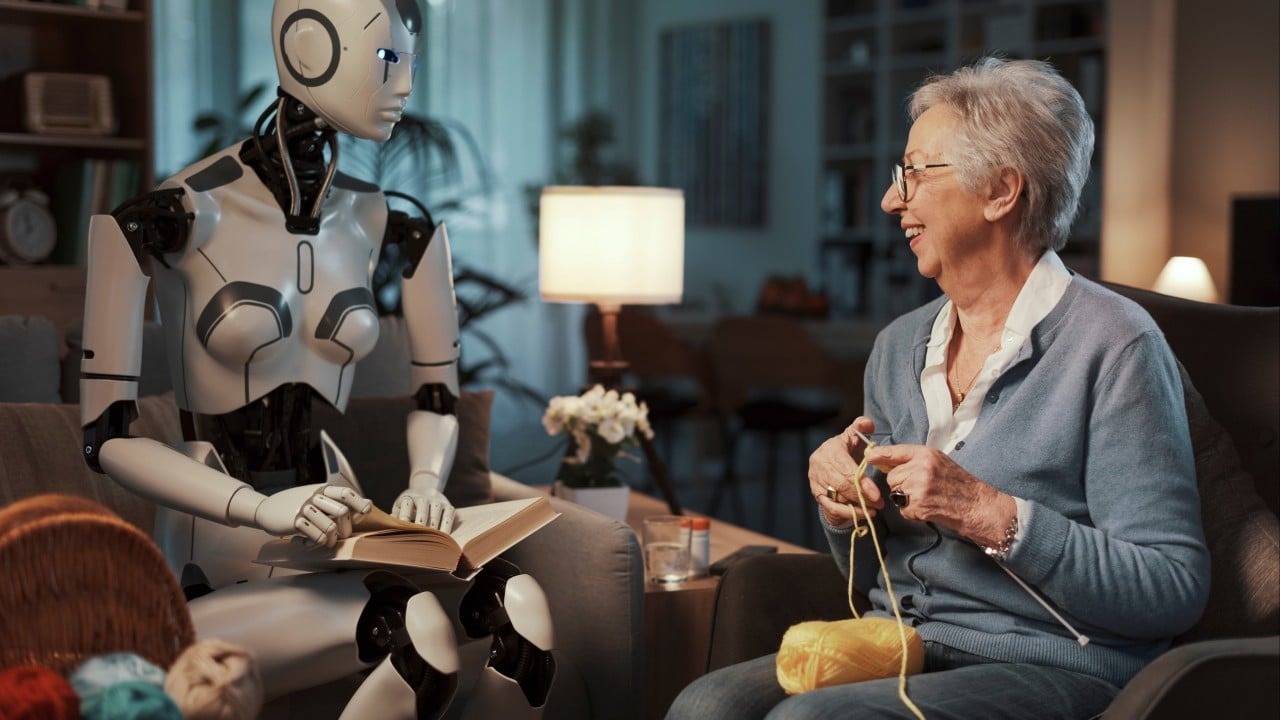
Li Wei sits in a small apartment in Shanghai, watching a mechanical arm pour tea. It is precise. It never spills. It doesn't shake. But it also doesn't talk. Li is eighty-four, and the silence in his home is so heavy it feels like a physical weight. Across the Pacific, in a sun-drenched bungalow in California, Margaret faces the same quiet. She has a smart speaker that reminds her to take her pills, but it cannot tell her if she looks tired or if the jasmine in her garden is finally blooming.
We were promised a robotic revolution that would solve the aging crisis. We were told that as the birth rates plummeted in the East and the West, steel and silicon would step in to fill the gap. It was a clean, mathematical solution to a messy, biological problem. But the math is failing. For a different look, check out: this related article.
The world is getting older, faster than we ever imagined. By 2050, one in four people in East Asia will be over the age of sixty-five. In the United States, the "silver tsunami" is no longer a distant tide; it is crashing against the shore of our healthcare systems right now. We are running out of young people to do the heavy lifting, the caretaking, and the tax-paying.
The logic seemed simple: build better robots. Similar coverage on the subject has been published by The Guardian.
The Myth of the Silicon Caregiver
Engineers have spent billions trying to teach machines how to be human. They’ve created "social" robots with big, blinking eyes and soft plastic skin. They’ve designed exoskeletons that help the elderly walk and sensors that detect a fall before the person even hits the floor. On paper, it looks like progress. In reality, it’s a band-aid on a gaping wound.
A robot can lift a human body from a bed to a chair without straining its back. That is a miracle of engineering. But it cannot provide the one thing a dying or aging human soul requires: the recognition of shared experience. When a human caregiver holds a hand, there is a biological feedback loop—a pulse, a warmth, an unspoken understanding of what it means to grow frail. A machine has no pulse. It has no fear of the dark.
Technology is a tool, not a substitute. If we rely solely on automation to manage the elderly, we aren't solving a crisis; we are merely sanitizing loneliness. We are creating a world where the old are stored away in high-tech warehouses, tended to by blinking lights and humming motors, while the rest of society carries on, detached from the reality of the human cycle.
The economic reality is even colder. Japan, the world’s laboratory for aging, has poured decades of investment into elder-care robotics. Yet, their nursing homes are still desperate for staff. Why? Because the most vital parts of care—empathy, intuition, and complex problem-solving—remain stubbornly unprogrammable.
The Geopolitical Wall
This brings us to a hard truth that many in Washington and Beijing would prefer to ignore. The aging crisis is a shared enemy, yet we are fighting it in silos.
China is facing the most rapid demographic collapse in human history. The "one-child policy" has left a generation of only children—the "4-2-1" problem—where a single adult is responsible for two parents and four grandparents. The sheer scale of the labor shortage is enough to stall the world’s second-largest economy.
Meanwhile, the United States is grappling with a fragmented healthcare system and a shrinking pool of professional caregivers. We have the innovation, but we lack the scale. China has the scale and the urgent necessity, but they are hitting a technological ceiling.
Instead of a joint effort to solve the fundamental biology of aging or the logistics of global care, we see a "tech cold war." We see export bans on the very chips that could power the next generation of medical diagnostics. We see a race to see who can build the best AI, not to save lives, but to gain military dominance.
Imagine if the two greatest powers on Earth treated aging like the Space Race, but with a collaborative twist. What if the goal wasn't to plant a flag, but to ensure that no person dies alone or in preventable pain?
Consider the potential of a "Global Aging Accord." China has a vast, centralized data set that could revolutionize how we understand age-related diseases like Alzheimer’s. The U.S. has a pharmaceutical and biotech infrastructure that is unrivaled in its ability to turn data into treatment. Separated, they are two halves of a broken engine. Together, they could actually move the needle on human longevity and quality of life.
The Invisible Stakes
This isn't about stock prices or GDP, though those will certainly crater if we get this wrong. It’s about the quiet moments in the middle of the night. It's about the daughter in Chicago who has to quit her job to care for a father who no longer remembers her name. It’s about the son in Shenzhen who works sixteen-hour days to pay for a nursing home he knows is substandard.
When we talk about "strategic competition," we are talking about abstract maps and digital borders. But the real front line is the bedside.
If the U.S. and China continue to decouple, the cost won't just be measured in tariffs. It will be measured in the years of life lost to diseases we could have cured together. It will be measured in the inefficiency of redundant research. It will be measured in the suffering of millions who could have benefited from a unified global supply chain of care.
We are currently choosing to compete over who can build the best weapons while both of our houses are burning down from a demographic fire.
A Different Kind of Innovation
The answer isn't just more robots. It's a new social architecture.
We need systems that integrate technology with human touch, not systems that use technology to replace it. This requires a level of international cooperation that feels almost impossible in our current political climate. It requires sharing breakthroughs in regenerative medicine. It requires standardizing data so that a researcher in Boston can build on the findings of a clinic in Wuhan.
But we are stuck.
We are stuck because it is easier to fear a rival than to admit we share the same fate. We are stuck because "cooperation" sounds like weakness to those who view the world as a zero-sum game.
The tragedy is that the biology of aging does not care about borders. A failing heart in Seattle is identical to a failing heart in Shanghai. The neurons that wither in a brain in London are the same as those in Tokyo. We are all bound by the same ticking clock.
The Cost of Silence
The mechanical arm in Li Wei’s apartment moves again. It places a lid on the teapot. It has performed its task perfectly. Li Wei looks at the machine and then at the empty chair across from him.
He doesn't need a faster processor. He doesn't need a more lifelike skin on the machine. He needs a world that hasn't forgotten that his life still has value, a world that prioritizes the preservation of his dignity over the protection of intellectual property.
If we continue on our current path—isolation, technological hubris, and geopolitical stubbornness—we will achieve the most efficient, most automated, and most miserable end-of-life experience in history. We will have succeeded in building the perfect machine, only to find there is no one left to hold our hand when the lights go out.
The machines won't save us. Only a radical, uncomfortable, and deeply human partnership can do that.
The chair remains empty. For now.