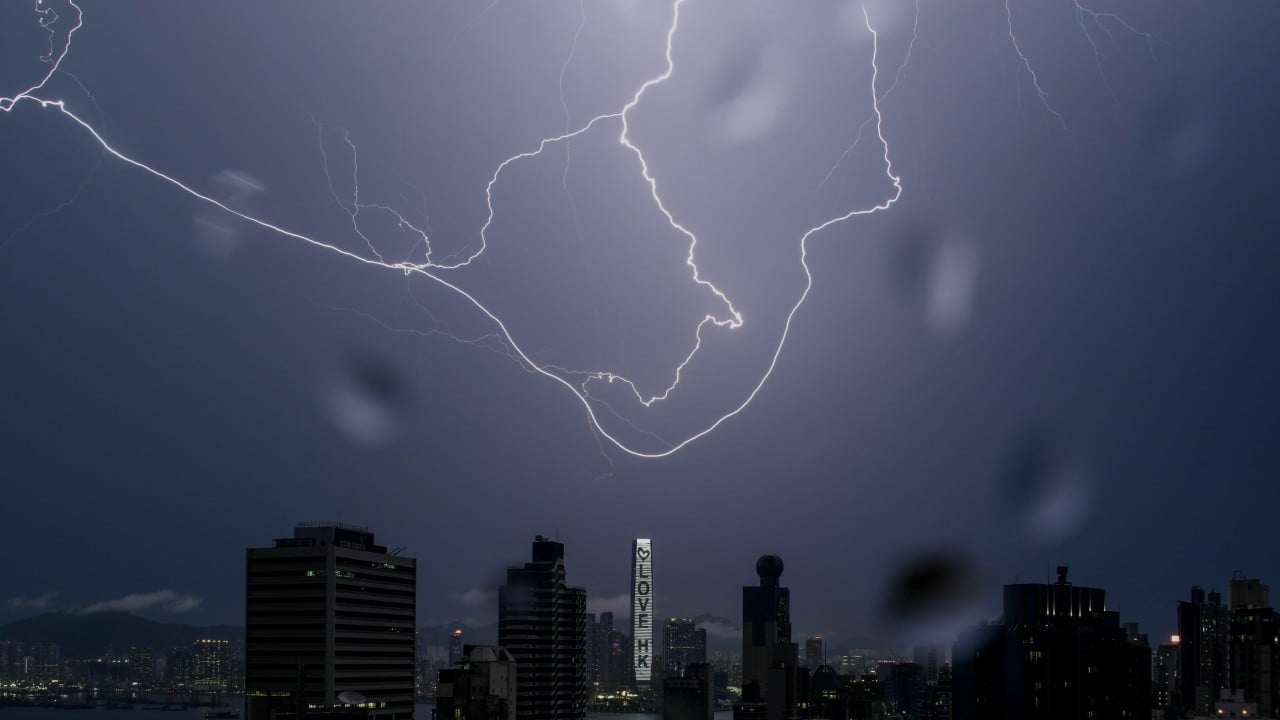
The smell of chlorine is exactly the same right before lightning strikes. It is sharp, chemical, and entirely ordinary. On a humid July afternoon in Hong Kong, the water in a public pool looks less like a recreational facility and more like a sanctuary. The air pressure drops, thick and heavy, pressing down on the Victoria Harbour skyline. Hundreds of swimmers are seeking refuge from the stifling heat, completely oblivious to the fact that they are floating inside a massive, highly efficient electrical conductor.
Then comes the whistle. It is a piercing, irritating sound that shatters the rhythm of splashing water. Lifeguards stand on their elevated chairs, waving their arms, ordering everyone out. Parents grumble. Children wail. Fitness swimmers look at their smartwatches, annoyed that their workout has been cut short. The sky is dark, yes, but the storm is miles away, over the hills of New Territories. For a deeper dive into this area, we suggest: this related article.
This scene plays out dozens of times every summer across Hong Kong’s 45 public swimming complexes. It sparks a fierce, recurring debate that moves from the pool decks to online forums: Why does a city obsessed with efficiency shut down its pools when the rain hasn't even started falling?
To understand the frustration, you have to look at the unique relationship Hong Kong has with its public spaces. In a city where living quarters are notoriously cramped, public pools are not a luxury. They are community living rooms. For the elderly resident in Sham Shui Po, a morning swim keeps arthritis at bay. For the stressed-out financial analyst in Central, it is the only hour of the day without a screen. When the Leisure and Cultural Services Department (LCSD) closes these facilities due to a thunderstorm warning, it feels like an eviction. For broader details on this topic, extensive reporting can also be found at Bleacher Report.
Opponents of the strict closure policy point across the oceans to justify their annoyance. In many parts of the world, indoor pools remain open during storms. Modern indoor facilities are housed within massive structures equipped with lightning rods, grounded steel frames, and advanced surge protection. The water is isolated from the external elements. So why does Hong Kong treat a rumble of thunder like an impending catastrophe?
The answer lies in the physics of a strike and the terrifying unpredictability of nature.
Consider a hypothetical scenario involving two swimmers. Let us call the first one Mei. She is swimming laps in an outdoor pool in Morrison Hill. The second is Lok, swimming inside a sleek, modern indoor complex in Kowloon Park.
When a lightning bolt descends from a cloud, it is looking for the path of least resistance to discharge its massive electrical energy. Water is an excellent conductor, especially when treated with pool chemicals. If lightning hits an outdoor pool, the electrical current spreads across the surface instantly. Water does not absorb the voltage; it distributes it. For Mei, standing or swimming in that water, the pool becomes a giant frying pan. The current travels through her body, threatening cardiac arrest, severe burns, and instant paralysis.
But what about Lok, inside the concrete and steel sanctuary of the indoor pool? This is where the debate gets complicated.
While the building itself acts as a Faraday cage—a structure that conducts electricity around the outside of the building rather than through it—the internal infrastructure remains vulnerable. An indoor pool is connected to a vast network of underground metal pipes, filtration systems, and electrical pumps. If lightning strikes the building or a nearby utility pole, that current can travel through the plumbing system.
The danger is not just a theoretical equation on a chalkboard. It is a documented reality. The National Lightning Safety Institute in the United States explicitly states that no indoor pool is entirely safe during a thunderstorm because of this interconnected web of conductive materials. The electricity can jump from the pipes to the water, or to the showers, or even to the metal bleachers where spectators sit.
Hong Kong faces a geographical reality that amplifies this risk. The city is a hyper-dense vertical jungle trapped between mountains and the sea. This topography creates microclimates that spawn sudden, violent convective storms. A thunderstorm warning in Hong Kong is not a gentle suggestion that rain might fall; it is an alert that the atmosphere above the city is highly unstable and capable of generating lethal electrical discharges in a matter of minutes.
The LCSD operates under a policy of absolute risk aversion. When the Hong Kong Observatory issues a thunderstorm warning, the protocol is clear: outdoor pools close immediately. Indoor pools often follow suit, or at least suspend operations if the storm is directly overhead.
This absolute stance clashes directly with the city’s culture of convenience. Critics argue that the blanket closures are lazy policy-making. They suggest a tiered system where indoor pools stay open unless a specific, localized lightning strike is detected within a certain radius. After all, the technology exists to track lightning strikes down to the meter in real time. Why use a sledgehammer to crack a nut?
But consider what happens next if that policy changes. Imagine the logistical nightmare of a fluid, real-time evacuation. A lifeguard spots a red flash on a monitor. They blow the whistle. Hundreds of wet, slippery people rush into the changing rooms simultaneously.
The changing room is actually one of the most dangerous places to be during a lightning strike inside a building. The showers are directly connected to the metallic water mains. The taps are metal. The wet floors are conductive. By rushing everyone out of the pool and into the showers to get dressed, the facility might actually be moving people from a low-risk zone into a high-voltage trap.
The true problem lies in our human inability to accurately calculate risk. We look at a clear patch of blue sky directly above us and refuse to believe that danger exists just over the horizon. We prioritize our schedules, our fitness goals, and our comfort over the invisible physics happening thousands of feet in the air.
I remember talking to an old lifeguard who had worked at the Kennedy Town pool for thirty years. He told me about a storm in the early nineties. It was a day just like any other, sunny with a few dark clouds in the distance. The warning had been issued, but the swimmers refused to leave, arguing with the staff. He forced them out anyway. Five minutes later, a bolt of lightning struck a metal flagpole just ten meters from the pool's edge. The flash was so bright it blinded him temporarily. The sound was like a bomb exploding. The concrete near the base of the pole cracked from the heat.
"They didn't complain after that," he said, adjusting his sunglasses. "People think safety is a switch you turn on when the rain starts. It’s not. Safety is the boring stuff you do before the rain starts."
That is the emotional core of this entire debate. It is a conflict between the visible present and the invisible future. We live in a world that promises us total control over our environment. We air-condition our malls, we tunnel through our mountains, and we reclaim land from the sea. We like to believe we have conquered nature. A thunderstorm warning at a swimming pool is a rude reminder that we have done no such thing.
The current policy in Hong Kong is frustrating, inconvenient, and occasionally inconsistent. It ruins weekend plans and interrupts training schedules. It costs money in lost revenue and wasted time.
But the alternative is a gamble with stakes that are simply too high. A single strike can turn a place of joy and health into a scene of tragedy. When the whistle blows and the lifeguards point toward the changing rooms, it is not an act of bureaucracy. It is an act of humility in the face of an unpredictable sky.
The sky above the city turns a deep, bruised purple. The first heavy drops of rain hit the concrete deck of the outdoor pool, leaving dark circles that dry instantly in the heat. The water is completely still now, devoid of ripples, reflecting the jagged silhouette of the high-rises. It is empty, quiet, and perfectly safe.