Silence.
In the flight control room at Darmstadt, Germany, the air tastes like stale espresso and ozone, and the only sound is the low, relentless hum of cooling fans behind the server racks. For eight years—nearly three thousand days of birthdays missed, hair turning silver at the temples, children growing from toddlers into gangly teenagers—a room full of engineers has been herding a stack of metal and gold foil across nine billion kilometers of nothingness.
Now, it has arrived.
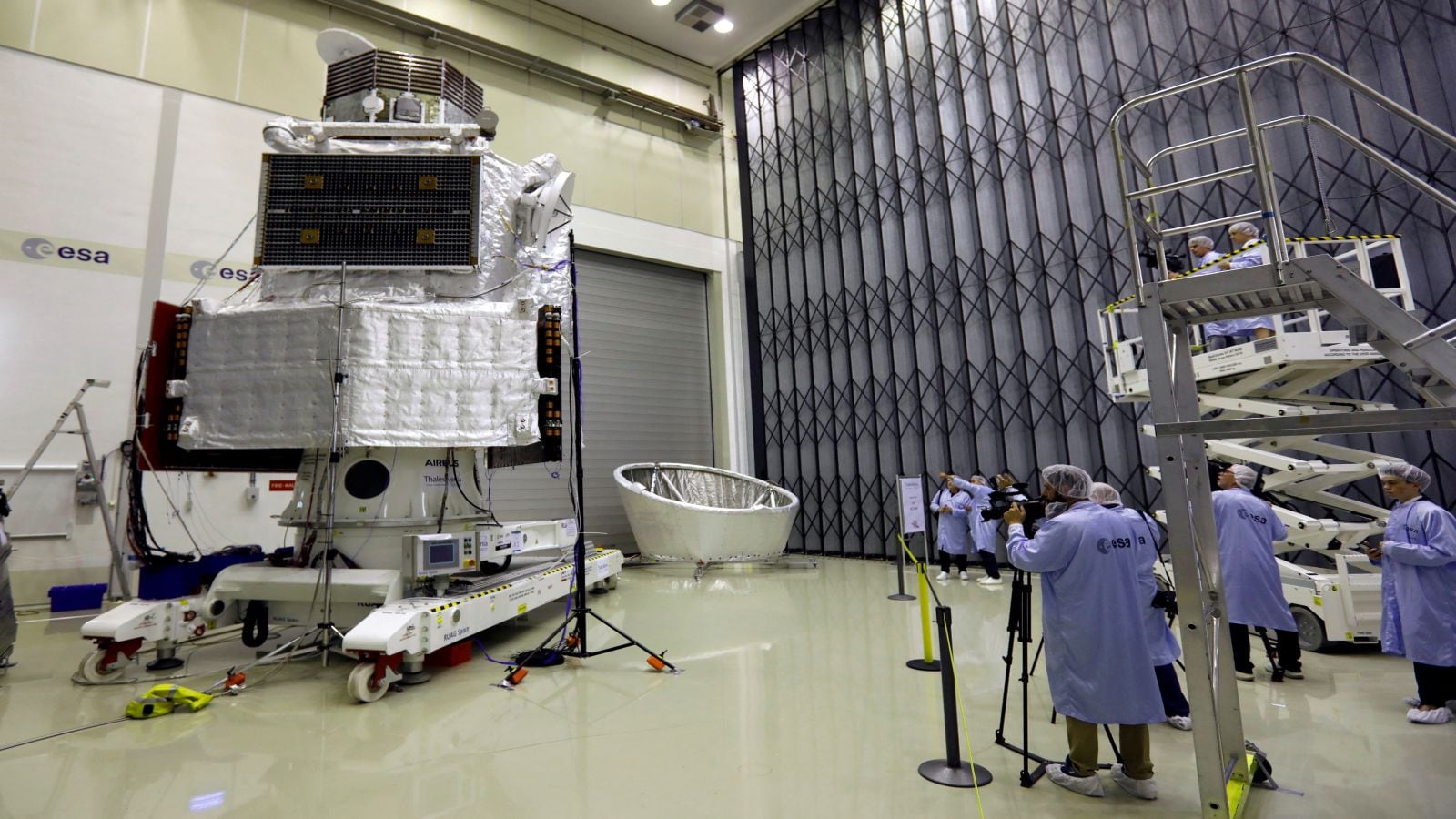
BepiColombo, the joint European and Japanese mission to Mercury, has finally slipped into orbit around the solar system’s smallest, densest, and most violent inner world. On paper, it is a triumph of celestial mechanics. The headlines write themselves. Humanity conquers the furnace.
Except for the telemetry line blinking amber on the third console from the left.
A technical glitch. Two sterile words that, in a press release, sound like a minor software hiccup—something you fix with a reboot and a cup of tea. Inside the room, though, those words carry the weight of a billion-euro gamble hanging by a frayed copper wire four hundred degrees above zero.
The Gravity Trap Nobody Talks About
To understand why a minor anomaly at Mercury feels like trying to perform open-heart surgery through a keyhole from across an ocean, you first have to throw away everything intuitive you think you know about space travel.
Most people assume flying to Mercury is easy. It is closer to the Sun, after all. You just point your rocket inward, let go of the steering wheel, and let the Sun’s massive gravity pull you downhill, right?
Wrong. Completely backward.
Think of the solar system not as a flat map, but as a steep, frictionless funnel—a metaphor that aerospace engineers live and breathe every single day. Earth orbits the Sun at roughly thirty kilometers per second. If you launch a spacecraft from Earth toward Mercury, you are dropping straight down that funnel. As the spacecraft falls inward toward the Sun, it accelerates uncontrollably. By the time you cross Mercury’s path, you are moving so fast that the tiny planet’s weak gravity cannot possibly grab hold of you. You blow right past it like a runaway freight train screaming past a whistle-stop station.
To actually stop at Mercury—to enter orbit rather than merely wave as you hurtle into the solar furnace—you have to slam on the brakes for nearly a decade.
That is what BepiColombo has been doing since October 2018. Named after Giuseppe "Bepi" Colombo, the brilliant Italian mathematician who first figured out how to use planetary flybys as cosmic speed bumps, the spacecraft had to execute an intricate, exhausting ballet. One flyby of Earth. Two of Venus. Six harrowing, razor-thin passes of Mercury itself, bleeding off orbital energy bit by agonizing bit, using the planets' own gravitational fields to slow down.
It took more energy to reach Mercury and park there than it took to send New Horizons all the way out to Pluto.
Let that sink in. Reaching our next-door neighbor inward requires more brute-force braking power than fleeing the solar system entirely.
Waiting in the Dark at Darmstadt
Consider what happens next when the eight-year braking maneuver finally ends.
Let us step inside the mind of a hypothetical flight dynamics engineer—we will call her Elena—who joined the European Space Agency straight out of university in 2017, wide-eyed and carrying a cardboard box of textbooks. When BepiColombo lifted off from French Guiana on an Ariane 5 rocket, she was twenty-six. She watched the launch from a folding chair in a crowded auditorium, cheering until her throat was raw.
By the time the spacecraft approached its final orbital insertion in late 2026, Elena was thirty-four. She had survived a global pandemic, two apartment moves, and the quiet, gnawing anxiety that comes with dedicating the prime of your career to a machine you can never touch again.
You cannot send a repair crew to Mercury. You cannot swap out a faulty valve. Every command sent from Earth takes minutes to cross the void at the speed of light, meaning by the time Elena sees a problem on her monitor, the spacecraft has already lived through it, survived it, or succumbed to it.
I have spent years reporting on deep-space missions, sitting in the back rows of mission control centers while grown adults with doctorates in orbital mechanics stare at green lines on black screens, praying that a thruster fires for four hundred milliseconds instead of four hundred and ten. There is a specific kind of exhaustion that settles into those rooms. It is not the frantic adrenaline of an emergency room; it is the slow, grinding terror of absolute helplessness paired with total responsibility. You built the ship. You wound the clock. Now you can only watch it tick.
And then, just as the spacecraft threads the needle—just as Mercury’s gravity finally captures the stacked assembly of the Mercury Planetary Orbiter and Japan’s Mercury Magnetospheric Orbiter—the telemetry shows a snag.
Inside the Furnace
Why did the machine stutter at the finish line? Because Mercury is a mechanical nightmare disguised as a planet.
Orbiting just fifty-eight million kilometers from the Sun, Mercury endures solar radiation roughly ten times more intense than what hits Earth. During the Mercurian day, surface temperatures soar past 430 degrees Celsius—hot enough to melt lead, zinc, and standard electronics into useless slag. At night, with virtually no atmosphere to trap that heat, temperatures plummet to minus 180 degrees.
Worse still, Mercury acts like a giant thermal radiator. Even when BepiColombo shields itself from the blinding glare of the Sun above, the scorched rock below bakes the spacecraft’s belly with ferocious infrared heat. Engineers had to wrap the spacecraft in newly invented, multi-layered ceramic and titanium insulation just to keep the internal instruments at room temperature.
Remember what happened earlier in the mission? Even before orbital insertion, BepiColombo’s solar electric propulsion system—its ion thrusters, which gently push the craft by accelerating xenon gas—suffered a power delivery glitch that prevented them from operating at full thrust. Engineers had to spend months rewriting the entire trajectory in mid-flight, recalculating every twist and turn across millions of kilometers to compensate for a few missing millinewtons of push.
When ESA confirmed the spacecraft had entered Mercury orbit alongside a newly reported technical glitch, the public reaction split down a familiar fault line. Casual readers shrugged. Space is hard, they thought, scrolling on to the next headline. They’ll patch it.
They missed the point entirely.
In deep-space exploration, a glitch during orbital capture is not a minor inconvenience; it is a tremor along a fault line that has been under immense pressure for nearly a decade. When a spacecraft transitions from interplanetary cruise to planetary orbit, everything changes. Thermal loads spike violently as the craft dips low over the sun-baked crust. Power demands surge as heaters, star trackers, and reaction wheels fight to keep the high-gain antenna pointed precisely at Earth while the sunshield remains locked between the delicate sensors and the blinding solar disk.
If the attitude control system slips by even a few degrees—if the sunshield tilts away from the Sun for a matter of minutes—sunlight hits unprotected instruments. Lenses warp. Detectors fry. Eight years of patience vaporize in silence.
Why We Risk Billions for a Barren Rock
It is fair to ask—and frankly, I have asked myself this during late-night budget hearings and endless press briefings—why we bother at all.
Mercury has no breathable air. It has no liquid oceans, no subterranean seas hiding alien microbes, no lush horizons for future astronauts to colonize. Looking at radar images of Mercury is like looking at a battered, gray cannonball pockmarked by four billion years of asteroid impacts. Why pour billions of euros and yen, thousands of careers, and decades of obsession into a scorched lump of iron?
Because Mercury is a crime scene, and it holds the fingerprints of how our own world survived.
Look at Mercury’s anatomy. It is bizarrely out of proportion. While Earth’s iron core makes up about fifteen percent of our planet’s volume, Mercury’s massive metallic core accounts for roughly eighty-five percent of its radius. It is essentially a giant ball of iron wrapped in a paper-thin crust of rock—like an apple whose flesh was peeled away down to the seeds.
How does a planet end up like that?
Planetary scientists are genuinely torn, and that uncertainty is what makes this mission so electric. One theory suggests Mercury formed much larger, only to be obliterated in the violent chaos of the early solar system by a catastrophic, glancing collision with a protoplanet that stripped away its outer rocky mantle. Another theory argues that the young, erratic Sun blasted away the lighter rock-forming elements before the planet could even finish assembling itself. A third suggests Mercury migrated inward from a completely different neighborhood of the solar system.
Until BepiColombo maps the surface chemistry, measures the magnetic field, and probes the interior gravity with unprecedented precision, we are guessing.
And our guesses matter here at home. Because Mercury possesses something almost no other small rocky body in the solar system has—not Venus, not Mars, not our Moon.
It has a global magnetic field.
It is weak, only about one percent as strong as Earth’s, yet it is there, generated by a churning liquid iron dynamo deep inside that oversized core. On Earth, our magnetic field is the invisible shield that deflects the solar wind, preventing the Sun from stripping away our atmosphere and boiling off our oceans. Without it, life on Earth would never have crawled out of the primordial mud. By studying how Mercury’s tiny, battered dynamo survives right in the teeth of the solar storm, scientists are decoding the exact physics that keep our own planetary shield alive.
We are not studying a dead rock. We are studying the survival manual for habitable worlds.
The Architecture of Resilience
There is a human truth buried inside that blinking amber alert at Darmstadt, and it has nothing to do with aerospace engineering.
We live in an era obsessed with effortless perfection. Our apps update invisibly overnight; our algorithms curate seamless feeds; our culture sells the illusion that brilliance looks smooth, inevitable, and glitch-free. When something breaks, we assume incompetence. We demand instant fixes.
Spaceflight strips away that delusion ruthlessly.
When you send two orbiters—Europe’s mapping craft and Japan’s magnetospheric probe—stacked together across the inner solar system, nothing is seamless. Every bolt, every line of flight software, every thermal blanket is a compromise between weight, heat, radiation, and cost. Things fail because you are operating at the absolute edge of what human materials and human mathematics can endure.
The real magic of BepiColombo is not that it arrived without a scratch. It is that hundreds of engineers in Darmstadt, Noordwijk, and Sagamihara anticipated failure long before the rocket ever left the launchpad. They built redundancies on top of redundancies. They wrote fault-protection routines capable of putting the spacecraft into safe mode in milliseconds if a sensor glitched, buying humans back on Earth enough time to diagnose the ghosts in the machine.
Right now, while the rest of the world moves on to tomorrow’s news cycle, those teams are dissecting every bit of diagnostic data trickling down from fifty-eight million kilometers away. They are running simulations on ground-based twin hardware, testing workarounds, preparing to separate the two spacecraft into their final science orbits so the real work can begin.
Think about the sheer audacity of that.
Across an expanse of space so vast that sunlight itself takes over three minutes to cross it, human beings are troubleshooting a machine baking in the glare of a star, guided by nothing more than radio whispers faint enough to be measured in fractions of a watt.
In the quiet hum of the control room, the amber light still blinks, steady as a heartbeat, waiting for the next command to climb out of the dark and tell it how to see.