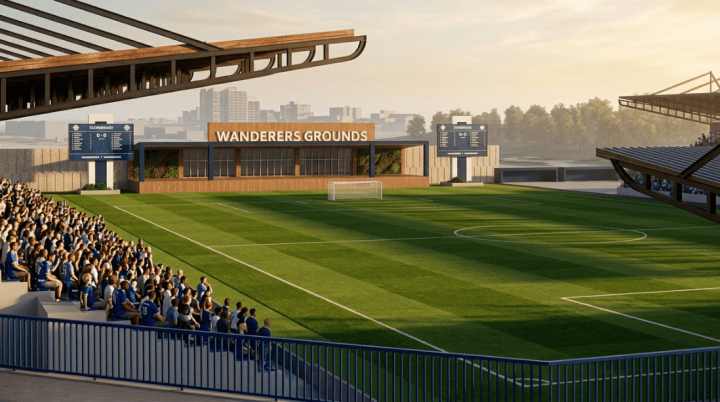
Capital expenditure in North American soccer infrastructure follows a historically rigid municipal financing model that routinely shifts fiscal risk onto taxpayers while privatizing upside gains. When the Halifax Wanderers proposed a privately-funded 100 million dollar stadium and sports hub, the initiative challenged traditional municipal ownership paradigms by attempting to internalize construction liability while externalizing community utility. Evaluating this proposal requires dismantling the project into its core financial mechanics: capital structuring, land-use efficiency, operational revenue diversification, and municipal opportunity costs.
The Capital Stack and Debt Service Exposure
The primary structural innovation of a privately-funded sports infrastructure project lies in the composition of its capital stack. Traditional stadium builds rely heavily on municipal bond issuances, tax-increment financing, or direct public appropriations. By substituting public debt with private equity and commercial debt, the risk profile shifts entirely away from municipal balance sheets.
However, private capital demands a predictable yield. A 100 million dollar capital outlay in mid-tier professional soccer—such as the Canadian Premier League—cannot be amortized through ticket sales alone. Operating margins in domestic soccer leagues are constrained by lower media rights valuations and capped stadium capacities compared to tier-one leagues like Major League Soccer or the English Premier League. Consequently, the capital return mechanism must decouple from matchday gate receipts and attach to real estate development rights and multi-use operational density.
The underlying economic mechanics depend on three distinct capital components:
- Equity contribution from ownership groups, functioning as the primary loss-absorbing buffer.
- Commercial debt secured against projected non-matchday cash flows, including hospitality, retail leases, and entertainment events.
- Ancillary public-sector investment restricted strictly to foundational infrastructure upgrades, such as municipal utility integration, transit access, and public square maintenance.
When private developers fund the core superstructure, the municipal exposure is theoretically zero for construction overruns, schedule delays, and maintenance shortfalls. The limitation of this model, however, rests on land valuation. If public land is leased below market rate to anchor the private development, the municipality incurs an implicit opportunity cost that functions as a hidden subsidy.
Real Estate Integration and Revenue Diversification
A standalone soccer stadium is an economically inefficient asset. Operating at maximum capacity for only 15 to 20 matchdays per year results in capital dormancy for the remaining 340-plus days. To achieve positive net present value, the facility must be engineered as a continuous-yield real estate ecosystem rather than a single-purpose athletic venue.
The proposed Halifax sports hub functions as an urban densification engine. By integrating retail footprints, residential or commercial office spaces, and public gathering zones directly into the stadium perimeter, the asset model transforms.
The revenue diversification matrix operates across four distinct horizons:
- Matchday operations, encompassing ticket sales, concessions, and localized merchandise.
- Permanent hospitality and commercial leases, providing stable baseline rental income independent of athletic performance.
- Large-scale entertainment hosting, including concerts and regional conventions that utilize modular turf and staging infrastructure.
- Public-private partnership programming, where community recreation space rentals offset operational overhead during off-peak hours.
This multi-faceted revenue stream mitigates the cyclical volatility inherent in sports franchise valuations. If team performance declines, resulting in suppressed attendance, the underlying real estate cash flows provide structural insulation against insolvency.
Municipal Opportunity Costs and Urban Sprawl Economics
Evaluating the net benefit to a municipality requires calculating the opportunity cost of the designated real estate parcel. Urban land in core economic zones carries high alternative productivity value. When a parcel is dedicated to a sports and entertainment district, planners must weigh the tax generation and job density of the stadium hub against alternative commercial or residential developments.
The economic justification for municipal cooperation rests on agglomeration effects and catalytic regeneration. Downtown stadiums generate pedestrian foot traffic that supports surrounding retail ecosystems, hotels, and food service providers. This localized economic clustering creates a multiplier effect, capturing tourism dollars that would otherwise bypass the local economy.
Yet, this dynamic introduces specific urban bottlenecks:
- Peak congestion externalities, where matchday surges strain municipal transit networks and parking infrastructure without generating proportionate user-fee revenue.
- Displacement pressure, where localized property values rise rapidly, triggering commercial gentrification and pricing out legacy small businesses.
- Fiscal maintenance transference, where even in private-build models, secondary municipal services such as police details, traffic management, and waste removal frequently absorb unaccounted-for public expenditures.
To ensure fiscal equilibrium, municipal frameworks must establish explicit performance covenants that tie tax relief or zoning concessions to verifiable job creation metrics and sustained commercial tax yields.
Long-Term Asset Valuation and Franchise Sustainability
The long-term viability of a 100 million dollar sports hub is inextricably linked to the macro-economic trajectory of the domestic league it anchors. Professional sports franchises operate as illiquid, capital-intensive assets where valuation growth is driven by broadcast rights inflation, league expansion fees, and brand equity maturation.
Investing nine figures into physical infrastructure signals a long-term commitment to geographic anchoring, which in turn enhances franchise enterprise value. A permanent, state-of-the-art facility elevates the tenant club's balance sheet, enabling easier access to institutional credit and attracting higher-tier corporate sponsorships.
The strategic play for stakeholders moving forward is not merely the construction of a venue, but the creation of a self-sustaining urban micro-economy. Success relies on minimizing reliance on matchday attendance spikes by maximizing real estate velocity, ensuring that the facility generates economic output 365 days a year regardless of the team's standing on the pitch.