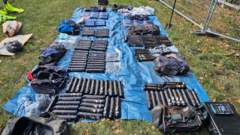
Large-scale music festivals operate as temporary metropolitan economies, complete with high-density infrastructure, localized supply chains, and complex regulatory enforcement. When Cheshire Constabulary announced the recovery of substantial quantities of Class A, B, and C substances—including hundreds of nitrous oxide canisters and bulk quantities of MDMA and ketamine—buried weeks in advance at the Creamfields site in Daresbury, media coverage framed the event as a quaint cat-and-mouse game between police and "brazen individuals". This framing masks a deeper operational reality. The underground caching of festival contraband represents a rational economic response to perimeter security economics, illustrating how asset hardening at access gates simply displaces illicit logistics temporally and spatially.
The Mechanics of Perimeter Displacement
Security operations at major multi-day camping festivals rely heavily on perimeter hardening and transactional friction at entry control points. When organizers deploy canine units, metal detectors, and bag searches at gates processing tens of thousands of attendees, the transaction cost of smuggling restricted items through standard entry vectors spikes dramatically. For high-volume participants or commercial suppliers operating within the festival sub-economy, carrying inventory through the main gate introduces an unacceptable probability of total asset seizure and criminal prosecution.
This dynamic creates a classic economic displacement effect. Prevented from moving goods concurrently with personal entry, suppliers utilize temporal arbitrage. By burying rucksacks, vacuum-sealed bags, and pressurized canisters weeks before the event gates open, actors bypass real-time surveillance corridors entirely. The Daresbury estate spans vast acreage, rendering continuous physical oversight of every square meter economically unviable for event operators and local law enforcement alike. Caching contraband underground exploits the gap between stationary perimeter defense and dynamic spatial surveillance.
The Cost Function of Subterranean Logistics
Burying inventory months prior to an event is not a casual endeavor; it requires calculating specific risk variables, including soil degradation, environmental moisture, geo-location accuracy, and pre-event sweep probabilities. The logistical chain involves distinct phases:
- Site reconnaissance to identify low-traffic zones outside the primary sweep paths of construction crews and groundskeepers.
- Material preparation, utilizing heavy-grade polyethylene or vacuum-sealed containers to mitigate water infiltration and soil contamination.
- Execution phase, requiring clandestine entry during pre-construction phases when site access protocols are porous.
- Retrieval mapping, relying on digital coordinates or physical landmarks to reclaim the asset once the crowd density of 80,000 attendees provides operational cover.
The recent seizures by specialist search teams demonstrate the failure point of this model. When law enforcement agencies conduct systematic pre-event sweeps using ground-penetrating techniques and intelligence-led asset tracking, the probability of intercepting cached inventory approaches certainty. The strategy fails because the static nature of a buried cache leaves it vulnerable to prolonged, methodical counter-surveillance operations that unhurried police units can execute prior to crowd arrival.
Systemic Vulnerabilities in Temporary Event Architecture
The presence of pre-planted contraband highlights structural vulnerabilities in how major outdoor venues manage multi-phase lifecycles. A festival site transitions from agricultural or open land to a secured commercial zone over several months. During the intermediate transition windows, security posture is optimized for equipment load-in and stage construction rather than counter-contraband interdiction.
This operational blind spot allows unauthorized individuals to access perimeter boundaries long before ticket holders arrive. Traditional policing models treat the festival timeline as a discrete four-day weekend, whereas professional supply chains for illicit goods treat it as a quarter-year logistics project. Until event operators integrate continuous, intelligence-led asset tracking across the entire pre-build lifecycle, physical security will remain reactive, catching only those caches unlucky enough to fall within immediate police sweep paths while leaving the broader economic incentive structure untouched.
Deploy continuous subsurface sensing arrays and thermal imaging during the pre-build phase to identify ground disturbance anomalies weeks before public gates open.