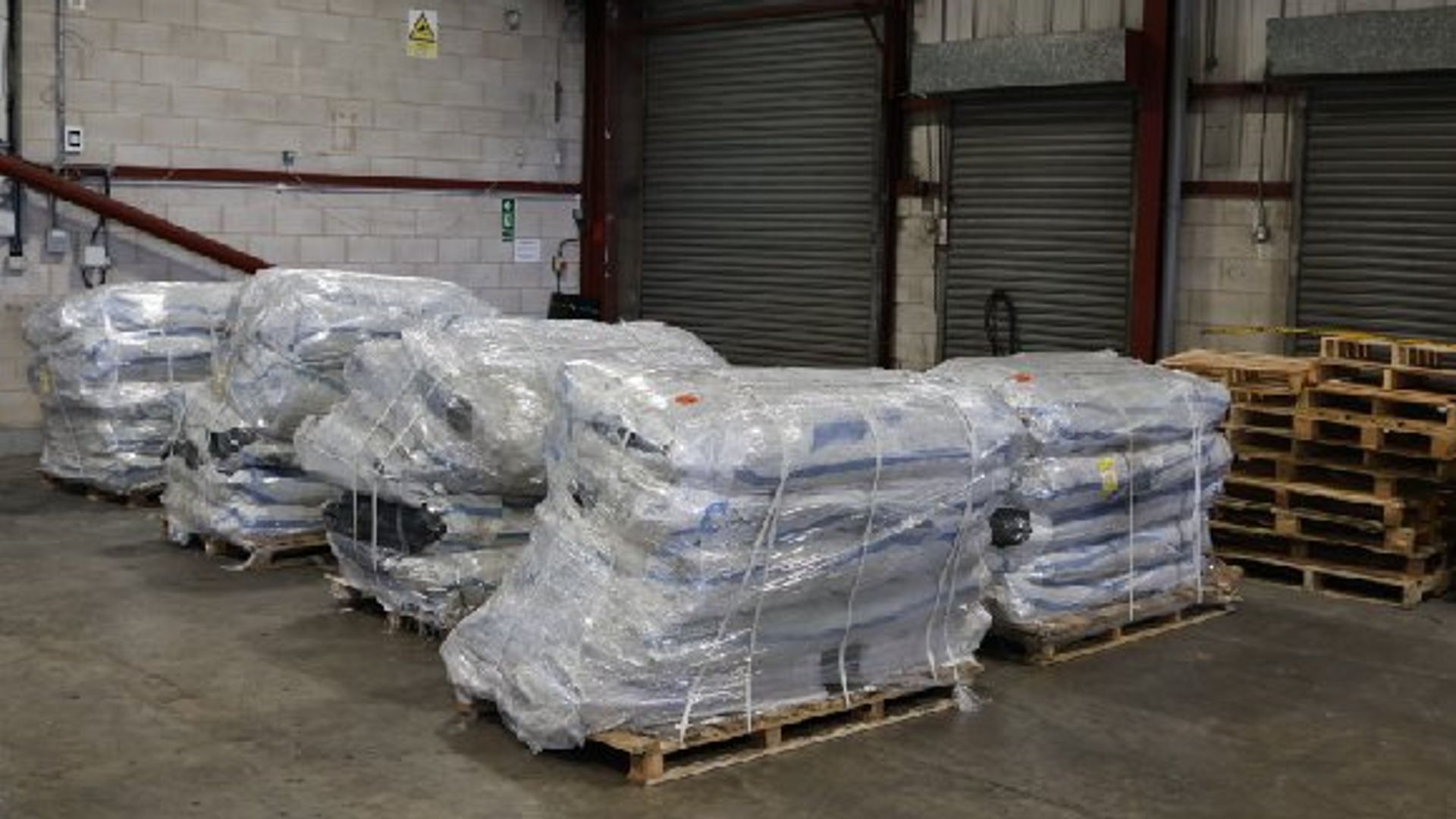
The operational mechanics of illicit maritime migration depend entirely on continuous asset replacement. When the National Crime Agency and Border Force intercepted 25 nine-metre inflatable vessels packed within an air freight transit originating in Turkey and passing through East Midlands Airport en route to the Netherlands, public discourse focused on the aggregate capacity metric: approximately 1,700 potential passengers. However, viewing this seizure through the lens of headcount potential misdiagnoses the underlying economic realities of cross-border syndicates. Interdiction at the logistics node level operates not as a humanitarian victory of prevention, but as a systematic disruption of an illicit supply chain cost function.
To evaluate the operational impact of this interception, one must examine the logistics architecture governing small-boat trafficking networks. These syndicates function as distributed supply chains reliant on three distinct components: raw manufacturing and bulk procurement in industrial hubs outside the European Union, multi-modal freight forwarding across legal commercial channels, and local maritime deployment teams stationed near the French coastline.
The utilization of mainstream air freight hubs for intermediate transit reveals a strategic shift in syndicate behavior. Moving bulk assets via commercial logistics corridors—such as flights from Turkey to the Netherlands—represents an attempt to exploit the high volume and velocity of legitimate trade. Commercial air cargo processing prioritizes throughput speed, creating systematic vulnerabilities for contraband concealment. By embedding inflatable hulls within standard pallets, syndicates reduce transit times and avoid the border checkpoints traditionally associated with overland trucking routes across continental Europe.
This interdiction exposes the structural vulnerabilities of the traffickers' business model through three specific economic pressures:
The first pressure is asset depreciation and capital loss. Inflatable hulls of this scale—measuring roughly nine metres and engineered to carry upwards of 70 individuals—represent heavy capital expenditure for criminal enterprises. Procuring, palletizing, and freighting 25 units ties up significant liquidity. Intercepting these assets prior to deployment forces syndicates back into immediate re-procurement cycles, draining operating cash flow.
The second pressure is supply chain friction. Relying on commercial air transit requires coordination with corrupt logistics providers or the clever obfuscation of manifest descriptions. When an interception occurs at a secondary transit hub like East Midlands Airport, it introduces uncertainty into the network. Syndicates must reassess the security of their freight forwarding channels, often forcing them to revert to slower, more easily monitored overland routes.
The third pressure is unit economic inflation. As law enforcement agencies target upstream supply lines—with cumulative seizures exceeding 1,600 boats and engines—the scarcity of viable maritime hardware drives up acquisition costs. Traffickers absorb these losses by increasing the price per passenger charged to migrants, which alters the risk-reward equilibrium of the operation but simultaneously shrinks their addressable market of paying clients.
The operational objective for border security agencies is therefore not merely the confiscation of physical rubber and plastic, but the systematic elevation of logistical friction. Every node disrupted in the supply chain forces criminal networks to adapt, increasing their operational overhead and diminishing their profit margins. Future interdiction strategies must continue to target the upstream manufacturing and mid-route freight consolidation points, shifting the burden of proof onto commercial logistics operators to verify the exact nature of palletized goods before they enter international transit corridors.


