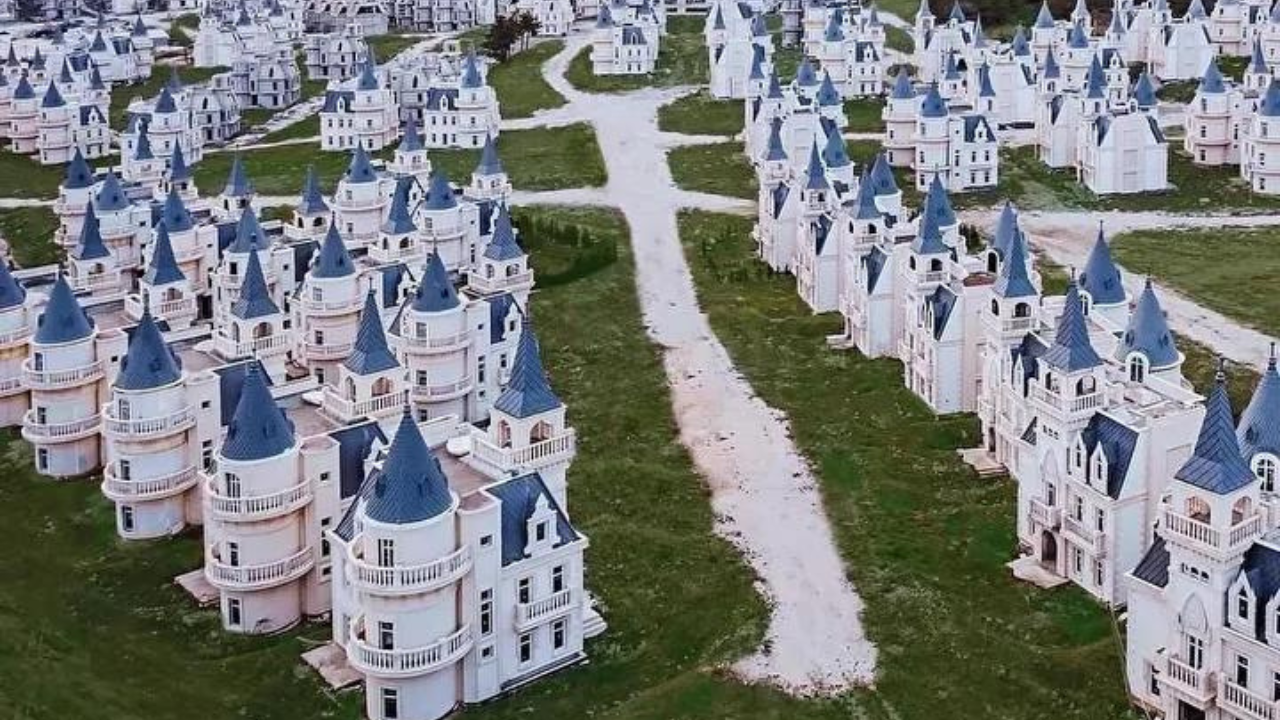
Burj Al Babas, a luxury housing development featuring over 500 identical Disney-style chateaux in Mudurnu, Turkey, stands as a case study in systemic capital misallocation. The $200 million failure of Sarot Group’s ambitious project was not driven by aesthetic eccentricity, but by structural flaws in capital structure, asset-liability matching, macroeconomic exposure, and market positioning.
Analyzing the decay of this development requires breaking down the core mechanisms that transformed a high-yield real estate venture into a frozen asset liability.
The Architecture of Failure: Three Primary Vectors
The breakdown of the Burj Al Babas project traces back to three compounding vulnerabilities: extreme product homogeneity, sovereign macroeconomic fragility, and currency denomination mismatches.
1. Homogeneity and the Erosion of Luxury Pricing Power
Real estate valuation in the luxury sector relies heavily on scarcity, exclusivity, and customization. Sarot Group inverted these fundamental principles by attempting to scale luxury through mass production.
- Supply Saturation: Building 732 near-identical French Renaissance-style castles within a single visually connected basin eliminated spatial differentiation.
- The Density Penalty: Planners optimized for unit volume over land parcel ratio, creating high proximity between villas. This design choice directly contradicted the privacy requirements of the target consumer base.
- Marginal Utility Collapse: As production scaled toward 500 completed shells, the perceived value of individual units decayed. Mass-producing luxury assets converted high-end real estate into a commodity, stripping buyers of long-term capital appreciation expectations.
2. Macroeconomic Dynamics and Debt Structure
The financing model relied on presales from Gulf-based buyers, calculated against stable exchange rates and low domestic inflation in Turkey. When macroeconomic volatility struck between 2016 and 2018, the venture's financial engineering fractured.
- Foreign Exchange Mismatch: Project costs were incurred locally in Turkish Lira (TRY) for labor and materials, while credit facilities and revenues were tied to foreign currencies (USD and SAR). The rapid depreciation of the Lira altered construction input costs, inflating project expenditure beyond projected contingencies.
- Presale Liquidity Freezes: Geopolitical friction and energy market fluctuations reduced capital outflow from Gulf buyers. The immediate drop in presale velocity starved Sarot Group of operating liquidity required to complete infrastructure and utility connectivity.
- Debt Servicing Insolvency: With $27 million in outstanding debt liabilities and stalled cash inflows, the operational debt service coverage ratio (DSCR) dropped below sustainable thresholds, forcing the developer into legal bankruptcy protection in late 2018.
3. Municipal Infrastructure Deficits
The physical reality of real estate development dictates that luxury structures are worthless without functional utility layers. Sarot Group prioritized surface-level vertical construction—the castle shells—over horizontal civil engineering.
- Utility Sequencing Errors: Hundreds of chateaux were erected before securing finalized water, sewage, electrical grid connections, and paved transit corridors.
- Ecosystem Isolation: Located in a rural province, the development lacked nearby commercial hubs, medical infrastructure, or international transport links required to support a permanent or semi-permanent high-net-worth population.
Structural Comparison of Project Design Assumptions vs. Market Realities
Understanding why the asset failed requires contrasting the developer’s underwriting assumptions against the realized operational outcomes.
- Target Demographic Assumption: Middle Eastern buyers would prioritize regional cultural affinity combined with European visual aesthetics.
- Realized Outcome: Buyers rejected the high-density layout and lack of private green space, opting instead for established European assets with clear legal titling and mature municipal services.
- Capital Structure Assumption: Continuous presale cash flows would fund ongoing vertical construction, minimizing the need for long-term equity reserves.
- Realized Outcome: A minor reduction in presale velocity created an immediate liquidity crisis, halting construction and damaging buyer confidence, which triggered widespread presale cancellations.
- Exit Strategy Assumption: Unsold inventory could be offloaded at a premium as the site approached full completion.
- Realized Outcome: Half-finished inventory degraded under winter weather conditions, transforming unsold units from balance-sheet assets into ongoing physical maintenance liabilities.
The Mechanics of Distressed Asset Recovery in Real Estate
Restructuring an abandoned megaproject of this scale requires navigating severe operational and financial bottlenecks. A standard liquidation or re-development playbook faces specific structural hurdles.
Capital Expenditure Requirements for Retrofitting
Reclaiming value from Burj Al Babas requires substantial capital injection, but conventional real estate turnaround tactics face low return-on-investment potential.
- Layout Repurposing: Altering the exteriors of 500 identical castles to create aesthetic variance requires high structural capital expenditure, destroying the original economies of scale.
- Infrastructure Retrofitting: Installing necessary underground utilities across a sprawling, half-built site carries significant capital intensity, often exceeding the original budget due to existing structural obstructions.
- Legal Encumbrances: Resolving thousands of partial ownership claims, creditor liens, and bankruptcy proceedings creates prolonged regulatory delays, discounting the net present value (NPV) of any potential acquisition for distressed asset funds.
The Land-Value Floor
When a real estate development fails to yield returns on its improvements, the asset value reverts toward the baseline value of the underlying land, minus the cost of demolition or site clearance. In the case of Burj Al Babas, the cost of clearing 500 reinforced concrete structures exceeds the agricultural or commercial value of the rural Mudurnu land parcel. The asset is trapped in a negative equity state where the cost of intervention exceeds the post-turnaround market value.
Strategic Execution Framework for High-Capital Real Estate Ventures
To prevent capital destruction in large-scale residential developments, developers and institutional investors must enforce strict operational constraints prior to capital deployment.
De-Risking Master-Planned Developments
- Phase-Gated Construction Capitalization: Never execute broad-scale vertical construction across an entire site simultaneously. Limit vertical construction to self-contained sub-phases (e.g., 20–30 units) funded entirely by committed equity and non-contingent debt, using presale revenue strictly for debt reduction rather than expansion capital.
- Horizontal-First Engineering: Complete 100% of civil infrastructure—roads, power, sewage, telecommunications, and civic services—before laying foundations for luxury superstructure inventory.
- Dynamic Aesthetic Variance Systems: Utilize modular design frameworks that offer variable floor plans and visual distinctions while retaining industrial supply-chain efficiencies, preserving the luxury pricing power tied to relative scarcity.
- Currency and Interest Rate Hedging: Align project revenue denominations directly with debt servicing structures. Match Lira-denominated operational liabilities with local currency reserves or execute FX hedging instruments to mitigate sovereign currency devaluation risks.
Executing large-scale real estate projects without these controls transforms development risk into systemic failure, leaving capital frozen in unmarketable concrete structures.


