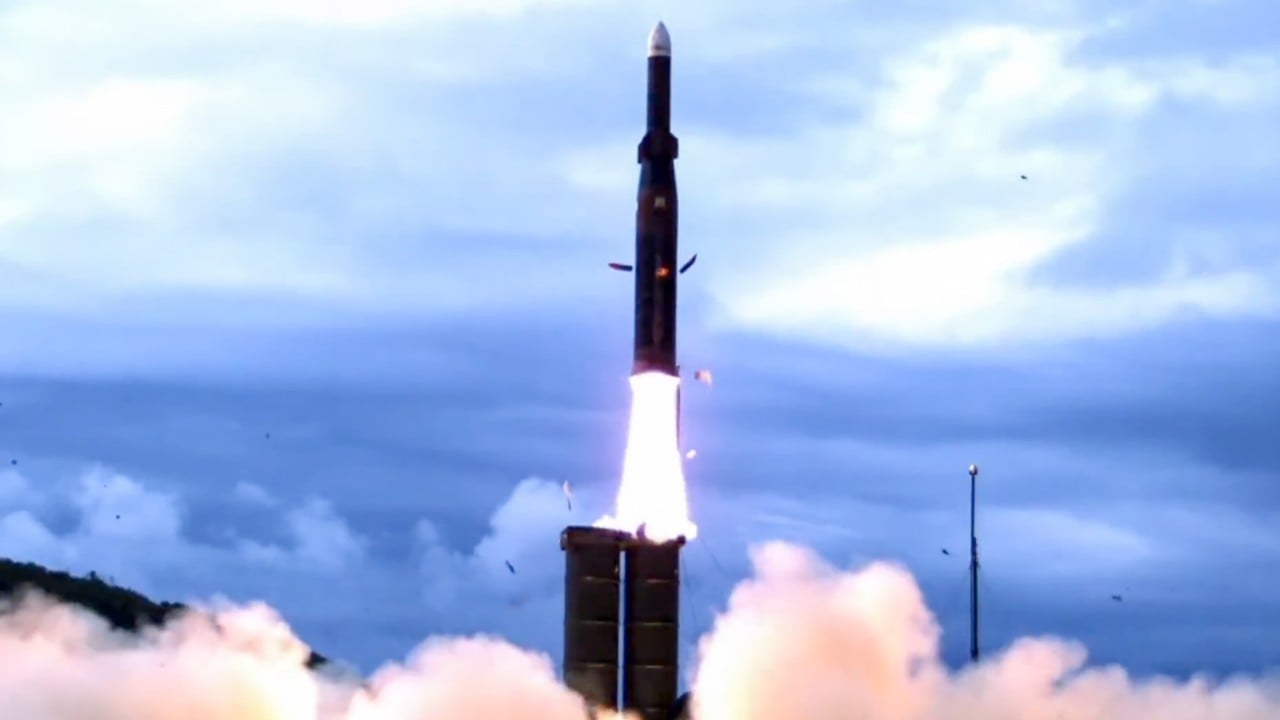
The procurement strategy for regional missile defense relies on balancing unit interceptor costs against incoming threat saturation models. Taiwan's National Chung-Shan Institute of Science and Technology published specifications for the Strong Bow system, targeting tactical ballistic missile interception at medium to high altitudes. Valued in funding requests around US$1.13 billion, the platform attempts to close the operational gap between lower-tier air defense assets and strategic long-range shields.
Evaluating the system requires deconstructing its underlying architecture, examining the capital allocation logic behind the projected production runs, and analyzing the structural limitations of layered defense networks in constrained geographical spaces.
The Structural Anatomy of the Interceptor Architecture
The Strong Bow platform—internally linked to the Tien Kung IV development framework—operates as a mobile, land-based counter-tactical ballistic missile asset. Its functional efficacy rests on three technical subsystems: propulsion, terminal guidance, and radar resource management.
The missile incorporates a two-stage configuration utilizing an integrated composite rocket motor. This manufacturing approach prioritizes structural reliability and production scalability over raw exotic material usage, addressing the industrial bottleneck of scaling interceptor inventories during a supply chain disruption.
During the terminal phase, the interceptor relies on thrust-vector control. Operating within the thin upper atmosphere requires active deflection of rocket exhaust vectoring because aerodynamic control surfaces lose authority. This mechanism maintains maneuverability against high-speed incoming threats executing terminal evasive paths.
Guidance is managed through an active electronically scanned array radar supporting multi-target tracking, electronic counter-countermeasures, and target classification. Each mobile transporter-erector-launcher carries four missile canisters, emphasizing tactical dispersion. Dispersion reduces asset vulnerability to preemptive counter-battery or cruise missile strikes by eliminating centralized static launch silos.
The Cost Function and Capital Allocation Logic
The requested US$1.13 billion funding envelope is earmarked for producing an initial tranche of at least 128 Strong Bow interceptors alongside associated command and radar infrastructure. This establishes a high per-unit capital cost, a standard economic characteristic of low-density, high-technology defense manufacturing.
Total Program Capital (US$1.13B)
  ├── Fixed Infrastructure & Mobile AESA Radars
  └── Variable Production (Minimum 128 Interceptors)
        └── Implied High Unit Cost / Low Volume Constraint
This expenditure layout highlights a fundamental cost-asymmetry problem in modern missile defense. Interceptors like Strong Bow require precision guidance, advanced microwave power amplifiers, and composite rocket bodies, driving up unit costs. Adversarial offensive doctrines often utilize lower-cost tactical ballistic or cruise missiles. Consequently, the defender faces an adverse economic ratio where destroying a cheaper offensive asset consumes a disproportionate share of the defense budget.
To mitigate this fiscal friction, the deployment model integrates Strong Bow into a multi-layered architecture alongside Sky Bow III systems and imported Patriot Advanced Capability-3 units, designated locally as the T-Dome network. This tiering ensures that low-cost or low-altitude threats are intercepted by less expensive assets, reserving the specialized medium-to-high altitude capabilities of Strong Bow for targets that breach outer tiers.
Operational Constraints and Geopolitical Mechanics
Deploying a regional missile defense shield across a constrained landmass introduces severe geometric and reaction-time limitations.
Geographic compression leaves virtually zero time for human-in-the-loop decision-making. The distance between coastal launch locations and potential impact zones requires radar systems to execute automatic target detection, classification, tracking, and fire-control solution generation in seconds. The inclusion of indigenous active electronically scanned array radars directly addresses this requirement by reducing dependency on external sensor feeds, ensuring sovereign control over the engagement loop.
However, saturation remains the primary systemic vulnerability. Even a baseline inventory of 128 interceptors provides finite capacity against a concentrated volley. Defense planners must rely on doctrine optimization—prioritizing high-value command nodes, airbases, and radar sites over total area coverage.
Strategic Forecast for Regional Shield Integration
The transition of the Strong Bow system into mass production signals an institutional shift toward indigenous defense self-reliance. By decoupling critical missile defense manufacturing from foreign export controls, military logistics gain resilience against political shifts in international supply chains.
The strategic success of the program will not be measured by ceremonial deployment metrics, but by factory throughput velocity and software iteration speed against evolving electronic countermeasures. Funding must continuously flow into component redundancy and mobile radar hardening to ensure the network can survive initial kinetic exchanges.
For a visual breakdown of how domestic missile shields integrate with broader deterrence structures, watch this Taiwan's missile defense analysis. This short overview details the operational mechanics and radar configurations associated with Taiwan's evolving high-altitude defense layers.