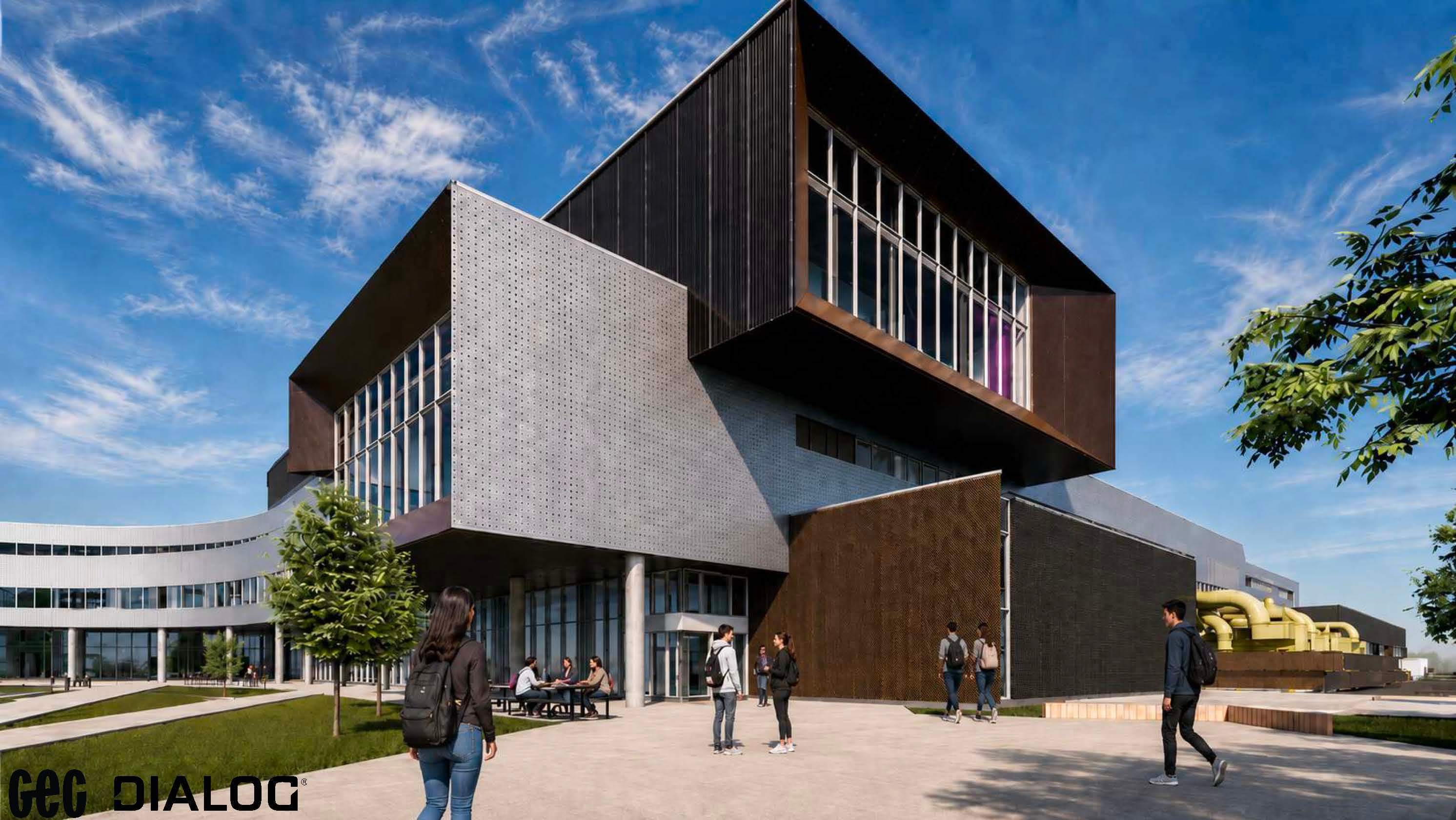
Capital allocation toward technical education infrastructure is a direct proxy for an economy's capacity to absorb structural labor shifts. When institutional spending scales to historic proportions, the underlying financial mechanics, capacity multipliers, and throughput constraints dictate whether the investment solves systemic bottlenecks or merely shifts them. The Northern Alberta Institute of Technology breaking ground on its 625,000-square-foot Advanced Skills Centre represents a $779 million capital expenditure designed to alter regional trade throughput. Analyzing this project requires stripping away institutional press releases to examine the unit economics, spatial logic, and capacity constraints of modern polytechnic scaling.
The Capital Architecture and Funding Matrix
The financial blueprint of the Advanced Skills Centre reveals a multi-stakeholder risk-sharing model. Totaling $779 million, the funding structure relies on a $384 million provincial cash injection distributed over a compressed three-year window, with the remaining balance absorbed through institutional reserves, philanthropic donations, and industry partnerships. Also making waves in this space: The Omani Anchor Dropped Far From Home.
- Public capital constitutes approximately 49.3 percent of the initial outlay, insulating the institution from immediate private market financing volatility.
- Private and internal matching capital covers the remaining $395 million, aligning institutional output directly with corporate labor consumers.
- Construction timelines span four years, targeting a completion date in the fall of 2030, which introduces inflation risk and supply chain cost variances over a multi-year execution window.
This distribution model externalizes a significant portion of capital risk onto taxpayers while ensuring that the physical asset design remains closely coupled with commercial specifications. The physical footprint, scaling at 625,000 square feet, yields a capital cost intensity of roughly $1,246 per square foot. This metric reflects the specialized mechanical, electrical, and structural reinforcement required for industrial training environments compared to traditional academic lecture halls.
Throughput Economics and the 5,500 Student Delta
The core operational justification for the project rests on a single capacity metric: an annual addition of 5,500 student spaces, bringing total annual facility throughput to 15,000 students across 29 distinct trades programs. To evaluate the efficiency of this expansion, one must examine the cost per newly created student slot. Further information into this topic are covered by The Economist.
Dividing the total capital expenditure by the annual incremental capacity yields a gross capital intensity of approximately $141,636 per student space. Because apprenticeship models rely on cyclical cohorts alternating between technical instruction and on-site employment, annual throughput capacity differs from instantaneous headcounts. The facility operates as a high-utilization asset, moving cohorts through intensive, equipment-heavy modules that cannot be easily scaled via remote instruction.
The economic rationale depends on reducing the marginal cost of credentialing over a multi-decade asset lifecycle. Traditional polytechnic expansion often suffers from equipment obsolescence. By housing 29 disparate trades under a single roof, the facility targets cross-disciplinary efficiencies. Shared foundational laboratories, common safety infrastructure, and centralized heavy-machinery bays reduce the duplicated overhead inherent in decentralized vocational setups.
Spatial Mechanics and Cross-Disciplinary Integration
Physical layout dictates cognitive and operational efficiency in high-hazard technical training. The integration of 29 programs into a unified structure mimics modern integrated job sites where electrical, mechanical, structural, and energy trades must interface concurrently.
- Proximity Economics: Co-locating trades reduces transit friction between specialized labs, allowing simulated cross-trade project execution.
- Asset Pooling: High-cost simulation machinery, automated fabrication tools, and digital twin testing environments are utilized across multiple department schedules rather than sitting idle in single-discipline silos.
- Worksite Simulation: Designing learning spaces to mirror live industrial environments shortens the transition friction from classroom instruction to billable commercial productivity.
The structural limitation of this approach lies in scheduling friction. When 29 distinct programs share specialized infrastructure, peak-load bottlenecks on high-demand machinery can restrict throughput unless shift-based utilization models are implemented. The operational success of the facility will depend on software-driven scheduling optimization rather than static classroom allocation.
Macroeconomic Alignment and Labor Market Absorption
Capital investments of this magnitude do not occur in a vacuum; they function as a counter-cyclical or matching response to macro labor deficits. Industrial projections indicate that hundreds of thousands of skilled trades professionals are approaching retirement eligibility, creating an impending structural vacuum in project execution capacity.
When regional pipeline, infrastructure, and housing construction demand accelerates simultaneously, the availability of certified journeymen acts as the primary constraint on GDP growth. Without adequate institutional throughput, capital projects face wage inflation driven by labor scarcity. By injecting 5,500 additional apprentices annually into the pipeline, the initiative attempts to elasticize labor supply relative to surging regional infrastructure demand.
The risk factor inherent in this supply adjustment is temporal mismatch. A facility breaking ground in 2026 and opening in 2030 delivers its first full cohorts into a macroeconomic environment four years removed from current projections. If regional capital expenditure cycles contract before 2030, the expanded graduate pool could face localized absorption friction, shifting the economic burden back to entry-level wage adjustments.
Allocate institutional tracking mechanisms to monitor equipment utilization rates and cohort completion velocities upon facility activation in 2030, ensuring that capital expenditure directly translates to verified commercial credential issuance rather than nominal enrollment growth.