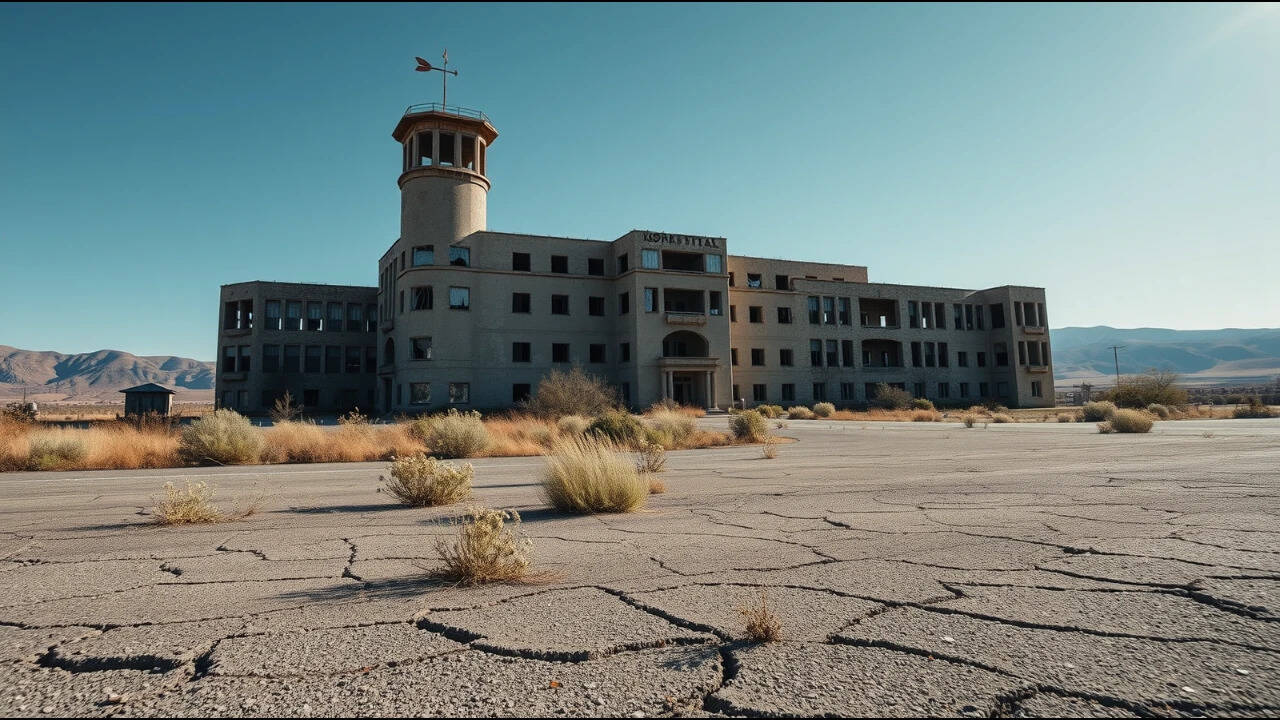
The transformation of a populated municipal grid into an empty settlement is governed by strict economic thresholds rather than random historical misfortune. When analyzing physical preservation in deserted settlements like Eagle Mountain in California or Kennecott in Alaska, casual observers focus on the arresting visual of a standing hospital or an intact residential block. A structural audit reveals that these locations persist as frozen anomalies because the cost function of complete human removal exceeded the cost of structural abandonment. Understanding why infrastructure remains upright long after economic utility evaporates requires deconstructing the resource dependency models, capital depreciation curves, and property rights frameworks that dictate settlement lifecycles.
The Monopsony Vulnerability Index
Most large-scale deserted settlements originate as company towns. In these environments, a single corporate entity acts as the sole employer, landlord, and commercial provider, creating a pure monopsony. This architecture generates high operational efficiency during resource extraction booms but introduces catastrophic systemic vulnerability when market prices shift. For another view, see: this related article.
The stability of a single-industry settlement depends on a simple equation:
$$\text{Extraction Revenue} > \text{Extraction Cost} + \text{Logistical Overhead}$$ Similar coverage on this trend has been published by Travel + Leisure.
When global commodity prices drop or environmental compliance expenses rise, the margin collapses. Corporations do not manage towns for civic longevity; they maintain them strictly to optimize resource extraction yield. Once the net present value of the remaining resource falls below the capital expenditure required to maintain worker housing and municipal services, the corporate owner initiates immediate divestment.
The speed of the subsequent evacuation correlates directly with asset ownership structures. In corporate-owned towns, residents hold no underlying equity in their homes. When the company announces a plant or mine closure, there is no real estate market to absorb the shock. Home values drop to zero instantly because the land possesses no alternative economic utility. Without home equity to protect or sell, residents relocate within weeks, leaving behind dense pockets of civic infrastructure, including schools, commercial spaces, and fully equipped medical facilities, exactly as they stood on the final day of operations.
The Infrastructure Persistence Threshold
A central paradox of abandoned settlements is the physical survival of complex facilities, such as multi-story hospitals and industrial mills, in remote environments subject to extreme weather. Standard building stock degrades rapidly without active climate control and roof maintenance. The survival of structures in sites like Eagle Mountain or Kennecott stems from two distinct variables: construction material quality and the prohibitive cost of demolition.
Industrial operations engineered during the mid-twentieth century utilized heavy structural steel, reinforced concrete, and old-growth timber designed to withstand continuous industrial vibration and harsh desert or sub-arctic climates. When these facilities were shuttered, the corporate parent calculated the return on investment for systematic demolition versus legal abandonment.
Demolishing a 4,000-person company town requires millions of dollars in heavy machinery transport, hazardous material abatement—such as asbestos and lead paint common in postwar construction—and site remediation. If the corporate entity enters bankruptcy or if the land value post-demolition remains lower than the remediation cost, corporate balance sheets dictate tactical abandonment. The physical infrastructure remains standing simply because neglect is cheaper than deconstruction.
Environmental Externalities and Subsurface Failure
Not all desertions follow the clean break of a corporate closure. A distinct category of abandonment is driven by catastrophic environmental degradation that invalidates the underlying land lease. The prime case study is Centralia, Pennsylvania, where an unmitigated underground coal mine fire started in 1962 and rendered the municipal grid uninhabitable through toxic gas diffusion and surface subsidence.
The trajectory of Centralia illustrates how government intervention can accelerate abandonment rather than arrest it. When a subsurface fire makes a residential zone toxic, the primary economic actor shifts from a private corporation to the state via eminent domain and buyouts. The federal and state buyouts of the early 1980s converted dispersed private property claims into a consolidated public holding.
By purchasing the homes and razing the physical structures to prevent illegal squatting, the state altered the landscape from a traditional ghost town—defined by standing ruins—into a silent green space. This demonstrates that the physical appearance of an abandoned settlement is a direct output of public policy decisions regarding liability management. If liability is high, structures are demolished. If liability is low or localized to remote federal land, buildings are left to weather the elements.
Geographic Isolation and Asset Lock-In
The final variable determining the preservation state of a ghost town is transport economics. Settlements that rely on bespoke logistical corridors—such as private rail spurs or single-lane mountain passes—suffer immediate asset lock-in upon closure.
When Kennecott’s copper veins were exhausted in 1938, the Kennecott Copper Corporation pulled up the-railroad tracks. Without rail access, hauling heavy machinery, commercial inventory, or building materials out of the valley cost more than the materials were worth. The physical assets were locked inside a natural geographic barrier.
This geographic friction acts as a preservation preservative. Because scrap metal scavengers cannot easily transport heavy industrial mill equipment out of a remote mountain range or deep desert basin without functional transit links, the artifacts remain in place. The very isolation that made the settlement profitable during its operational peak guarantees its preservation as an intact ruin once the industry departs.
Strategic Capital Allocation for Abandoned Assets
The presence of standing homes, schools, and hospitals in abandoned settlements represents a permanent record of mid-century industrial central planning. These sites function as physical ledgers of capital deployment, revealing the immense resources once dedicated to extracting raw materials for domestic industrial expansion. Analyzing these locations provides predictive insight into modern single-industry boomtowns currently cycling through the exact same economic vulnerabilities. Long-term regional stability requires diversifying local economies before resource depletion triggers the inevitable threshold of corporate withdrawal and structural abandonment.
.jpg)