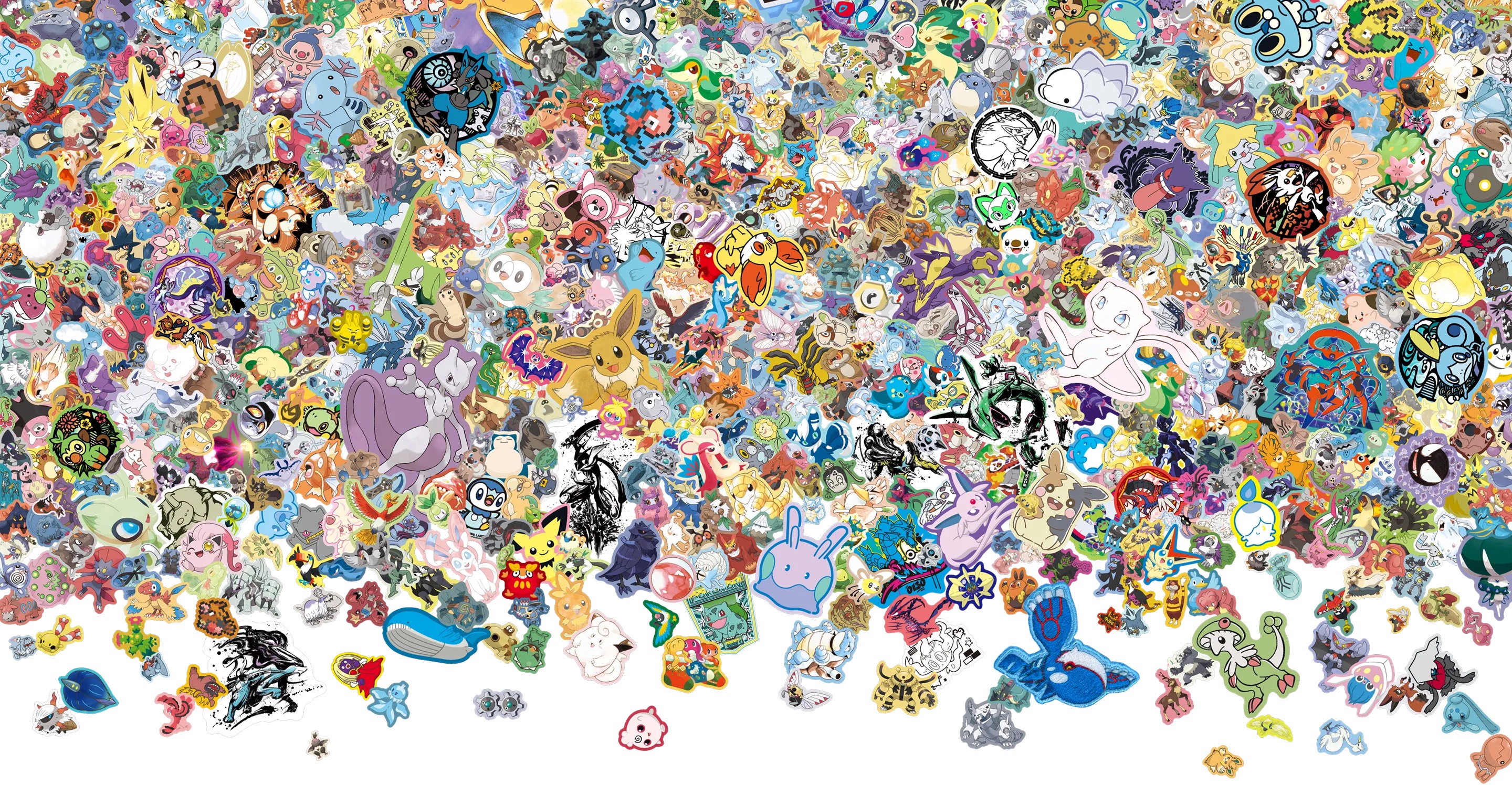
The sustained dominance of the Pokemon franchise over three decades is not a result of nostalgia, but rather the precise calibration of an asynchronous collection loop designed to exploit the completionist drive. While casual observation attributes the brand’s longevity to "fandom," a structural analysis reveals a sophisticated interplay between artificial scarcity, social signaling, and a variable ratio reinforcement schedule. The "Catch 'Em All" directive functions as a primary economic engine that converts player time into digital equity, which is then preserved through cross-generational software compatibility.
The Triad of Collection Persistence
The persistence of the Pokemon ecosystem relies on three foundational pillars that differentiate it from standard RPG (Role-Playing Game) cycles. Most interactive media follows a linear path—start, middle, and exhaustion of content. Pokemon utilizes a non-linear acquisition model that prevents the player from ever reaching a definitive "end state" without significant external interaction.
- Version-Locked Scarcity: By splitting the software into two or more distinct SKUs (Stock Keeping Units) with exclusive data sets, the developer creates a structural deficit. A single user cannot fulfill the core objective in isolation. This necessitates a secondary market or a social exchange network, effectively turning the player base into a distributed marketing force.
- Trans-Generational Data Portability: Unlike most gaming franchises that reset progress with new hardware iterations, Pokemon established the "Pokemon Home" (formerly Bank) architecture. This allows users to migrate assets from 2002 into software released in 2026. This data persistence transforms a "game" into a "collection," increasing the sunk-cost fallacy and making the cost of exit—abandoning decades of accumulated digital assets—prohibitively high.
- The Variable Ratio of Shininess: The introduction of ultra-rare color variants, known as "Shiny" Pokemon, introduced a gambling mechanic into a non-monetary environment. With base encounter rates historically set at $1/8192$ (and later $1/4096$), the system utilizes a variable ratio reinforcement schedule. This is the same psychological mechanism that governs slot machine addiction, ensuring that the "quest" remains indefinitely renewable even after the primary Pokédex is complete.
The Mathematical Barrier to Completion
The objective of "catching them all" has undergone a radical shift in difficulty since 1996. In the original Red and Green versions, the target was 151 entities. As of 2024, that number has surged past 1,000. However, the raw number is a misleading metric of difficulty. The real complexity lies in the Taxonomy of Acquisition, which categorizes how these entities are distributed across different media and time-gated events.
- Standard Spawns: Easily accessible through routine gameplay.
- Version Exclusives: Requires peer-to-peer trade or a secondary hardware/software purchase.
- Trade Evolutions: Mechanical barriers that prevent certain creatures from reaching their final form without a verified exchange, forcing social engagement.
- Mythical Distributions: Artificially limited assets released only during specific real-world windows. These create "legacy gaps" in a collection that can only be filled through high-value trading or waiting for a multi-year re-release cycle.
This stratification ensures that the barrier to entry for a "Master Collection" grows exponentially with every year. For a new player entering the ecosystem today, the path to 100% completion is not a game; it is a multi-year logistical project involving hardware procurement, subscription management, and participation in global trade forums.
The Cognitive Architecture of the Catch
The psychological hook of Pokemon is rooted in the "Endowment Effect"—a circumstance where individuals value an object more highly simply because they own it. In Pokemon, this is amplified by the customization of the data. Each creature is not a generic copy; it possesses unique identifiers:
- IVs (Individual Values): Hidden genetic markers that dictate stat potential.
- EVs (Effort Values): Values gained through specific training, reflecting the player's labor.
- OT (Original Trainer) ID: A digital fingerprint that proves the player was the one who performed the capture.
When a player "catches" a Pokemon, they are not just checking a box; they are generating a unique digital asset that bears their signature. This creates a sense of stewardship. The labor required to optimize a Pokemon for competitive play or to find a rare variant creates a "value-add" that exists purely in the mind of the player but is validated by the game's social infrastructure.
The Bottleneck of Live Service Integration
As the franchise moves further into the "Live Service" model, the friction between traditional collection and modern monetization becomes apparent. The "National Dex" controversy—where developers began removing the ability to use every Pokemon in a single game—highlighted a critical flaw in the infinite-growth model.
The technical debt required to animate, balance, and maintain data for over 1,000 unique models with thousands of move combinations is nearing a breaking point. From a strategy consulting perspective, the developer (Game Freak) is currently managing a "Legacy Asset Crisis." They must balance the player's expectation of data persistence with the hardware limitations of mobile and console platforms.
This has led to the "Dexit" strategy: a rotational system where only a subset of the 1,000+ Pokemon are available in any given title. While this manages technical debt, it creates a "Storage Fee" economy. Players must pay for cloud services (Pokemon Home) to house their assets that cannot currently enter a game. This transforms the collection from a static achievement into a recurring revenue stream for the corporation.
Evolutionary Dynamics of the Trading Economy
The trading economy has transitioned from local link cables to a globalized digital marketplace. This globalization has commodified the Pokemon experience. In the 1990s, a rare Pokemon was a neighborhood status symbol. Today, the Global Trade System (GTS) has led to "Hyper-Inflation."
When any player in the world can offer a rare asset, the "value" of that asset approaches the marginal cost of its production—which, for players using automated bots or "genning" (generating fake data), is near zero. This has forced the hardcore community to pivot toward "Certified Legitimacy."
The value is no longer in the data itself, but in the Proof of Work. A "Shiny" Pokemon caught in a modern game is worth less than one caught in a 2003 GameBoy Advance title because the latter requires the maintenance of legacy hardware and a verified transfer path. The community has effectively developed its own internal "Blockchain" of authenticity, where the history of the data file is more important than the pixels on the screen.
Strategic Forecast for Long-Term Engagement
The "Quest to Catch 'Em All" will eventually move away from the "Catching" and toward the "Managing." We are observing a transition from active gameplay to an asset-management paradigm. To maintain the brand's valuation, the following structural shifts are inevitable:
- Normalization of the Vault: The cloud storage system will become the primary "game," with individual software releases acting as temporary "adventure modules" where assets can be checked in and out.
- Artificial Scarcity 2.0: As the standard Pokédex becomes trivial for long-term players, the focus will shift to "Marks," "Ribbons," and "Sizes"—additional metadata layers that make one Pikachu objectively rarer than another Pikachu.
- The Integration of Real-World Geodata: Following the success of Pokemon GO, the "Catch 'Em All" mechanic will increasingly rely on physical movement and geographic exclusivity to prevent the digital market from total saturation.
The most effective strategy for the individual collector is no longer the pursuit of quantity, but the curation of "Origin-Authenticated" assets. In an era of infinite digital replication, the only remaining value lies in the verifiable history of the encounter. The franchise will survive not because people love the characters, but because the system has successfully convinced millions that digital labor equals tangible wealth.
To optimize for the next decade of the ecosystem, users must prioritize the acquisition of "Event-Exclusive" metadata over standard species completion. As the total count of entities approaches 1,500, the baseline "Catch 'Em All" objective will be downgraded to a tutorial phase, while the true endgame will focus on the acquisition of non-replicable data strings tied to specific historical moments in the franchise's timeline.