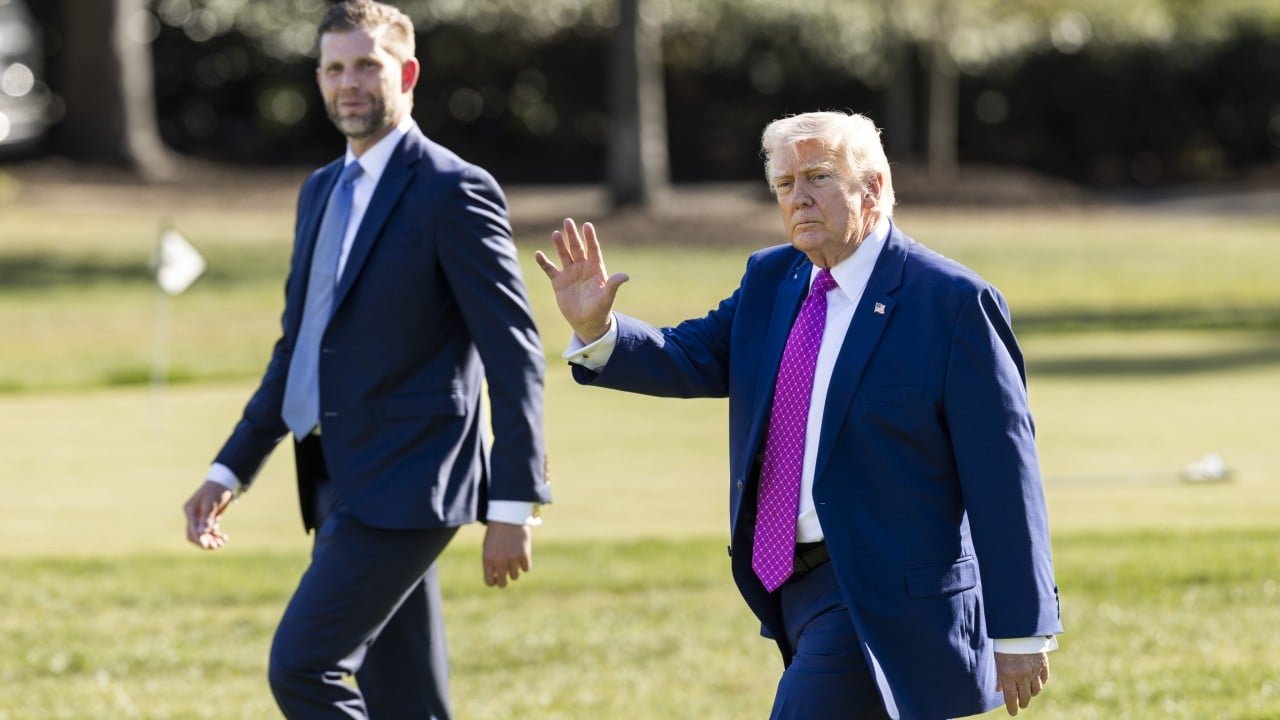
The inclusion of Eric Trump in a formal state visit to China represents a fundamental shift from traditional diplomatic protocols to a transactional, family-centric model of international relations. This maneuver bypasses the standard bureaucratic friction of the State Department, replacing institutional safeguards with a direct line of familial trust. In the context of U.S.-China relations, where the distinction between state interests and corporate influence is frequently blurred, the presence of a family member who manages the executive's private business interests signals a hybrid form of statecraft. This strategy operates on three distinct levels: the signaling of long-term commitment, the reduction of information asymmetry, and the creation of a parallel negotiation track that is shielded from legislative oversight.
The Mechanism of Familial Signaling
Diplomacy usually relies on career civil servants to ensure continuity across administrations. However, the Chinese political system places a high premium on lineage and personal loyalty, often viewing institutional actors as transient figures. By introducing a family member into the delegation, the administration aligns its communication style with the Confucian-rooted political culture of the host nation. Read more on a related issue: this related article.
This creates a high-stakes signaling mechanism. When a president sends a cabinet member, they send a functionary; when they send a son, they send a proxy for their personal reputation. This reduces the "trust deficit" by suggesting that the agreements reached are not merely departmental policies, but are tied to the family’s long-term legacy. The cost of reneging on a deal becomes personal rather than just political, which, in the eyes of Chinese negotiators, adds a layer of stability that Western institutionalism often lacks.
Information Asymmetry and the Private-Public Nexus
The most significant friction point in this arrangement is the inherent conflict of interest between national policy and private enterprise. Eric Trump’s role as an executive in the Trump Organization creates an environment where the "Cost Function of Diplomacy" is impacted by potential private gains. Further journalism by NBC News explores related perspectives on the subject.
- The Access Premium: Foreign officials may perceive that concessions made to the family's business interests are more effective at securing presidential favor than concessions made to the national interest.
- The Shadow Track: Conversations that occur between family members and foreign counterparts do not produce the same paper trail as those involving official ambassadors. This creates a "black box" of negotiation where sensitive trade topics can be discussed without triggering the immediate scrutiny of the press or political rivals.
- Regulatory Arbitrage: Because family members are often technically private citizens, they can navigate legal grey areas that would be strictly off-limits to a government employee bound by the Hatch Act or traditional ethics requirements.
This dynamic functions as a form of "asymmetric diplomacy." While the public-facing officials discuss tariffs and territorial disputes, the private-facing proxies can gauge the temperature of the business environment, identifying sectors where the foreign power is willing to provide "soft" concessions—such as trademark approvals or expedited permitting—that do not appear in a formal treaty but influence the overall bilateral relationship.
Strategic Capital and the Perception of Stability
China’s "Princeling" culture—where the children of revolutionary leaders hold immense power in both the CCP and state-owned enterprises—provides the perfect backdrop for this approach. To the Chinese leadership, Eric Trump is a recognizable entity. He represents a "Princeling" equivalent. This alignment simplifies the social architecture of the visit.
The logistical advantage is clear: institutional diplomacy is slow. It requires inter-agency review, legislative briefings, and public justifications. Dynastic diplomacy is rapid. It relies on the "Speed of Trust." If the objective of the state visit is to achieve a quick reset of trade relations or to de-escalate military tensions in the South China Sea, the shortcut provided by a familial proxy is an efficient, albeit risky, tool.
Quantifying the Risks of Institutional Erosion
The primary danger of this model is the systematic hollowing out of professional diplomatic corps. When the most sensitive or high-value discussions are moved into the familial sphere, the traditional State Department apparatus becomes a "shell organization."
- Brain Drain: Career diplomats lose the incentive to specialize when they realize that the path to influence is determined by bloodline rather than expertise.
- Intelligence Gaps: If the core of a negotiation happens in private family meetings, the intelligence community cannot accurately brief future leaders on the nuances of the agreements made. This creates a "succession risk" where the knowledge of the relationship disappears once the specific family leaves office.
- Counter-Intelligence Vulnerability: Family members, lacking the rigorous security clearances and counter-espionage training of career officers, represent a softer target for foreign intelligence services looking to gain leverage through social engineering or business enticements.
The Economic Calculus of Sovereign Negotiation
From a game theory perspective, the state visit is a "repeated game." In standard diplomacy, the players change every four to eight years, leading to a focus on short-term wins. By involving the next generation of the family, the administration attempts to transform the encounter into an "infinite game."
The Chinese side calculates the "lifetime value" of the relationship. If they believe the family will remain a powerhouse in American politics for decades, they are more likely to offer concessions today to secure favorable treatment in the future. Eric Trump’s presence is the physical manifestation of this multi-generational bet. It forces the Chinese to consider the Trump brand—both political and commercial—as a permanent fixture in the geopolitical landscape.
The Structural Shift in Geopolitical Power
We are witnessing the "corporatization of the state." In this framework, the nation-state is managed like a family office or a global conglomerate. The metrics of success are not just GDP growth or geopolitical stability, but "Brand Equity" and "Market Share."
The visit to China, therefore, is not a traditional diplomatic mission; it is a merger and acquisition meeting on a global scale. The agenda is likely divided into two distinct tiers. Tier 1 involves the public theater: joint press conferences, discussions on North Korea, and broad statements on trade deficits. Tier 2 involves the structural reality: securing the supply chains for family-linked industries, opening markets for high-end real estate and hospitality, and ensuring that the family's global footprint is protected from regulatory shifts.
Strategic Play: The Counter-Institutional Pivot
To navigate this landscape, observers must stop evaluating state visits through the lens of 20th-century political science. The standard metrics—number of treaties signed, official communiqués issued—are lagging indicators. The leading indicators of a successful "Dynastic Visit" are found in the following data points:
- Trademark and Intellectual Property Grants: Tracking the speed and volume of IP approvals for family-affiliated businesses in the months following the visit.
- Private Equity Flow: Monitoring the movement of capital from state-backed Chinese investment funds into sectors where the family has significant holdings or influence.
- Frequency of Side-Channel Communication: The number of unrecorded meetings between the "Princelings" of both nations compared to the number of formal bilateral sessions.
The strategic recommendation for analysts and competing nations is to build "Family Intelligence Profiles" that parallel their traditional "State Intelligence Profiles." Understanding the personal debts, business ambitions, and internal family dynamics of the leadership is now as critical as understanding their military capabilities or economic output. The state visit is no longer a meeting of two governments; it is a meeting of two dynasties, and the rules of engagement have shifted from the constitutional to the patrimonial. Success in this new era requires the ability to negotiate simultaneously in the currency of national sovereignty and the currency of private interest. This duality is not a bug in the system; it is the new operating system of 21st-century power.



