The Weight of the Air
You taste it before you see it.
It arrives on a dry Tuesday afternoon, carried by the heavy draft of an accelerating delivery truck or kicked up by the sneakers of a child sprinting toward a swing set. It is an unremarkable grey film, settling quietly across the hood of a parked sedan, dusting the leaves of a suburban oak, clinging to the weathered wood of a park bench.
Most people call it dirt. Or grime. Or just urban soot.
They are wrong.
It is an archive.
For decades, scientists have looked up at the smokestacks or down at the riverbeds to measure our industrial footprint. They have tracked the sulfur in the clouds and the mercury in the fish. But they missed the floorboards of our daily lives. They missed the asphalt carpets we walk across every single day.
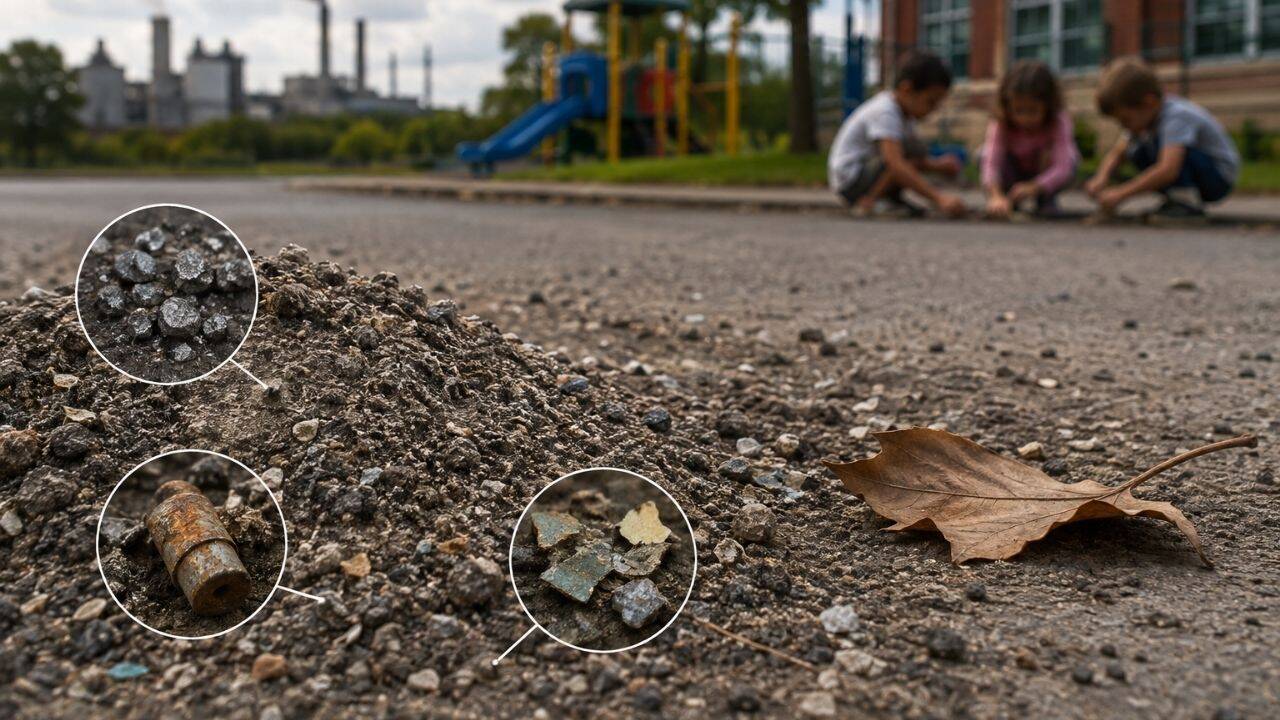
Look closely at the road dust gathered from seven major cities across the eastern United States. What researchers found in those gritty urban samples is not mere earth. It is a stubborn, microscopic ledger of a century we thought we had safely buried. Lead. Chromium. Cadmium. Nickel. Heavy, toxic legacy metals that do not biodegrade, do not wash away with a sudden spring shower, and do not simply vanish because a zoning board declared an area clean.
They linger. Right where the children play. Right where the windows stay open on warm autumn nights.
The Anatomy of an Invisible Inheritance
Consider what happens next.
A heavy rain hits the pavement. It pools, it mixes with oil drippings from commuter sedans, rubber particles sheared off from braking tires, and decades-old particulate matter trapped in the porous crevices of aging concrete. When the sun comes out, the puddles evaporate. The water goes up, but the metals stay down. Ground down into a fine, powdery matrix, this toxic cocktail becomes airborne at the slightest provocation.
I remember standing at the edge of a neighborhood park in an eastern industrial hub a few summers ago, watching toddlers scoop up loose earth near the base of a sliding board. Their hands were stained brown. Within minutes, those same hands were wiping sweat from foreheads, clutching snack crackers, rubbing tired eyes.
The parents sitting on the green benches were smiling. They were breathing deeply, grateful for the fresh air, believing they had brought their children to a safe sanctuary away from the congested downtown corridors.
They did not know about the heavy metals. How could they? You cannot smell a legacy of mid-century manufacturing. You cannot see the microscopic flecks of lead paint blasted off bridges decades ago, now pulverized into the very foundation of the urban playground.
Scientists tested the dust in seven eastern cities. The results read like an autopsy of American industry. In neighborhoods flanking historic parks and public schools, concentrations of these elements routinely exceeded baseline expectations. These are not isolated industrial spills. This is diffuse, pervasive contamination. It is the dust of progress, returning to collect its debt.
Why the Past Refuses to Leave
History is heavy. Sometimes, it is literally heavier than the ground beneath it.
Think about how our cities were built. They rose on the backs of coal fires, leaded gasoline, heavy smelting, and unchecked manufacturing. When the factories closed and the smokestacks were capped, we breathed a collective sigh of relief. We planted grass over brownfields. We built modern schools on top of old rail yards. We assumed that time was a disinfectant.
It is not.
Metals do not age out. They transform, they migrate, and they accumulate. When a car tire grinds against asphalt, it sheds synthetic polymers and trace metals embedded in the rubber. When a historic bridge undergoes weathering, microscopic lead flakes settle into the runoff gutters that feed local neighborhood drainage systems.
It is a quiet, continuous deposition. Year after year, layer upon layer.
By the time researchers scoop up samples of road dust from street corners adjacent to elementary schools, they are collecting the accumulated debris of four or five generations. They are measuring the ghost of every car that ever burned leaded fuel before the ban took effect in the late twentieth century. They are measuring the ash from incinerators long since demolished.
The environment does not suffer amnesia. Every choice leaves a signature. And the signature of our industrial ascent is written in the heavy metals coating the urban curb.
The Human Cost of the Ordinary
Statistics are sterile things. They tell you that a certain threshold of parts per million represents a chronic risk, but they fail to capture the texture of the threat.
The threat is a four-year-old child whose developing neurological system is uniquely vulnerable to heavy metal exposure. The threat is a mail carrier walking a ten-mile route through dust-choked intersections twice a day, drawing those fine particles deep into lung tissue with every stride. The threat is an elderly resident tending to a sidewalk garden, unknowingly pulling root vegetables from soil enriched by decades of atmospheric fallout.
When we talk about environmental justice, we often point to the smoking pipe or the chemical runoff pipe discharging directly into a creek. Those are the visible villains. We know how to protest those.
We do not know how to protest the street itself.
How do you look at a paved road, the literal artery of community connection, and see a hazard? It feels unnatural. It feels alarmist. We want our streets to be safe corridors of commerce and mobility, not reservoirs of ancient toxins.
Yet, the data from those seven eastern cities paints an undeniable portrait of urban geography. The highest concentrations of legacy metals do not sit in locked, abandoned industrial parks. They sit right along the edges of our communal lives—the verges, the medians, the school drop-off zones, and the urban green spaces designed to offer respite from city life.
The irony is sharp. The places where we seek health are often the places where history sits thickest in the dirt.
Breaking the Cycle
Understanding a problem of this magnitude requires a shift in how we perceive urban maintenance.
For generations, street sweeping has been about aesthetics. We sweep the gutters to clear out autumn leaves, plastic wrappers, and discarded coffee cups. We want our neighborhoods to look tidy.
If road dust is a toxic archive, sweeping takes on an entirely different urgency. Traditional dry sweeping often does more harm than good, launching settled particles back into the air where they can be inhaled by passersby. Modern mitigation demands vacuum-assisted, high-efficiency particulate filtration sweepers. It demands systematic soil replacement in urban parks where legacy contaminants have pooled over decades. It demands rigorous testing not just of factory emissions, but of the very ground our children walk on.
This is not cheap. And it is not quick.
It requires acknowledging that our cleanup efforts in the past were incomplete. We stopped the bleeding at the smokestack, but we left the patient's clothes soaked in the poison.
The Dust Settles
The afternoon fades. The delivery trucks turn off their engines. The children go inside for dinner, washing their hands at the kitchen sink, leaving a faint grey smudge on the white porcelain.
Outside, the streetlights flicker on, casting a yellow glow over the asphalt. The breeze dies down. The dust settles back into the grain of the concrete, waiting for tomorrow's tires, tomorrow's footsteps, tomorrow's wind.
It has been there for a hundred years. It will be there tomorrow morning, resting quietly at the edge of the playground, keeping its heavy count.