Home crowds can lift an athlete to glory or crush them under the weight of expectation. When Duncan Scott stepped onto the blocks at the Tollcross International Swimming Centre in Glasgow, everyone in the arena knew what was riding on his shoulders. Scotland needed a strong start at the 2026 Commonwealth Games. Australia had already begun piling up podium finishes, and the pressure on the home team was thick enough to cut with a knife.
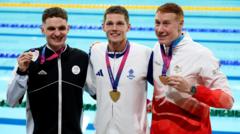
Scott delivered. In a blistering performance that set a new Games record of 1:56.38 in the men's 200-metre individual medley, the 29-year-old Scot grabbed his country's first gold medal of the Games. He held off New Zealand's Lewis Clareburt, who took silver, and his close friend and Great Britain teammate Tom Dean, who claimed bronze for England.
It wasn't just another medal for the trophy cabinet. It was a tactical masterclass, a relief for a home nation, and a reminder of why Scott remains one of the most dependable big-race performers in modern swimming.
The Raw Pressure of Swimming at Home
Opening night at a major championship is always intense. When you're the face of the host nation, that intensity multiplies tenfold.
Scott isn't a rookie. He knew the crowd came to Tollcross specifically to see him win. Being one of the senior figures on Team Scotland meant the burden of setting the tone rested squarely on him.
He admitted after the race that nerves almost got the better of him before diving into the water. That honest admission says a lot about what goes on behind the scenes at this level. Fans often assume elite athletes are immune to anxiety, but they feel every bit of the tension. The difference between good swimmers and legendary ones comes down to how they channel that nervous energy when the horn sounds.
Scott focused that energy into his pacing. The 200m individual medley demands excellence across all four strokes—fly, back, breast, and free. You can't afford a weak leg, especially against a field containing world-class medleys specialists like Clareburt and Dean. Scott executed his strategy to perfection, pacing his butterfly and backstroke before making his move during the breaststroke turn and bringing it home with a fierce freestyle leg.
His winning time of 1:56.38 didn't just secure the top spot on the podium. It erased the previous Commonwealth Games mark, proving that even at 29, Scott is still refining his speed and stamina.
Battling a Close Friend and Training Partner
One of the most compelling aspects of elite swimming is how often fierce rivals share the same lane lines during training. Scott and Tom Dean have spent years swimming alongside each other, representing Great Britain on the world stage and sharing Olympic podiums.
When they line up representing Scotland and England, the personal friendship stays on the pool deck, but the respect remains.
Dean entered this race following a brutal, injury-plagued season that almost derailed his entire year. A change in his training program and months of rehabilitation meant Dean wasn't even sure he'd make it to Glasgow, let alone compete for medals. Standing on the block next to Scott was a victory in itself for the English swimmer.
Dean put up a serious fight, stopping the clock at 1:57.22 to secure a feel-good bronze medal just 0.84 seconds behind Scott. For Dean, that bronze felt like gold after everything he had endured over the previous twelve months. For Scott, racing against someone he knows so well added an extra layer of competitive bite to the final 50 metres.
That battle highlights what makes the Commonwealth Games distinct from the Olympics or World Championships. Friends become rivals for a week, bragging rights are on the line, and the racing is often looser and more aggressive as a result.
Breaking Up the Australian Juggernaut
To understand why Scott's victory mattered so much on opening night, you have to look at the broader picture in the pool. Australia came into Glasgow with a massive squad, backed by serious financial incentives and decades of dominance in Commonwealth swimming.
The Aussies started the night in typical fashion. Lani Pallister led a clean sweep of the podium in the women's 400m freestyle, while Jenna Forrester edged out Scottish contender Katie Shanahan in the 200m backstroke. Australia also swept both the men's and women's 4x100m freestyle relays, with their men's quartet breaking the Games record in 3:09.49.
Without Scott's performance in the 200m medley, Australia would have completely owned the opening session. Scott single-handedly broke up that green-and-gold wave, giving the local fans something massive to celebrate and proving that Team Scotland can stand toe-to-toe with the world's best.
His gold medal was a massive psychological boost for the entire Scottish delegation. In multi-sport events, early momentum is real. Athletes sitting in the village watch their teammates compete on television, and seeing a veteran like Scott get the job done creates a ripple effect across every sport in the schedule.
The Career Legacy of Duncan Scott
With this gold medal, Scott brought his personal Commonwealth Games medal tally to 14, including four golds. That record places him among the most decorated Scottish athletes in history.
He made his Commonwealth debut back in Glasgow in 2014 as a fresh-faced 19-year-old. Coming back to Tollcross twelve years later as a mature champion brings his career full circle. He has evolved from a talented teenager riding the coattails of older stars into the undeniable leader of Scottish swimming.
What sets Scott apart isn't just his raw physical ability. It's his versatility and race intelligence.
Many swimmers excel in a single discipline, like sprint freestyle or pure breaststroke. Scott can compete for gold in individual medley events, sprint freestyle, and relays. That range makes him invaluable to both Team Scotland and Team GB in team competitions.
His ability to adapt to different race conditions and management styles over more than a decade at the highest level speaks to his work ethic. Swimming training is notoriously grueling, involving thousands of early-morning thousands of metres in cold water every week. Maintaining that level of dedication over three Olympic cycles requires mental toughness that few sports demanding more of.
Key Milestones in Duncan Scott's Commonwealth Career
- Glasgow 2014: Made his debut as a teenager, earning a silver medal in the 4x200m freestyle relay.
- Gold Coast 2018: Enjoyed a breakout Games in Australia, winning gold in the 100m freestyle along with four bronze medals.
- Birmingham 2022: Collected six medals, including gold in the 200m freestyle and 200m individual medley.
- Glasgow 2026: Set a Games record of 1:56.38 to claim gold in the 200m individual medley on opening night.
Why Technical Precision Won the 200m Medley
The 200m individual medley is often called the ultimate test of a swimmer's complete skill set. You can't hide any technical flaws across 50 metres of fly, back, breast, and free.
Scott's victory came down to precise technical choices during the second half of the race:
The Underwaters and Walls
Scott generated massive distance off every turn, particularly on the breaststroke-to-freestyle transition. While Clareburt tried to pull away during the backstroke segment, Scott stayed calm, trusting his underwater streamline to close the gap without burning extra oxygen.
Stroke Rate Efficiency
Instead of rushing his stroke when Clareburt pulled even, Scott maintained a steady, power-focused stroke rate through the breaststroke leg. That patience preserved enough energy in his legs for a devastating final 20 metres of freestyle.
Breathing Management
During the final freestyle sprint, Scott restricted his breathing to keep his body alignment flat and minimize resistance in the water. That small mechanical adjustment preserved his speed when fatigue set in over the closing metres.
What Team Scotland Needs to Keep the Momentum Going
Winning the first gold medal sets a high standard for the rest of the Scottish squad in Glasgow. Celebrations have to be brief because the swimming schedule moves fast, with finals packed into every evening session.
Scottish coaches will look to capitalize on Scott's early success across several key areas:
- Protect Senior Athletes from Burnout: Experienced competitors like Scott often race multiple events plus relay legs. Managing recovery time between heats, semi-finals, and finals is essential to avoid late-week fatigue.
- Channel Home Crowd Energy: Younger athletes can sometimes freeze when performing in front of a loud home crowd. Coaches need to help them treat the noise as an advantage rather than an added pressure point.
- Target High-Probability Relay Medals: Relays offer an excellent chance to build team spirit and add to the medal count, especially when led by an experienced stroke swimmer like Scott.
Scott gave Scotland the exact spark it required on day one. By overcoming mounting pressure, beating world-class rivals, and lowering the Games record, he proved once again why he is one of the most reliable athletes in Scottish sporting history.