The concrete outside Qatar’s Lusail Stadium baked under a punishing Arabian sun. Thousands of fans swirled in a chaotic sea of green jerseys, singing, chanting, and drowning out the low hum of the desert wind. If you stood in the middle of that crowd during the winter of 2022, your senses were assaulted by the smell of roasted nuts, the thrum of heavy bass from speakers, and the desperate, electric anxiety of the World Cup group stages. Mexico was playing. The stakes were suffocating.
Then, the crowd parted. Not for a legendary striker. Not for a Hollywood A-lister.
They parted for a duck.
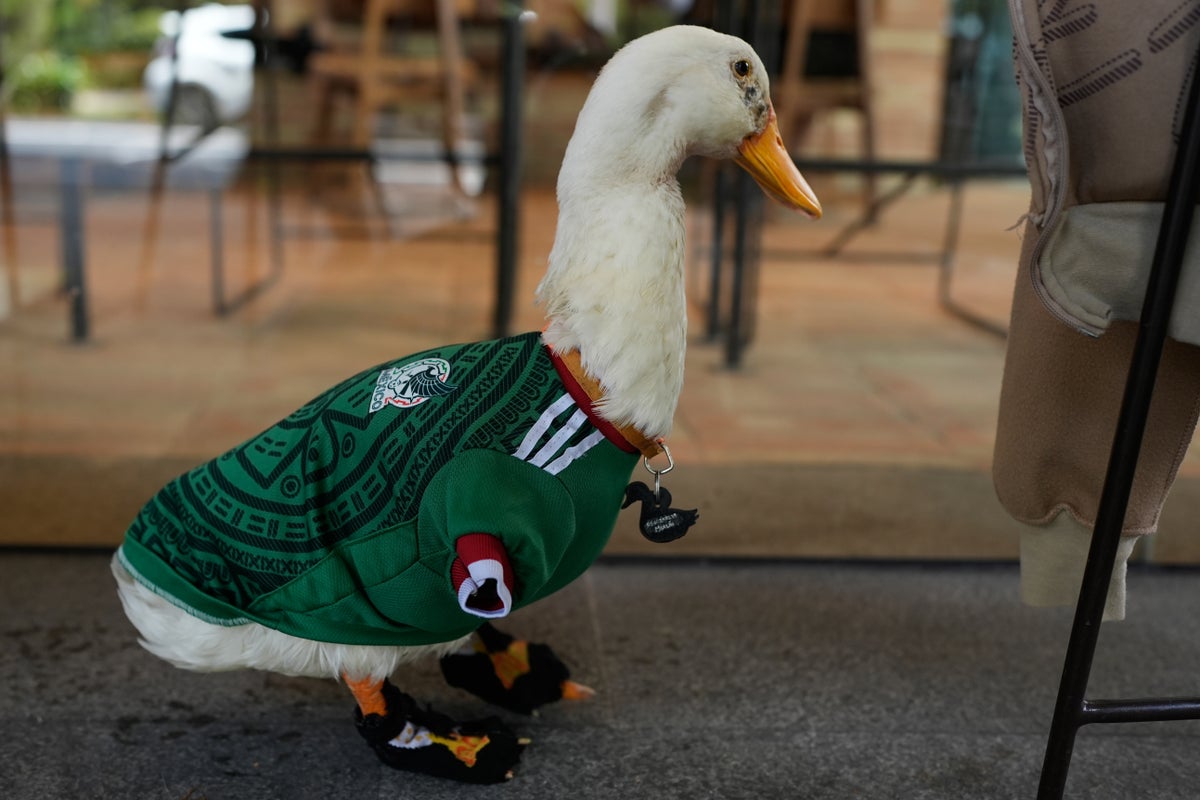
He wore a custom-tailored green Selección Nacional kit, complete with tiny white shorts. On his webbed feet, miniature custom sneakers clacked against the hot pavement. He waddled with a serene, almost royal composure, entirely unbothered by the wall of smartphones thrust into his face.
His name was Merlin. Within forty-eight hours, he became the undisputed, viral heart of Mexico’s tournament run.
To the casual scroller on TikTok, Merlin was a funny meme, a fleeting piece of internet fluff designed to be consumed in six seconds and forgotten. But if you watched the faces of the fans who knelt in the dust just to touch his feathers, you realized something else was happening. This wasn’t about a bird. This was a collective exhale for a fan base carrying the crushing weight of a nation’s expectations.
The Weight of the Green Shirt
To understand why a waterfowl captured the imagination of millions, you have to understand the unique torment of being a Mexican football fan. It is a beautiful, agonizing inheritance. Every four years, the country convinces itself that this is the moment. The year we break the curse of the quinto partido—the elusive fifth game, the quarter-finals that have mocked the nation since 1986.
The pressure is not abstract. It is a physical presence. It sits on the shoulders of the players, but it weighs even heavier on the fans who spend their life savings on flights to Doha, trading their financial stability for a sliver of hope.
Enter Merlin’s owner, an ordinary fan named Hugo. Consider a hypothetical teenager back in Mexico City, waking up at 4:00 AM to watch the match, feeling their stomach twist into knots as the referee blows the whistle. Football at this level stops being a game. It becomes a referendum on national joy. When the team struggles, the national mood darkens.
Hugo brought Merlin to Qatar not as a stunt, but as an antidote.
He noticed months earlier at local matches in Mexico that when people saw Merlin, their posture changed. The tight, angry lines around their mouths dissolved into smiles. In a sport increasingly dominated by multi-million-dollar sponsorships, corporate clinicality, and toxic social media debates, Merlin was pure, unadulterated absurdity.
You cannot yell at a duck about tactical failures. You cannot blame a duck for a missed penalty.
The Logistics of a Viral Miracle
Let’s step back from the romance for a moment and look at the sheer, baffling reality of the situation. Flying an animal across the globe to a strict, highly regulated Middle Eastern country during the biggest sporting event on earth is a bureaucratic nightmare.
Customs officials are not known for their sense of whimsy.
Hugo had to navigate a labyrinth of international veterinary health certificates, avian influenza screenings, and airline pet policies that seemed designed to elicit a surrender. There were moments in the airport lounges where the entire dream threatened to collapse under a mountain of paperwork. Imagine the anxiety of holding a carrier bag, knowing that one missing stamp from a government office in Mexico City could mean your companion is impounded or sent back on the next flight.
But the universe, or perhaps the football gods, favored the bold. Merlin cleared customs.
When he finally took his first steps on Qatari soil, the contrast was stark. Qatar was a hyper-modern landscape of glass, steel, and flawless infrastructure. Merlin was a creature of earth and water. Yet, the moment Hugo set him down outside the stadiums, the rigid atmosphere of the tournament cracked open.
Local Qatari security guards, usually stoic and unyielding in their crisp uniforms, broke character. They smiled. They pointed. They took photos. In a country with strict cultural boundaries, a duck in a football kit became a universal translator.
How the Internet Redefined the Mascot
Statistically, the digital footprint of the 2022 World Cup was the largest in human history. Billions of views rolled in daily across platforms. Content creators spent millions trying to engineer the perfect viral moment, hiring production crews and analyzing algorithms.
Merlin defeated them all with a simple waddle.
Videos of him crossing the street, drinking water from a plastic bottle cap, and standing proudly next to fans wearing massive sombreros began to flood TikTok and Instagram. The algorithm didn't need to force it; the engagement was entirely organic. People were starving for something genuine.
Consider what happens next when a meme becomes an idol.
Merlin wasn't just a mascot for the Mexican fans anymore. Supporters from Argentina, Brazil, and Saudi Arabia sought him out. He became a neutral zone of peace. In the tense hours leading up to the high-stakes match between Mexico and Argentina—a game fraught with historic rivalry and fan friction—Merlin stood as a tiny, feathered diplomat. Fans from opposing sides who had been trading insults minutes prior found themselves laughing together, taking joint photos with the duck.
He softened the tribalism of the sport. He reminded everyone that underneath the flags and the fierce loyalty, we are all just fragile humans looking for a reason to feel connected.
The Fragility of Hope
There is a vulnerability in loving something so deeply that it can break your heart, whether that is a football team or a pet. Throughout the tournament, Hugo carried a quiet anxiety. Merlin was a living being, sensitive to heat and crowds. Hugo’s primary job wasn't managing the fame; it was protecting his friend. He carried specialized hydration, shaded umbrellas, and constantly monitored the duck’s stress levels.
The journey was exhausting. The heat was relentless.
As Mexico's on-field fortunes began to falter—a draw against Poland, a heartbreaking loss to Argentina—the mood in the fan camps grew desperate. The mathematical equations required for Mexico to advance were dizzying. The stress was palpable in every restaurant and fan zone across Doha.
Yet, every afternoon, Hugo and Merlin would emerge.
The duck didn't care about the group standings. He didn't know what Goal Difference meant. He simply existed in the present moment, perfectly content in his little green jersey, accepting the adoration of a broken-hearted fanbase.
When Mexico was ultimately eliminated in the group stage—a devastating blow that broke a seven-tournament streak of making the knockout rounds—the silence in the stadium was deafening. Grown men wept openly in the stands. The dream was dead for another four years.
But outside the arena, the next day, a small crowd still gathered around Hugo’s hotel.
They didn't want to talk about the manager's tactics. They didn't want to argue about the referee. They just wanted to see Merlin one last time before the long flight home. He gave them a soft place to land. He was a reminder that the joy of the World Cup isn't actually found in the trophy at the end; it is found in the ridiculous, beautiful, unpredictable community that forms along the way.
The sun eventually set over the Doha skyline, casting long shadows across the empty plazas as the fans packed their bags to leave. In the grand tapestry of football history, Mexico’s 2022 campaign will be recorded as a failure on the pitch. But for those who were there, the memory of the tournament will always be painted in the vibrant green of a tiny jersey, accompanied by the steady, comforting sound of webbed feet marching softly against the desert sand.