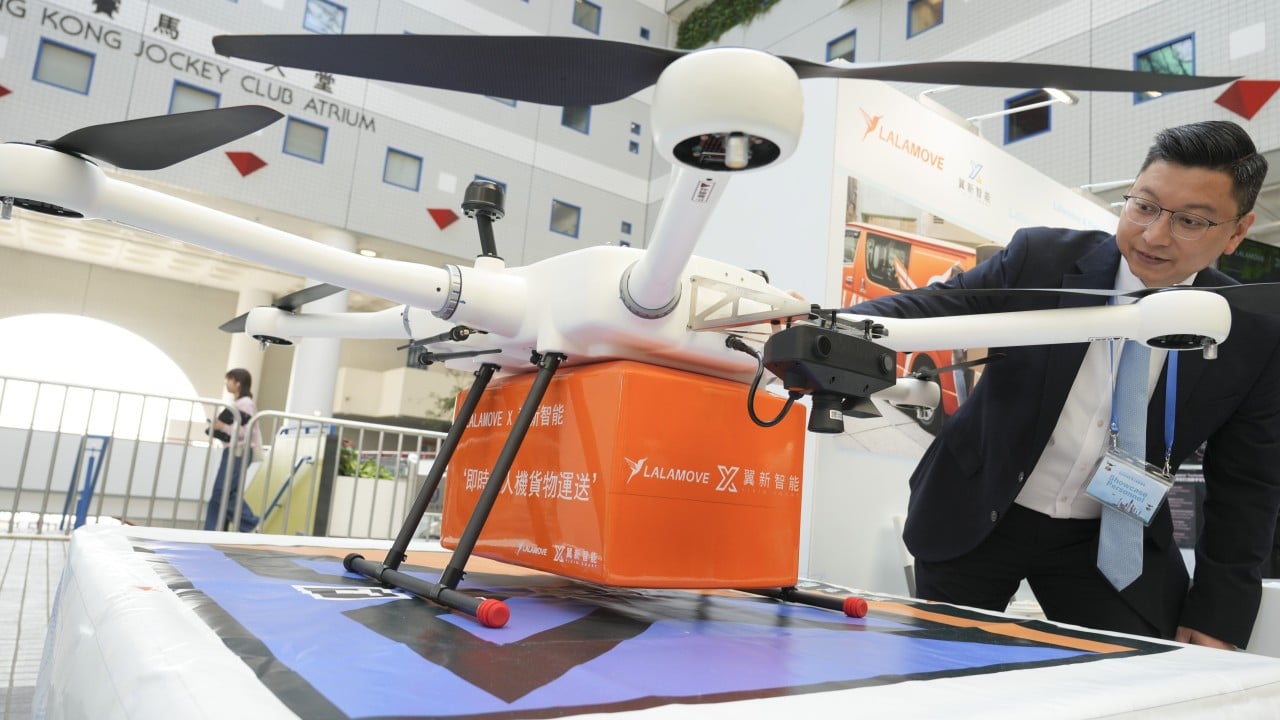
Drones flying over skyscrapers and dropping packages directly onto balconies sounds like a neat sci-fi trope. Most people think tech companies will just deploy thousands of flying robots and solve the final-mile problem overnight. It's an aggressive hallucination. Hardware is easy, but building a viable commercial network in the sky above a dense metropolis is a completely different beast.
The recent alliance between on-demand delivery giant Lalamove and consulting firm EY reveals exactly what it takes to move commercial flight paths from speculative hype to actual revenue. They signed a Memorandum of Understanding explicitly targeting Hong Kong and the Greater Bay Area. They aren't trying to build shinier drones. Instead, they're tackling the invisible wall that keeps unmanned flight grounded: the infrastructure, the legal frameworks, and the complex mechanics of multi-layered transit. Don't forget to check out our previous article on this related article.
If you think the low-altitude economy is just about hardware, you're missing the real structural shift.
The Logistics Illusion of the Skies
Drones can't carry a couch, and they definitely won't replace the standard delivery van anytime soon. The unit economics of sending isolated aerial units to individual residential doorsteps don't add up in a city like Hong Kong, where high-rise density and volatile wind tunnels create immense operating hazards. To read more about the history of this, Reuters Business provides an in-depth breakdown.
The Lalamove and EY strategy shifts focus away from retail gimmicks toward high-volume enterprise logistics. Think about massive B2B operations where speed translates directly into millions of dollars. The real play here is a combined framework: ground transport handles the heavy, bulky freight, while automated aerial networks bypass gridlocked city streets to move high-value, time-sensitive components.
When you integrate aerial paths with an active fleet of vans and motorcycles, you aren't replacing the ground network. You're giving it an emergency bypass valve. Lalamove brings an enormous existing base of enterprise customers and a massive physical fleet. EY brings the regulatory blueprint and risk management frameworks required to make sure those fleets don't conflict with local aviation laws.
Where the Real Economic Value Sits
The hardware side of the low-altitude economy is already commoditized. Mainland China dominates the manufacturing of small-scale drones and electric vertical takeoff and landing (eVTOL) aircraft. Hong Kong isn't trying to out-manufacture Shenzhen. The actual value lies in three distinct operational layers identified by the partnership:
- Institutional Establishment: This means building the actual rules of the road. Who insures a drone that drops a package onto a crowded highway? How do cross-boundary operations between Hong Kong and the mainland handle differing custom jurisdictions?
- Infrastructure Enablement: We need physical vertiports, dedicated charging nodes, and complex Unmanned Aircraft System Traffic Management (UTM) software that prevents aerial collisions in real-time.
- Service Applications: Turning raw flight capability into automated enterprise workflows that businesses can buy as a standardized service.
Hong Kong is leaning into its traditional strengths as a financial, insurance, and legal hub to become the regulatory and certification capital of this new economy. The city launched its advanced "Regulatory Sandbox X" to test complex scenarios like automated traffic management and cross-border flight corridors.
Designing for Complex Realities
A common mistake companies make when entering the logistics space is assuming technology operates in a vacuum. Hong Kong presents a logistical nightmare for autonomous flight: extreme vertical density, tight airspace constraints, and complex maritime boundaries.
To build a workable business model, the partnership is focusing heavily on compliance and risk management layers. If an enterprise cannot predictably guarantee that a drone route will stay open during high-density traffic or shifting municipal restrictions, they won't use it. EY is acting as the ecosystem integrator to connect the hardware providers, the software engineers, the insurance underwriters, and the government regulators.
This isn't just about moving a box from point A to point B. It's about designing automated workflows that plug directly into existing supply chain software so an enterprise customer can scale their operations without thinking about the underlying aviation tech.
Immediate Steps for Enterprise Leaders
If you operate a business reliant on regional supply chains, don't wait around for drones to park outside your office windows. You need to prepare your internal data architecture right now.
First, audit your current last-mile distribution costs and isolate your high-value, time-critical freight lines. These are the only segments where low-altitude transit will be financially viable during the early commercial stages.
Second, standardize your internal dispatch data. Ground-to-air integration requires absolute precision in inventory metrics, weight distributions, and timing. If your warehouse management system can't talk to automated third-party routing platforms, you'll be locked out of these multi-dimensional logistics networks when they scale over the next few years.
Stop looking at drones as standalone gadgets. Treat them as a highly specialized, hyper-fast layer of your existing ground infrastructure. The businesses that master this hybrid approach will move their goods seamlessly while competitors remain stuck on the asphalt.