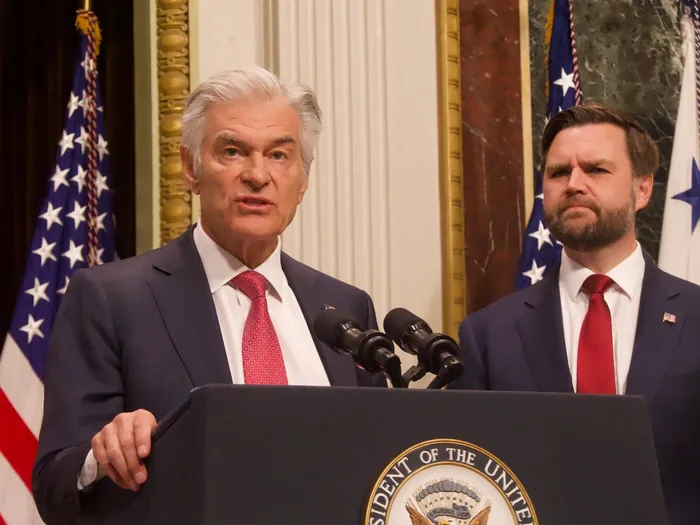
The headlines are singing a familiar tune. Mehmet Oz, now a central figure in federal healthcare oversight, has declared a 50-state war on fraud. It sounds noble. It sounds efficient. It sounds like the kind of common-sense cleanup that every taxpayer should cheer for.
It is a trap.
When politicians talk about "anti-fraud efforts," they are rarely talking about catching the sophisticated syndicates stealing millions. They are talking about building a massive, clunky surveillance apparatus that treats every local doctor and every sick patient as a potential criminal. We are about to witness the birth of a bureaucratic monster that will burn three dollars in administrative friction for every one dollar it "saves" from fraudsters.
The Myth of the Clean Sweep
The competitor narrative suggests that fraud is a leak we can simply plug with better oversight. This is a fundamental misunderstanding of how the American medical system functions. In our current model, the line between "fraud," "waste," and "complex billing" is a blurry mess of grey.
Most "fraud" identified by federal audits isn't a doctor buying a yacht with stolen Medicare funds. It is a coding error. It is a physician choosing $Current Procedural Terminology (CPT)$ code 99214 instead of 99213 because the patient had three complaints instead of two. By launching a nationwide "crackdown," the government isn't just targeting criminals; it is intimidating providers into "downcoding"—billing for less work than they actually performed—to avoid the Eye of Sauron.
The result? Providers lose revenue, they spend more on compliance officers, and they pass those costs directly to you. You aren't saving money. You are just shifting the budget from "healthcare delivery" to "legal defense."
The Surveillance Tax is Real
I have seen hospital systems spend $5 million annually on "compliance software" designed specifically to satisfy federal audit triggers. These tools don't heal people. They don't reduce wait times. They are a pure "Surveillance Tax."
When Dr. Oz pushes this initiative into all 50 states, he is mandating a nationwide upgrade to this tax. Imagine a scenario where every local clinic has to hire an extra staffer just to double-check that their notes match the ever-changing federal "anti-fraud" criteria. That staffer’s salary is paid by your premiums.
The math of government crackdowns rarely accounts for the Opportunity Cost of Friction. If a doctor spends 20% of their day clicking boxes to prove they aren't a thief, that is 20% less time spent diagnosing patients. In a country already facing a massive primary care shortage, we are literally trading lives for line-item audits.
Data Mining is Not a Silver Bullet
The current obsession with "AI-driven fraud detection" is the latest shiny object. The promise is that algorithms will sniff out anomalies and save billions. In reality, these algorithms are notoriously blunt instruments.
- False Positives: They flag legitimate, high-complexity cases because they look like "outliers."
- The Chilling Effect: Once a provider is flagged, their payments are often frozen. For a small rural practice, a 90-day payment freeze is a death sentence.
- Gaming the System: True professional fraudsters—the ones actually hurting the system—are the first to learn how to mimic "normal" data patterns.
We are building a net that is too small to catch the sharks but perfectly sized to choke the salmon.
Why We Should Embrace "Good" Waste
This is the take that makes people angry: We need a certain amount of "waste" in the system to ensure access.
If you make the rules so rigid that there is zero room for error, you create a system that is too brittle to function. Healthcare is messy. Human bodies don't follow a linear path. Sometimes a doctor needs to order a "wasteful" test because a patient’s symptoms are non-standard. If an anti-fraud algorithm punishes that doctor for deviating from the mean, the doctor stops ordering the test.
The "fraud" is eliminated, but the patient dies of an undiagnosed condition. Is that a victory?
The obsession with 100% purity in billing is a race to the bottom. We should be willing to tolerate a margin of error if it means doctors can focus on patients instead of paperwork. Instead, we are choosing to burn the house down to kill a few spiders.
The Consultant Industrial Complex
Follow the money. Who actually wins when a 50-state anti-fraud initiative is launched?
It isn't the taxpayer. It is the massive consulting firms and "integrity contractors" who get the billion-dollar government contracts to run the audits. These firms have a direct financial incentive to find "fraud" where none exists. If they don't find "recoverable funds," their contract doesn't look valuable.
They aren't auditors; they are bounty hunters.
The Better Way (That Nobody Wants to Discuss)
If we actually wanted to stop fraud, we wouldn't build a 50-state police force. We would simplify the pricing.
Fraud lives in the complexity of the $Healthcare Common Procedure Coding System (HCPCS)$. It thrives because nobody—not the doctor, not the patient, and certainly not the insurer—actually knows what anything costs until six months after the fact.
- Move to Flat-Fee Models: Direct Primary Care (DPC) models virtually eliminate billing fraud because there is no "billing." You pay a monthly fee. The incentive for the doctor is to keep you healthy, not to find a more expensive code to bill.
- Transparency over Audits: Instead of auditing after the fact, mandate real-time price publishing. Fraud hates sunlight.
- Decentralize Oversight: High-level federal crackdowns are too slow and too broad. Localized peer-review boards understand the nuances of a community's health needs far better than an algorithm in D.C.
Stop Cheering for Your Own Obstruction
Every time a politician promises to "crack down on waste," they are handing you a heavier bag to carry. You will see longer wait times. You will see more "prior authorization" headaches. You will see more doctors retiring early because they are tired of being treated like suspects.
Dr. Oz’s plan isn't a cure for a broken system. It is a steroid shot for the bureaucracy that broke it in the first place.
If you want a healthcare system that works, stop asking for more cops and start asking for fewer rules. The most "fraud-proof" system is the one that is too simple to cheat. We are heading in the exact opposite direction.
Get ready to pay more for the privilege of being watched.