Donald Trump does not view the world through the lens of Westphalian sovereignty or historical grievance. He views it as a series of balance sheets and personal slights. When the 47th President of the United States begins musing about a United Ireland, he isn't suddenly channeling the spirit of Wolfe Tone or 1916. He is executing a calculated squeeze on three fronts: a trade war with the European Union, a personal vendetta against the British establishment, and a protectionist drive to repatriate the American pharmaceutical industry.
By injecting the volatility of Irish reunification into the transatlantic dialogue, Trump has turned a century-old diplomatic stalemate into a high-stakes bargaining chip. For the Irish government, this is a terrifying "gift." For the British, it is a strategic nightmare. For Trump, it is simply business as usual. You might also find this similar article interesting: The $2 Billion Pause and the High Stakes of Silence.
The Pharmaceutical Hostage Situation
The primary driver behind Trump’s sudden interest in Irish borders is not geography, but chemistry. Ireland has spent decades positioning itself as the global hub for Big Pharma, a strategy that has yielded a massive trade surplus with the United States. In 2024 alone, the U.S. imported over $100 billion in Irish goods—mostly high-value pharmaceuticals—while exporting less than a fifth of that in return.
Trump has publicly labeled this a "theft" of American industry. During his 2025 and 2026 meetings with Taoiseach Micheál Martin, Trump repeatedly lamented that "stupid leaders" allowed Pfizer, Merck, and Eli Lilly to "flee" to the low-tax emerald shores of Ireland. By dangling support for a United Ireland, Trump is signaling to Dublin that the price of American "friendship"—and the avoidance of 25% across-the-board tariffs—is a radical restructuring of their tax regime. As highlighted in recent articles by USA Today, the results are significant.
The subtext is clear: if Ireland wants the U.S. to support its territorial ambitions, it must stop "poaching" American jobs. It is a transactional brand of diplomacy that views the border in Ulster and the tax rate in Dublin as interchangeable variables in a single equation.
Slighting the Starmer Administration
While the pharmaceutical trade provides the "why," the British government provides the "who." Trump’s relationship with UK Prime Minister Keir Starmer has been frosty at best. Since taking office, Starmer has attempted to "reset" the British-Irish relationship, moving away from the bellicose rhetoric of the Brexit years. Trump, however, views Starmer as an over-reliant bureaucrat and has taken every opportunity to undermine him.
During the March 2026 St. Patrick’s Day engagements, Trump went off-script to criticize the UK’s reluctance to support U.S.-Israeli military actions in the Middle East. By flirting with the idea of Irish unification, Trump is poking at the most sensitive nerve in the British body politic. It is a classic "maximum pressure" tactic. He knows that the mere mention of a border poll by a U.S. President sends shockwaves through Westminster, potentially destabilizing a Labour government that is trying to maintain a delicate balance between Unionist and Nationalist interests in Belfast.
The McGregor Factor and the New Populism
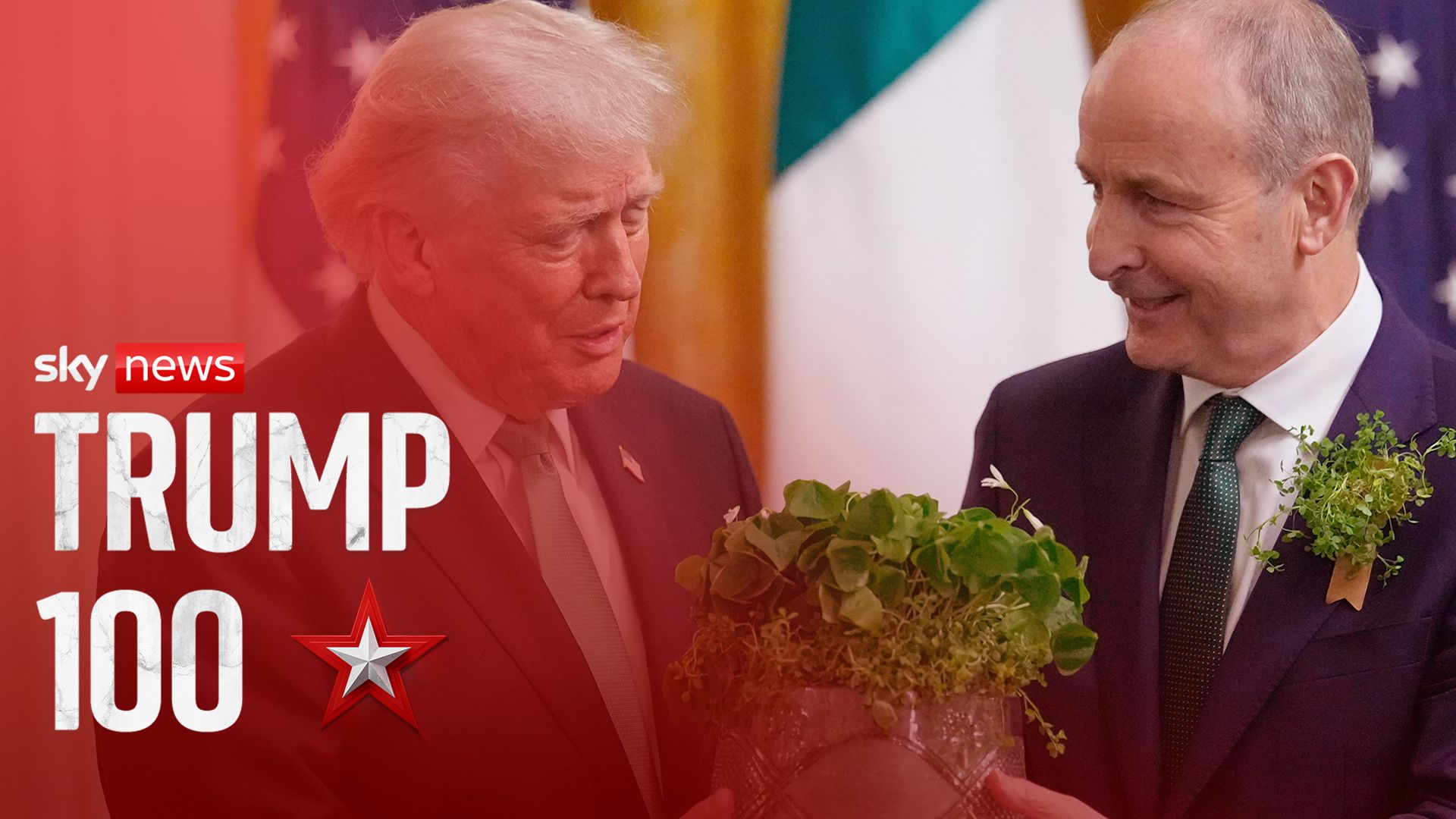
Perhaps the most disruptive element of Trump's Irish strategy is his cultivation of "alternative" Irish leaders. The invitation of MMA fighter Conor McGregor to the White House in March 2025 was a deliberate slap in the face to the Irish diplomatic corps. While the Taoiseach was presenting a traditional bowl of shamrock, McGregor was in the press room echoing Trump’s anti-immigrant and anti-establishment rhetoric.
This alliance serves a dual purpose. First, it allows Trump to appeal to the 40 million Irish-Americans who make up a crucial part of his base. Second, it creates a "MAGA-lite" movement within Ireland itself, putting pressure on the Dublin government from the right. By aligning with figures like McGregor, Trump is suggesting that the "real" Ireland is not the one represented by EU-aligned bureaucrats, but by a populist, nationalist sentiment that shares his "Ireland First" (or America First) worldview.
The Doonbeg Grudge
We cannot ignore the personal. Trump’s ownership of the Doonbeg Golf Links in County Clare has provided him with a decade’s worth of grievances against Irish and EU environmental regulations. His long-standing battle to build a sea wall to protect his resort was thwarted by what he perceived as "ragtag" activists and "European rules."
In Trump’s mind, the European Union is a "foe" designed to take advantage of the United States. His support for a United Ireland—which would technically see Northern Ireland leave the UK to join an EU member state—seems contradictory until you realize his goal is not to strengthen the EU, but to disrupt the status quo of his perceived enemies in London and Brussels.
The Reality of a Border Poll
Despite the rhetoric, the path to a United Ireland remains governed by the Good Friday Agreement, which requires a "border poll" to be called by the Secretary of State for Northern Ireland if it appears a majority would vote for unification. Trump’s "support" cannot bypass this legal framework. However, the American President’s voice carries immense weight in the North, where the U.S. has historically acted as a guarantor of peace.
If Trump begins to actively fund or diplomatically endorse the "Yes" side of a unification campaign, he could tilt the scales of public opinion, or at least create enough chaos to force concessions on trade and defense spending.
Overlooked Factors in the Unification Debate
- Defense Spending: Trump has noted that Ireland is a "neutral" country that benefits from the NATO security umbrella without paying into it. A United Ireland would force a massive conversation about the security of the North Atlantic, a conversation Trump wants to lead.
- The 250th Anniversary: As the U.S. approaches its semiquincentennial in July 2026, Trump is looking for "legacy" wins. Re-ordering the map of Europe is exactly the kind of "big deal" he craves.
- Sinn Féin’s Calculus: The rise of Sinn Féin in both the North and the Republic creates a natural partner for a President looking to upend the old guard. While their ideologies differ on almost everything else, their shared desire to dismantle the current constitutional arrangement makes them "strange bedfellows" in the Trumpian era.
The danger for Ireland is that it becomes a pawn in a game it doesn't control. While the dream of a United Ireland is a powerful emotional and political force in Dublin, having that dream championed by a transactional President means it comes with a price tag.
If Trump succeeds in repatriating the pharmaceutical industry, Ireland’s economy—which is currently running a surplus—could crater. The "housing crisis" Trump dismissed as a "good problem" would become an existential one as tax revenues dry up. The Irish government must now decide if the prospect of unification is worth the risk of an all-out trade war with their most important ally.
The "Irish Question" is no longer just about green and orange; it is about the "art of the deal."
Would you like me to analyze how the current civil case against Gerry Adams in London is impacting Sinn Féin's leverage with the Trump administration?
.png?1683568805)