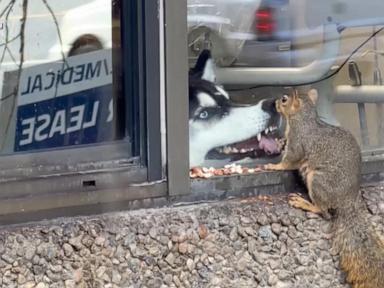
The internet lost its collective mind over a ten-second clip of a domestic canine staring intently through a glass door at a bushy-tailed rodent eating a crust of bread. The viral caption screamed about pure joy, shared amusement, and interspecies bonding. Millions watched. Millions projected their own sentimental longing onto a pair of uncomprehending mammalian nervous systems.
It is time to stop treating pets like furry toddlers in Halloween costumes. Also making news lately: The Woods We Thought We Lost Are Quietly Growing Back.
That dog was not meditating on the beauty of nature. It was experiencing a hardwired predatory fixation loop mediated by dopamine spikes, completely devoid of the complex existential appreciation you desperately wish was there. When we romanticize basic evolutionary machinery, we miss the actual reality of how animals experience existence. We do them a disservice by masking biology in cheap sentimentality.
The Lazy Consensus of Interspecies Empathy
Pop-psychology animal content relies on a predictable formula. Take a mundane predatory instinct, wrap it in a cozy acoustic soundtrack, and title it something syrupy about friendship. The narrative goes that pets possess a sophisticated moral compass and an aesthetic appreciation for the world around them. Additional insights regarding the matter are explored by Glamour.
This is comforting fiction.
Look closer at the physical mechanics of the viral clip. The animal exhibits classic predatory motor patterns: jaw tension, lowered center of gravity, involuntary tail twitching, and fixed pupillary dilation. This is not amusement. This is the nervous system gearing up for an explosive pursuit sequence that is physically blocked by a sheet of tempered glass.
Behavioral biologists have documented this loop for decades. When a prey stimulus enters a canine visual field, the mesolimbic pathway floods with dopamine before any conscious choice occurs. The animal is trapped in a neurochemical bottleneck. Interpreting this high-stress arousal state as heartwarming entertainment is like watching someone stare at a vending machine with zero money and calling it peaceful contemplation.
Unpacking the Cost of Cute Narratives
Attributing human emotional depth to canine stimulus response creates tangible harm in how we train, house, and manage domestic animals.
When owners believe their dogs view the neighborhood wildlife as little buddies, they misinterpret warning signs. They ignore subtle stress signals because the animal looks so delightfully engaged. They anthropomorphize resource guarding, barrier frustration, and predatory drift into cute personality quirks.
I have watched owners fail basic behavioral management because they preferred the warm hallucination of emotional reciprocity over the cold mechanics of ethology. A dog staring at a squirrel is calculating velocity, wind resistance, and escape vectors through millions of years of selective breeding for predation. It wants to catch it, kill it, and consume it. Pretending otherwise makes you feel poetic, but it makes the animal misunderstood.
The Neuroscience of the Stare
Let us define the terms accurately without the poetic padding.
Canine vision is optimized for motion detection. Their high density of rod photoreceptors means they spot a twitching tail across a yard long before you notice movement. When that squirrel picks up a nut, the kinetic trigger locks the dog's attention in place.
The prefrontal cortex does not drive this interaction. The subcortical structures take the wheel. The autonomic nervous system accelerates heart rate and primes musculoskeletal tissue for sprinting. If you measured the cortisol and adrenaline levels in that animal during the viral moment, you would not find serene joy. You would find an organism locked in acute predatory arousal with nowhere to put the kinetic energy.
To call this enjoyment is to misunderstand the very definition of play and predation. Real play involves relaxed facial expressions, loose musculature, and role-reversal behaviors like play-bowing. A rigid spine and a locked jaw signal the exact opposite.
The Uncomfortable Truth About Domestic Projection
We project our own isolation onto our pets because reality is lonelier. We want nature to be a harmonious Disney montage where the predator and the prey share a quiet moment of mutual recognition across a backyard boundary.
The squirrel does not know the dog is there as an individual entity; it evaluates a mobile silhouette for predation risk while scavenging calories. The dog does not see a sentient peer enjoying a snack; it sees a moving bundle of high-value protein wrapped in fur.
Strip away the projection, and you are left with raw ecology operating right outside your sliding glass door.
Stop anthropomorphizing the nervous system. Stop writing poetry for predators. Respect the biology, understand the drive, and let the animals be what they actually are instead of what you need them to reflect.