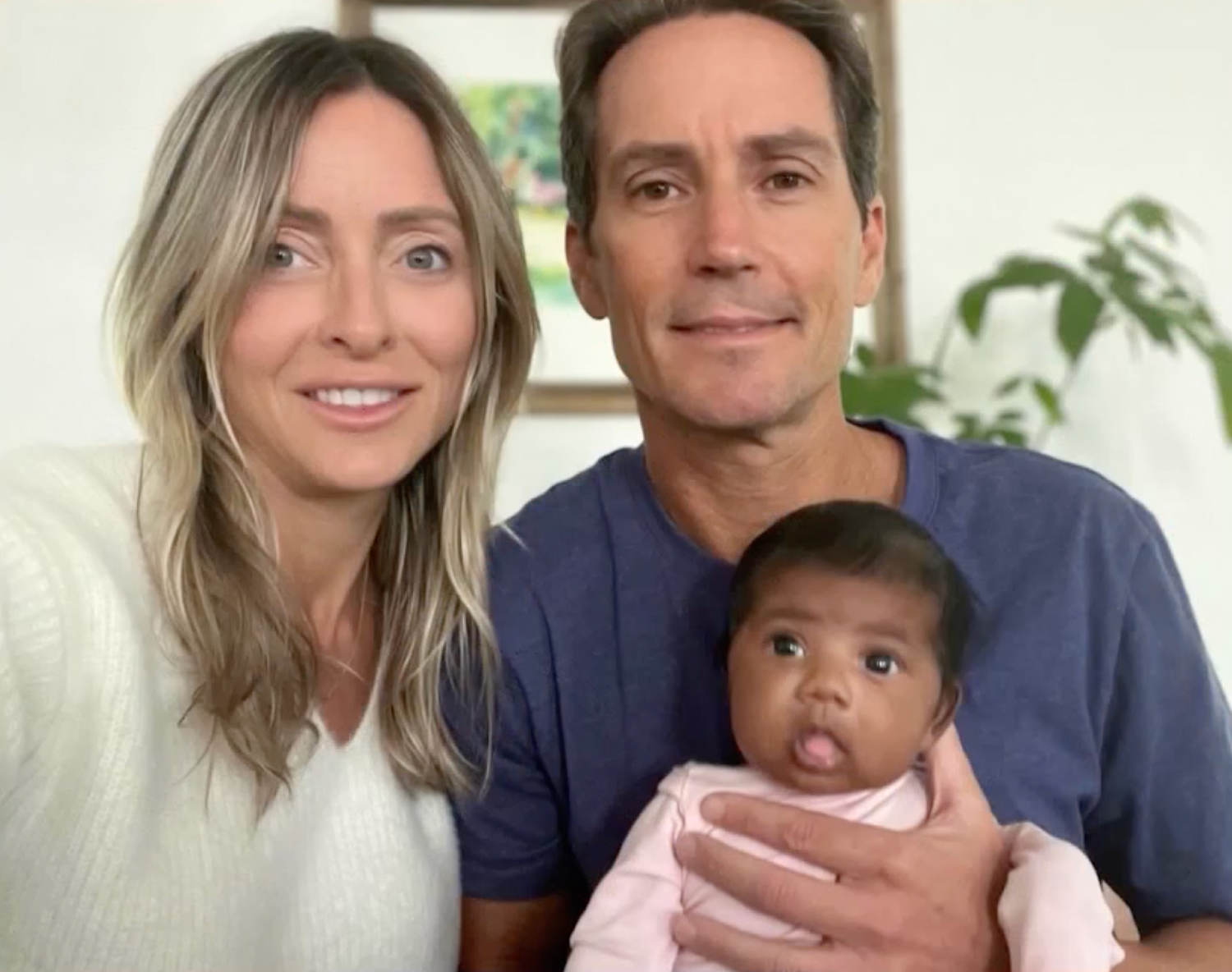
The call came not with a bang, but with a clinical, terrifying silence. For a Florida couple whose names became synonymous with a modern medical nightmare, the world did not end with a crash. It ended with a DNA test result that turned their family tree into a collection of question marks. They had spent years dreaming of a child. They had undergone the grueling, expensive, and deeply personal process of In Vitro Fertilization. They had done everything right.
Then the science broke.
They looked at their baby, a child they had carried, birthed, and loved for months, and realized that while the heartbeat was familiar, the genetic code was a stranger’s. An embryo mix-up at a fertility clinic had swapped their future for someone else’s. For a long time, the most haunting part of this ordeal wasn't just the error itself—it was the mystery. Somewhere out there, the biological parents of their child were living a parallel life, completely unaware that their genetic legacy was being raised by strangers in the Florida sun.
Now, that mystery has a face. The biological parents have been identified. But as the legal and emotional dust begins to settle, we are forced to look into the sterile, high-tech mirrors of the fertility industry and ask: who does a child belong to when the biology and the bonding are torn apart by a lab technician's oversight?
The Fragile Architecture of Hope
To understand the weight of this identification, you have to understand the physical and emotional cost of IVF. It is a world of refrigerated vials, timed injections, and the kind of hope that feels like a glass sculpture in a windstorm. You trade your privacy and your bank account for a chance at a miracle.
Imagine a woman—let’s call her Elena, a stand-in for the countless mothers navigating this path. Elena spends months charting her cycle with the precision of an architect. She endures the bruising of her abdomen from hormone shots. She walks into a clinic where the air is filtered and the light is soft, trusting that the tiny specks of life in the petri dishes are guarded with more security than a bank vault.
When the transfer happens, it is a holy moment. The embryo is tucked away, a tiny seed of potential. When the pregnancy test finally shows two pink lines, the relief is a physical weight lifting off the chest. The child grows. The kick against the ribs is real. The labor is real. The first cry in the delivery room is the most beautiful sound in the world.
Then, the data arrives. A routine genetic test, perhaps out of curiosity or a minor medical concern, reveals the impossible. The child is not yours. Not biologically.
The Florida couple lived this. They held a child that was biologically related to two people they had never met. The identification of those biological parents isn't just a news update; it is the collision of two families who were tethered together by a mistake in a laboratory. It is the moment the "ghosts" in their family story became flesh and blood people with their own lives, their own grief, and their own claims to a miracle.
The Identification of the Invisible
The process of finding the biological parents in an embryo swap is a detective story where the clues are written in ACGT—the building blocks of DNA. In the Florida case, the identification came through a mix of legal discovery and the relentless march of genetic genealogy.
The search is fraught with a specific kind of terror. What if the biological parents want the child back? What if they don't? What if they are already raising the Florida couple's biological child? This isn't just a legal puzzle; it is a profound existential crisis. It challenges the very definition of parenthood.
We have long operated on the assumption that "blood is thicker than water." Our laws, our inheritance structures, and our cultural myths are built on the foundation of genetic lineage. But the Florida couple’s experience suggests something different. They are the ones who woke up at 3:00 AM to soothe a crying infant. They are the ones who felt the first tooth break through the gums. They are the ones who memorized the smell of the child's hair.
The biological parents, now identified, are suddenly thrust into a story they didn't know they were writing. They are the "donors" by accident, the creators of a life they never held. The legal system struggles with this. Is the "owner" of the embryo the parent? Or is the person who gave birth and provided the soul-level care the parent?
The identification doesn't provide an answer. It only makes the question louder.
The Industry of Human Error
Behind every human story in the fertility world is a massive, multi-billion-dollar industry. We like to think of these clinics as sanctuaries of science, but they are also businesses. They are high-volume environments where human beings handle microscopic materials.
Statistics on embryo mix-ups are notoriously hard to pin down because many are settled quietly out of court with strict non-disclosure agreements. However, when these cases do break into the public consciousness, they reveal a terrifying lack of federal oversight in the United States. The "Wild West" of fertility medicine means that protocols for labeling, storing, and transferring embryos can vary wildly from one clinic to the next.
Consider the logistics. A single embryologist might be responsible for hundreds of samples. In a busy lab, the pressure to maintain "throughput" can lead to the unthinkable. A mislabeled tube. A misplaced dish. A momentary lapse in concentration that alters the course of multiple lives for generations.
The Florida couple’s case is a flashing red light on the dashboard of modern medicine. It tells us that our technological reach has exceeded our moral and regulatory grasp. We can create life in a dish, but we haven't yet figured out how to protect the sanctity of that life from the mundane reality of human error.
The Living Room vs. The Laboratory
If you sit in the living room of a family facing this, the legal jargon fades away. The talk of "chain of custody" and "genetic material" feels cold and distant. In the living room, there is only a toddler playing with blocks on the rug.
That child is the center of the storm. To that child, there is no "mix-up." There is only Mommy and Daddy—the people who are there when a knee is scraped or a nightmare wakes them up. The child doesn't know about the vials or the lawyers. The child only knows love.
This is where the tragedy of the identification truly lies. The more we focus on the "rightful" biological owners, the more we risk losing sight of the child’s stability. The Florida couple has been vocal about the trauma of this process, not because they hate the biological parents, but because they are terrified of the disruption to the only life their child has ever known.
The biological parents, too, are victims. They have been robbed of the chance to raise their own child. They have been made parents in absentia, a role no one asks for. The identification brings a sense of truth, but truth is not always a healer. Sometimes, truth is just a sharper edge to the pain.
The New Definition of Kinship
We are entering an era where technology is forcing us to rewrite the dictionary of the heart. The Florida embryo mix-up is an extreme case, but it reflects a growing reality in a world of egg donors, surrogacy, and advanced genetic editing.
What makes a father? Is it the DNA, or is it the years of presence?
What makes a mother? Is it the egg, the womb, or the work?
The identification of the biological parents in this Florida saga marks the end of a mystery, but the beginning of an unprecedented social experiment. These two families are now linked in a way that no two families have ever been before. They are mirrors of each other’s loss and gain.
There is no roadmap for this. There are no Hallmark cards for "I’m sorry the lab gave your baby to me." There are only long conversations in wood-paneled offices and the heavy realization that some mistakes can never be fully corrected. You can identify a parent, but you cannot rewind time. You cannot un-love a child you thought was yours.
The story ends not with a resolution, but with a lingering image of a nursery. In that room, the light is dim. A parent leans over a crib, watching the rhythmic rise and fall of a small chest. The DNA inside that child belongs to people miles away, strangers who have just been given names and faces. But the hand resting on the child's back is the one that has been there since the beginning.
In the battle between the laboratory and the living room, the living room usually wins—but the scars left by the lab will never truly fade.
The science gave them a child, but it took away their peace. Now, with the biological parents identified, the Florida couple must find a way to live in a world where "family" is no longer a simple word, but a complex, fragile, and unintended map of human connection.