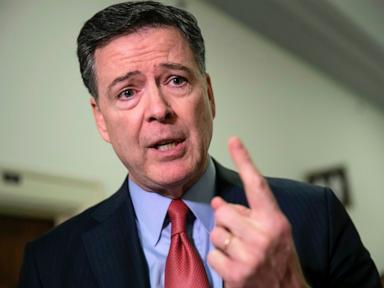
Federal prosecutors hunting for a criminal interpretation of a seashell photograph turned to a retired Mafia underboss, recruiting Salvatore "Sammy the Bull" Gravano to help construct a case against former FBI Director James Comey. Newly unsealed court filings reveal that the Department of Justice and federal investigators consulted the infamous mob turncoat to establish whether the numerical shorthand "8647" constituted a violent threat against the president.
The bizarre evidentiary trail illuminates the lengths to which federal authorities went following Comey's May 2025 social media post featuring seashells arranged on a beach. Comey's defense team uncovered the consultation with Gravano while picking apart the warrants used to access digital records, exposing an investigation that relied on unconventional linguistic consultations—ranging from chatbot inquiries to convicted felons—to justify criminal charges.
The Anatomy of a Shell Game
The underlying controversy began when Comey shared an image of shells spelling out "86 47," a numerical play directed at the 47th president. The post detonated across political channels, triggering immediate blowback and swift deletion by Comey, who insisted the phrase meant to discard or get rid of something rather than cause physical harm.
Instead of treating the post as protected political speech or low-level public posturing, the machinery of the state ground into motion. Secret Service agents conducted warrantless electronic tracking of Comey's cellphone as he and his wife drove north from North Carolina toward Virginia. Internal communications show that agents debated the legality of pinging his device without declaring an emergency exemption for an imminent threat to life or limb. They proceeded anyway, under pressure from superiors while Air Force One tracked the political fallout in real time.
To convert a social media snapshot into a felony indictment, prosecutors needed to prove intent. They needed a linguistic bridge connecting a common slang term to underworld execution styles.
Enter the Underboss
Investigators pinned their semantic hopes on the testimony of Sammy Gravano. Best known for orchestrating nineteen murders before turning state's evidence against John Gotti, Gravano was interviewed by federal agents to determine if a former prosecutor like Comey would inherently associate "86" with homicide.
According to defense filings, Gravano offered a nuanced take that ultimately undercut the government's core theory. While the former mobster suggested that law enforcement might link the phrase to extreme violence, he noted that actual gangsters rarely used the term "86" for murder because it was far too obvious. Furthermore, Gravano could not recall ever discussing the term with Comey during the decades-old organized crime prosecutions that defined Comey's early career.
The reliance on a legendary mafia figure highlights a desperate scramble for expert validation. Driven by a desire to prove that "86" functioned as a death threat, investigators bypassed standard lexical sources and consulted criminal databases, automated chat interfaces, and dictionary searches, before landing on a career criminal turned podcast personality.
The Defense Strikes Back
Comey's legal team weaponized the bizarre nature of the government's investigation in motions to dismiss the indictment. By exposing the thin reed of evidence underpinning the original search warrants, the defense argued that federal agents misled magistrate judges by omitting contradictory information.
To counter Gravano's assertions, the defense secured an affidavit from former federal prosecutor and federal judge John Gleeson. Gleeson, who spent decades dismantling organized crime families in New York, stated flatly that he had never encountered "86" used as mafia jargon for murder across thousands of hours of debriefing mobsters.
"The claim that '86' is mafia jargon for 'kill' is preposterous," Gleeson wrote in the court record.
The inclusion of contradictory expert opinions from respected jurists alongside interviews with cooperating felons reveals the deep fractures within the prosecution's foundation.
Procedural Overreach
The unsealed records do more than question the definition of local diner slang; they expose the mechanics of politically sensitive prosecutions. When executive pressure intersects with criminal investigation, normal institutional safeguards fray. Agents tracking a citizen without a warrant across state lines, combined with frantic database searches for slang definitions, point to a process searching backward for a crime to match an offense.
The indictment itself stands as a test case for the boundaries of political speech in a hyper-polarized environment. Yet the method of its assembly—bolstered by mob informants and disputed etymology—serves as a case study in investigative distortion.
The trial will ultimately test whether a federal court will tolerate an indictment built on seashell photographs and underworld consultations, or if the intervention of Sammy the Bull will be remembered as the moment the prosecution collapsed under the weight of its own absurdity.
Watch coverage of the federal case involving James Comey and the DOJ investigation
This segment provides additional context regarding the legal strategy and the public reaction to the Justice Department's reliance on unorthodox witness testimony.
http://googleusercontent.com/youtube_content/1