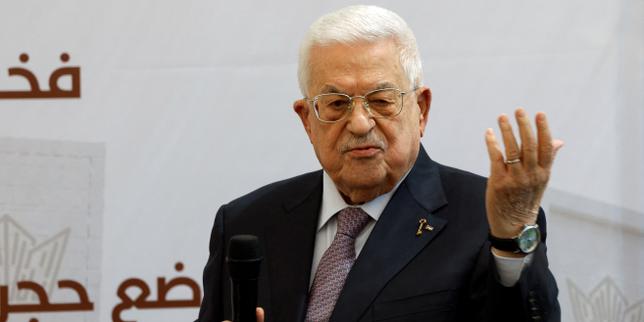
The headlines write themselves with predictable outrage. Washington blocks Mahmoud Abbas from flying to New York for the United Nations General Assembly, and the international commentariat erupts into chorus lines of condemnation. Another violation of host-country agreements. Another arrogant display of American unilateralism. Another symbolic humiliation of Palestinian leadership.
Everyone is screaming about the wrong thing.
Stop viewing this bureaucratic visa denial through the sentimental lens of diplomatic protocol. Strip away the institutional pearl-clutching and look at the brutal, unvarnished mechanics of modern statecraft. When the United States bars an octogenarian president from entering Manhattan, it is not suppressing Palestinian representation. It is inadvertently performing the single greatest act of political deconstruction on the current Ramallah establishment that anyone could ask for.
Abbas does not need another podium in New York. He needs an exit strategy. And Washington, in its clumsy, self-interested way, just handed him one.
The Comfort of Impotent Rituals
For decades, the United Nations General Assembly has served as a global palliative care ward for the Palestinian national movement. September rolls around, delegations pack their bags, speeches are delivered to half-empty halls, resolutions condemning various status-quo violations pass by overwhelming margins, and absolutely nothing changes on the ground in the West Bank or Gaza.
It is theater. Expensive, high-definition, politically bankrupt theater.
Every year, leaders like Abbas return from Turtle Bay brandishing moral victories while presiding over institutional decay, cancelled elections, and shrinking civic space at home. The UN rostrum has become a psychological substitute for sovereignty. It allows an aging leadership class to project an illusion of international relevance while their actual leverage dwindles to zero.
Imagine a corporation whose stock has plummeted by ninety percent, whose factories are idle, and whose board responds by chartering a private jet to fly to an annual gala in Cannes to deliver a strongly worded speech about marketing strategy. You would fire the board. Yet in international relations, we weep when the private jet gets grounded.
When the State Department plays gatekeeper and slams the door on Abbas, it strips away the velvet curtain. It forces a stark, unavoidable confrontation with reality: the Oslo framework is dead, international bodies are structurally incapable of enforcing their own resolutions without great power backing, and traveling to New York to beg a superpower for permission to speak to an audience that cannot help you is the definition of political irrelevance.
Dismantling the Myth of Diplomatic Leverage
Let us look at the legalistic defense usually mounted by defenders of the status quo. Under the 1947 UN Headquarters Agreement, the United States has an obligation to permit foreign officials transit to UN headquarters. Washington’s refusal is a violation of international norms.
Fine. Grant the premise. It is a violation. Governments break treaties and agreements all the time when domestic politics or hard security interests dictate it. But clinging to the legalism misses the strategic forest for the bureaucratic trees.
What real-world currency does an Abbas speech at the UN buy in 2026? Does it stop settlement expansion in Area C? Does it alter the fiscal strangulation imposed by the Israeli finance ministry? Does it unify a fractured national movement that hasn't held a presidential election since 2005?
None of the above.
In fact, the reliance on international forums has created a moral hazard for Palestinian leadership. It externalizes responsibility. As long as Ramallah can blame Washington for blocking visas or Israel for withholding tax revenues, it never has to answer for its own governance failures. It never has to answer why security coordination continues while political horizons vanish. It never has to confront the generational crisis of a population that views its leadership with a mixture of apathy and contempt.
When you remove the UN stage, you remove the props. You force the actors to look at the empty room.
The Succession Vacuum Nobody Wants to Talk About
To understand why this visa denial matters—and why the mainstream analysis is so catastrophically backwards—you have to look at the internal dynamics of Palestinian politics.
Abbas has been in office since 2005 on a four-year term. He governs by presidential decree. There is no designated successor, no functioning parliament, and a deep, festering legitimacy deficit. The entire system is built around a gerontocracy that treats state-building like an administrative NGO project funded by international donors who are terrified of total collapse.
International actors, particularly in Washington and European capitals, are paralyzed by the succession question. They fear a chaotic power struggle in Ramallah more than they fear stagnation. Consequently, they prop up the existing structure, engaging in endless cycles of management rather than resolution.
By denying Abbas a visa, US officialdom inadvertently punctures its own illusion of control. It demonstrates that the relationship is entirely conditional on American domestic political whims, not institutional respect or international law. More importantly, it highlights to the Palestinian public just how hollow their current institutional architecture is. If your entire strategy relies on a ninety-year-old man getting a stamp in his passport to plead your case to a body that has passed thousands of non-binding resolutions while your land is carved up block by block, your strategy is already bankrupt.
This is not a defense of American heavy-handedness. It is an indictment of a Palestinian national strategy that outsourced its leverage to a diplomatic waiting room.
The Uncomfortable Truth About International Solidarity
There is a deeper, more uncomfortable conversation that nobody in the diplomatic corps wants to have: international solidarity without domestic teeth is a narcotic.
Decades of diplomatic networking, Geneva communiqués, and UN committee meetings have produced a global consensus that is mile-wide and inch-deep. Everyone agrees on the two-state solution in theory, while every single actor on the ground works to render it physically impossible in practice.
When Abbas is denied entry, commentators wring their hands over the "silencing" of the Palestinian voice. But whose voice is actually being silenced? Not the generation of young Palestinians organizing locally, building digital networks, bypassing traditional party structures, and rejecting the exhausted compromises of the Oslo generation. Their voices were already muted by the very leadership currently sitting in Ramallah.
The old guard treats the Palestinian cause as a diplomatic file to be managed through UN channels. A new generation understands it as a struggle for basic rights, dignity, and structural transformation that cannot be negotiated away in a backroom in Geneva or appealed to a Security Council paralyzed by vetoes.
What Real Strategy Looks Like
If you want to change the equation, stop treating visa denials as tragedies and start treating them as diagnostic tools.
A serious national liberation or state-building project does not hinge on whether a foreign government lets its aging president land at JFK airport. It builds internal resilience. It forces accountability. It organizes locally, rebuilds fractured coalitions, and develops alternative sources of power that do not depend on the benevolence of Western ministries of foreign affairs.
When Washington locks the door, it does something accidental and profound. It signals the definitive end of an era. The illusion that international institutions will ride to the rescue if you just give one more eloquent speech is dead.
The sooner the Palestinian political class internalizes that reality—the sooner they stop mourning missed flights to New York and start building power where it actually counts—the better off they will be.
Stop crying over a canceled plane ticket. Start asking why anyone was still buying a ticket on a flight to nowhere.