Two hundred meters beneath the surface of the Indian Ocean, the world shrinks to the size of a heartbeat.
There is no sunlight here. The crushing weight of the sea presses against a steel hull with thousands of pounds of pressure per square inch. Inside, eighty sailors live in a pressurized tube, breathing recycled oxygen, sharing narrow bunks, and moving with deliberate, whispered precision. They call it the Silent Service. It is an existence defined by calculated isolation. For a closer look into this area, we suggest: this related article.
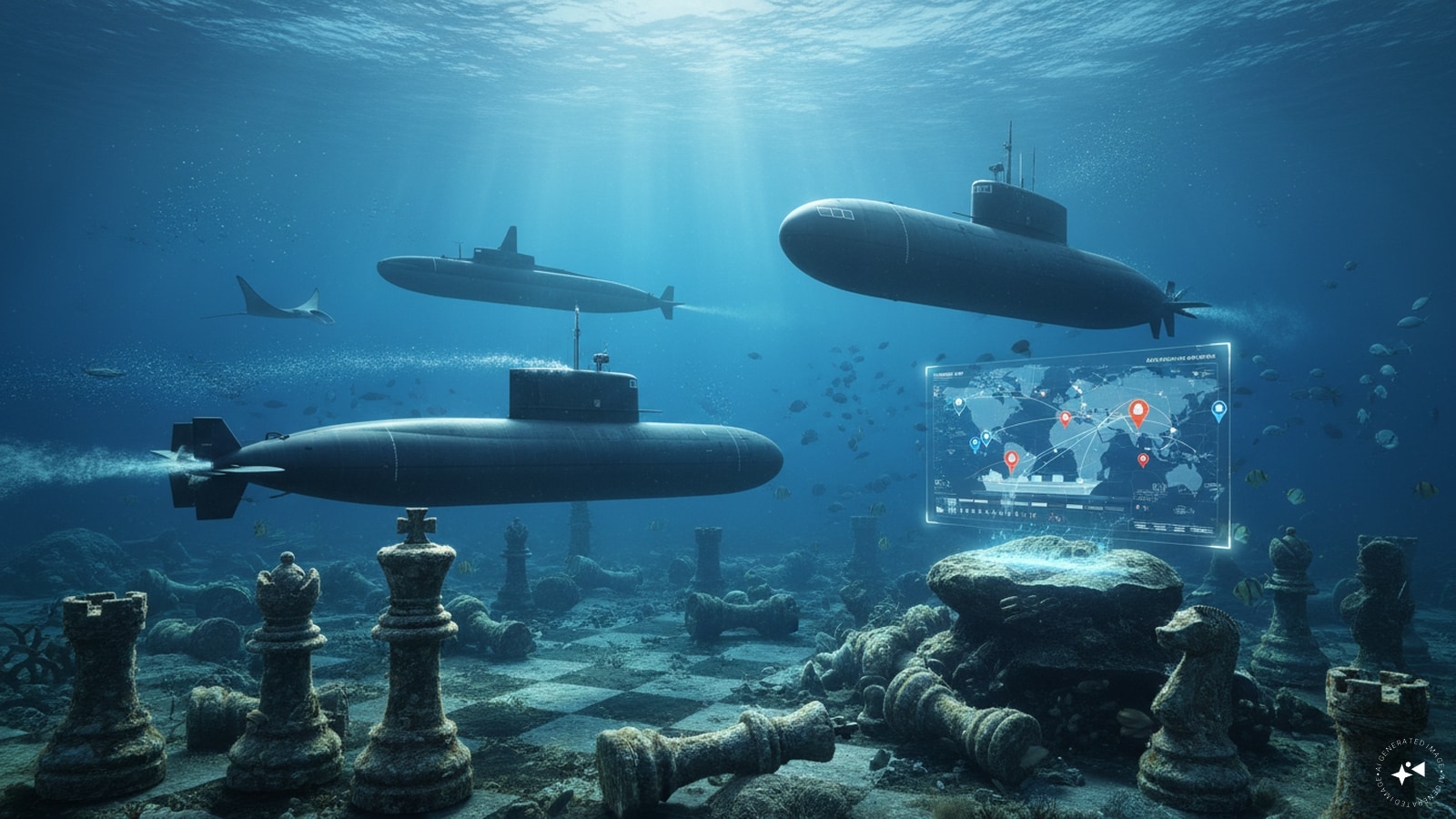
For these sailors, the geopolitical tensions of the Asian subcontinent are not abstract headlines read over morning tea. They are the immediate reality of sonar pings, thermal layers, and the constant, invisible chess match played out in the dark.
India shares thousands of kilometers of volatile land borders with nuclear-armed neighbors. Yet, the nation's ultimate strategic vulnerability—and its most formidable hidden strength—lies not in the snowy peaks of the Himalayas, but in the vast, blue expanse of the ocean. The Indian Ocean is the highway of global commerce. It is also becoming the primary arena for a quiet struggle for dominance. For further background on the matter, in-depth analysis can also be found on TIME.
In this theater of shadows, the surface fleet is a visible deterrent. A massive aircraft carrier sends a loud, unmistakable message. But loud messages can be tracked, targeted, and countered. The real advantage belongs to the unseen.
The Geography of Vulnerability
To understand why the depths matter, look at a map from the perspective of a maritime strategist.
The Indian Ocean Region acts as a massive funnel for global trade. Nearly eighty percent of the world’s seaborne oil trade passes through critical chokepoints like the Strait of Malacca in the east and the Strait of Hormuz in the west. If these veins are constricted, the global economy suffers a stroke. For India, this ocean is not just a backyard; it is a lifeline. More than ninety percent of the country’s trade by volume moves by sea.
Consider a hypothetical scenario involving a merchant vessel named the Meghna. She is a commercial tanker carrying crude oil toward the port of Mumbai. In a time of heightened regional conflict, a surface warship patrolling near the Malacca Strait is highly visible. Satellites track its coordinates in real time. Long-range anti-ship ballistic missiles can be locked onto its position from thousands of miles away. The Meghna is vulnerable because her protectors are exposed.
Now, change the variable.
Beneath the waves, an Indian attack submarine sits completely motionless, suspended in a thermal layer of water that bends and distorts sonar waves. The submarine is invisible to satellites. It emits no sound. To an adversary looking to disrupt the shipping lanes, the mere suspicion that this vessel exists somewhere in the millions of square miles of ocean changes the entire calculus of aggression.
This is the power of asymmetric warfare. You do not need to match an adversary ship-for-ship on the surface if you can hold their entire fleet at risk from below.
The Chemistry of Confinement
Living aboard a submarine requires a fundamental recalibration of human psychology.
Space is the most valuable commodity. Every square centimeter is utilized. A sailor walking down the narrow gangway must learn the "submariner slouch"—a slight tilt of the shoulders to avoid hitting valves, pipes, and electrical conduits. Fresh water is strictly rationed. The air carries a permanent, distinct scent compounded of diesel fuel, cooking oil, amine canisters used to scrub carbon dioxide, and human sweat.
The human body adapts to this artificial environment in strange ways. Without natural sunlight, the circadian rhythm fractures. Sailors work in rigid shifts, their days measured not by the rising and setting of the sun, but by the changing of the watch.
The psychological burden is immense. A crew member might receive a highly compressed, one-way text message from home once every few weeks, heavily vetted to ensure it contains no distressing news that could distract them from their duties. If a crisis occurs on land, the sailor in the deep remains in the dark. They must trust that the world they left behind is still spinning.
Why do they endure it? Because the machine they inhabit is the ultimate instrument of national resilience.
The Nuclear Shield
The concept of deterrence relies entirely on credibility. If an adversary believes they can wipe out your ability to retaliate in a single, coordinated strike, the deterrent fails. This is why the most critical leg of India’s strategic defense is its fleet of nuclear-powered ballistic missile submarines, the SSBNs.
Land-based missile silos have fixed coordinates. Airfields can be targeted. But a nuclear-powered submarine, capable of staying submerged for months at a time because it does not need to refuel, is a moving, un-trackable second-strike capability.
The distinction between conventional diesel-electric submarines and nuclear-powered ones is vast. A diesel-electric vessel is incredibly quiet, making it an exceptional defensive weapon for coastal waters. However, it must periodically surface or raise a snorkel to run its diesel engines and recharge its batteries. During this window, it becomes vulnerable to detection by maritime patrol aircraft.
A nuclear submarine suffers no such limitations. Its endurance is limited only by the amount of food it can carry and the psychological limits of the crew. It can run fast and deep, thousands of miles from home ports, remaining on station indefinitely.
For a country committed to a policy of no-first-use regarding strategic weapons, this hidden retaliatory capability is the ultimate insurance policy. It ensures that any attempt to destabilize the nation from the outside carries an unacceptable, unpredictable cost.
The Silent Encirclement
The strategic landscape of the Indian Ocean is shifting rapidly.
For decades, the waters surrounding the Indian peninsula were relatively uncrowded. That is no longer the case. A rival superpower has been steadily expanding its maritime footprint, establishing dual-use ports and naval bases along the rim of the ocean—a strategy often described as a string of pearls. Chinese research vessels, data-gathering buoys, and conventional submarines are increasingly detected operating in the Bay of Bengal and the Arabian Sea.
This is not a blunt invasion; it is a slow, methodical encirclement.
Surface warships attempting to counter this presence are easily monitored. When an Indian destroyer leaves the naval base at Karwar or Visakhapatnam, its departure is noted. Its trajectory is calculated.
But when a submarine slips beneath the waves just outside the harbor, it vanishes into an information void.
The adversary is forced to spend enormous resources on anti-submarine warfare. They must deploy maritime patrol aircraft, drop expensive sonar buoys, and task their own attack submarines to hunt for the ghost in the water. By simply existing, a well-deployed submarine forces the opponent onto the defensive, draining their resources and limiting their freedom of action.
The Anatomy of the Hunt
Underwater warfare is a discipline of pure mathematics and acute listening.
In the sonar room, a technician sits in darkness, wearing high-fidelity headphones. They are not looking through a periscope; they are looking at a waterfall display—a cascading visual representation of sound frequencies captured by the hydrophones mounted on the submarine’s hull.
Every ship has an acoustic signature. The rotation of the propeller blades, the rhythmic thrum of the auxiliary pumps, even the unique vibrations of the hull design create a distinct underwater voice. An experienced sonar operator can distinguish between a commercial container ship, a biological school of clicking shrimp, and the faint, distant hum of a hostile warship's cooling system.
The ocean itself is an active participant in this game. It is not a uniform block of water. It is a shifting mosaic of temperature layers, salinity gradients, and pressure fronts.
A submarine commander uses these natural variations like terrain on a battlefield. If they find a sharp thermocline—a layer where the water temperature drops rapidly—they can hide beneath it. The temperature change acts as a mirror, bouncing the sonar pulses of surface hunters away and leaving the submarine completely cloaked in the shadow zone below.
It is a terrifyingly intimate form of combat. If a torpedo is launched, there is no armor to deflect the blow. The hull either holds, or it implodes. Victory belongs to the crew that sees without being seen, that hears without making a sound.
The Hidden Cost of Readiness
Building and maintaining this undersea wall is one of the most complex engineering challenges a nation can undertake.
A modern submarine is more sophisticated than a space shuttle. It requires domestic expertise in specialized metallurgy to forge hulls that can withstand the immense pressure of the deep. It demands advanced nuclear engineering to create compact reactors that operate flawlessly in a confined, moving space. And it requires an immense, sustained financial commitment.
There are critics who argue that the vast sums spent on these hidden machines would be better allocated to visible, immediate infrastructure on land. A highway can be driven on; a bridge can be crossed. A submarine spends its life hidden from public view, its successes classified, its failures catastrophic.
But the value of the Silent Service is measured by what does not happen.
It is measured in the merchant ships that arrive safely at their destinations, the coastal cities that remain unthreatened, and the territorial waters that are left unviolated. The investment is not just for the steel and the reactors; it is for the preservation of sovereign choices.
The real strength of India’s naval strategy does not lie in the grandiosity of its surface fleet or the public displays of military might. It rests in the quiet professionalism of the men who willingly step into the steel tube, wave goodbye to the horizon, and disappear into the dark. They are the ultimate guardians of the nation's peace, operating on the principle that the most effective deterrent is the one the world never sees coming.