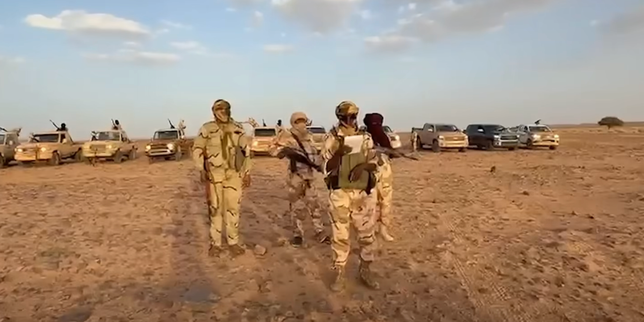
The military dynasty of Khalifa Haftar in eastern and southern Libya rests on a fundamental miscalculation: that financial rents from oil fields can permanently offset the high logistical and security costs of suppressing the Fezzan's tribal and ethnic factions. The emergence of armed resistance in the southwestern Sahara reveals the structural limits of this coercive model.
Rather than a unified national force, the Libyan National Army (LNA) operates in the south as a security franchise. It relies on a fragile network of local proxies, mercenary forces, and family-led elite brigades. When local actors rebel, they do not merely challenge a military command; they disrupt the financial nervous system of the Haftar clan's patronage network.
The Structural Anatomy of the Southern Command
To understand the vulnerability of the LNA in the south, one must dissect its operational footprint. The region of Fezzan is not governed through administrative consent but through a militarized extractive economy. This economy is overseen primarily by the Tariq bin Ziyad (TBZ) Brigade, commanded by Saddam Haftar, and the 128th Brigade, led by Hassan Maatoug al-Zadma.
                  [ Haftar Family / LNA High Command ]
                                   │
         ┌─────────────────────────┴─────────────────────────┐
         ▼                                                   ▼
[ Tariq bin Ziyad Brigade ]                        [ 128th Brigade ]
(Saddam Haftar - Elite Coercion)               (Hassan al-Zadma - Proxy Networks)
         │                                                   │
         └─────────────────────────┬─────────────────────────┘
                                   ▼
                   [ Extractive Rent Generation ]
             (Oil Blockades, Smuggling, Gold, Borders)
This command structure bypasses traditional military hierarchies to ensure direct family control over the region's key cash flows. The LNA's presence in the south relies on three core operational pillars.
- Pillar 1: Infrastructure Securitization. Direct physical control over the Sharara and El Feel oil fields. These assets serve as geopolitical leverage against the Tripoli-based Government of National Unity (GNU) and the National Oil Corporation (NOC).
- Pillar 2: Border Subcontracting. The utilization of localized militias—often drawn from the Arab, Tebu, or Tuareg communities—to police smuggling routes. The LNA does not stop illicit trade; it taxes it.
- Pillar 3: Transnational Logistical Alliances. Collaboration with the Russian Africa Corps (formerly the Wagner Group) to secure airbases like Al-Jufra and Brak al-Shati. These bases act as logistical nodes linking the Mediterranean to the Sahel.
The weakness of this three-pillar system is its transactional nature. The loyalty of southern factions is directly proportional to the LNA's ability to distribute patronage. When the Haftar clan attempts to centralize revenues or squeeze local intermediaries, the security architecture fractures.
The Triad of Southern Instability
The new wave of unrest in the Libyan Sahara is not an isolated ethnic dispute. It is the direct output of three systemic friction points that the LNA cannot resolve without undermining its own business model.
1. Resource Extraction vs. Local Deprivation
The Fezzan contains the majority of Libya's liquid wealth, yet it suffers from chronic fuel shortages, crumbling infrastructure, and a lack of basic services. The Sharara field, capable of producing approximately 300,000 barrels per day, is frequently shut down by local protesters or armed groups.
The LNA treats these shutdowns as security crises to be suppressed rather than symptoms of economic marginalization. When the Tariq bin Ziyad Brigade uses force to reopen fields, it deepens local resentment. This creates a feedback loop: local communities feel economically colonized, leading them to view armed rebellion as their only viable bargaining tool.
2. Ethnic Polarization and Tactical Exclusion
The Haftar clan's security strategy in the south has historically relied on playing ethnic groups against one another. By empowering specific Arab tribes (such as the Awlad Suleiman or Magarha) and marginalizing non-Arab minorities (the Tebu and Tuareg), the LNA has created a highly volatile social environment.
- Tebu Grievances: The Tebu feel systematically excluded from the region's security apparatus and accuse the LNA of facilitating demographic changes along the southern border.
- Tuareg Marginalization: The Tuareg, concentrated around Ghat and Ubari, face political disenfranchisement and lack of national identity documentation, preventing them from accessing state employment or formal economic opportunities.
A rebellion led by these marginalized groups is highly dangerous for the LNA because these communities possess cross-border networks extending into Niger and Chad. They can easily secure rear bases, ammunition, and manpower outside of Libya's jurisdiction.
3. Transnational Mercenary Dynamics
The presence of foreign fighters—including Chadian opposition groups, Sudanese paramilitaries, and Russian mercenaries—complicates the LNA's security calculations.
The Russian Africa Corps uses southern Libyan airfields to support operations in Mali, Burkina Faso, and Niger. To maintain this transit corridor, Russia requires a stable, compliant southern Libya. However, the LNA’s reliance on Russian assets alienates local populations who view foreign forces as occupying armies.
Furthermore, Chadian rebel groups, such as the Front for Change and Concord in Chad (FACT), operate in the security vacuums of the southern desert. Their interests frequently align with local Libyan insurgents who wish to weaken Haftar's northern-led brigades.
The Cost Function of Remote Authoritarianism
The sustainability of the LNA’s southern campaign can be modeled as a cost function where the total cost of maintaining authority ($C_{total}$) must not exceed the economic rents generated from the region ($R_{south}$).
$$C_{total} = C_{logistics} + C_{coercion} + C_{tribal_subsidies}$$
Where:
- $C_{logistics}$ represents the cost of maintaining supply lines across hundreds of kilometers of desert.
- $C_{coercion}$ is the direct military expenditure required to suppress active insurgencies and secure oil infrastructure.
- $C_{tribal_subsidies}$ represents the financial payouts and concessions required to keep local tribal elites loyal.
If an active insurgency emerges, $C_{coercion}$ spikes dramatically. Simultaneously, if insurgents successfully blockade oil fields, $R_{south}$ drops toward zero.
Because the LNA lacks a legitimate political mandate in the Fezzan, it cannot rely on voluntary civic compliance. It must pay for every unit of order it establishes. This makes the southern occupation economically unsustainable during prolonged insurgencies. The Haftar clan is forced to divert elite units from eastern Libya to the south, thinning their defenses in their core territory of Cyrenaica.
Succession Vulnerability and Command Friction
The timing of the southern rebellion coincided with the gradual transition of power from the aging Marshal Khalifa Haftar to his sons, Saddam and Belqasim. This transition is highly contested and introduces command friction within the LNA.
Older, established LNA commanders, who earned their positions during the campaigns in Benghazi and Derna, resent the rapid promotion of Haftar’s sons. Saddam Haftar’s heavy-handed tactics in the south—characterized by arbitrary arrests, asset seizures, and the sidelining of traditional tribal councils—have alienated local military commanders who previously acted as stabilizers.
"The transition from a charismatic military leader to a dynastic family dictatorship is the most volatile phase of any autocratic regime. In Libya's south, local actors are exploiting this transitional friction to renegotiate their terms of submission."
The LNA's command structure is ill-equipped for counter-insurgency in a vast desert terrain. The elite family-led brigades are heavily mechanized and optimized for conventional urban warfare or static defense of infrastructure. They lack the mobility, local intelligence, and desert warfare capabilities possessed by indigenous Tebu and Tuareg fighters.
Strategic Trajectory
The LNA cannot resolve the southern insurgency through military force alone. The vast geography of the Sahara makes absolute physical control impossible. The Haftar clan faces a strategic trilemma: they must either decentralize resource revenues to appease local actors, permanently deploy their most loyal elite brigades to the deep south at the expense of northern security, or accept a degraded security environment where their control does not extend past the perimeter fences of the oil fields.
The most likely outcome is a protracted, low-intensity conflict that periodically disrupts Libyan oil exports. Local insurgent groups will avoid decisive engagements with the LNA, choosing instead to conduct hit-and-run attacks on supply convoys and security checkpoints.
For international actors, this instability means that southern Libya will remain a major security black hole. It will continue to serve as a transit zone for human trafficking, weapons smuggling, and transnational jihadist movements. The Haftar clan’s claim to be the sole guarantor of stability in eastern and southern Libya is increasingly decoupled from the reality on the ground.