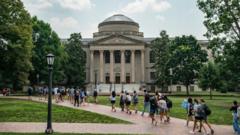
The collective weeping coming from elite university administration offices and higher education lobbies right now is deafening.
On July 16, 2026, the Department of Homeland Security dropped a bomb on the international student industry: the official end of "duration of status" (D/S) for F-1 and J-1 visas. For nearly fifty years, international students could enter the United States with an open-ended ticket, staying indefinitely as long as they remained enrolled in school. Now, they get a hard cap of four years. If they need more time—whether they are pursuing a doctoral degree or finishing up localized research—they must apply for a formal Extension of Stay directly through USCIS. For a more detailed analysis into similar topics, we recommend: this related article.
Predictably, the academic establishment is calling this an existential threat to American innovation, warning of a catastrophic brain drain that will drive global talent into the arms of Canada or Europe.
They are wrong. They are crying because their favorite cash cow has just been put on a diet. For broader information on this issue, in-depth analysis can be read at Associated Press.
For decades, American universities have run a highly lucrative, border-line predatory racket. They have treated international students not as minds to be nurtured, but as high-yield financial assets designed to subsidize skyrocketing administrative budgets, luxurious campus amenities, and bloated bureaucracies.
By forcing a strict, four-year regulatory structure, the federal government is not destroying higher education. It is forcing a desperate market correction on an industry that has avoided accountability for half a century.
The Open-Ended Visa Was a Cover for University Exploitation
Let us dispense with the fairy tale that the old "duration of status" framework was designed purely to champion academic freedom.
Under the old system, once a student entered the country on an F-1 visa, the university held almost complete authority over their legal status. The school’s Designated School Official (DSO) could simply extend a student’s program end-date in the SEVIS database with a few keystrokes. No government eyes. No external auditing. No rigorous vetting.
This absolute power created a toxic incentive structure. Universities realized they could charge foreign students three to four times the tuition rate of domestic students, with virtually zero oversight on how long those students remained enrolled.
I have watched public and private universities balance their books by aggressively recruiting overseas, offering mediocre degree programs at premium prices, and then dragging out graduation timelines. Why graduate a student in four years when you can keep them paying out-of-state tuition for six?
The new rule strips this unchecked authority away from university registrars and hand it back to federal immigration officers. Now, if an academic program exceeds four years, the student must file Form I-539 with USCIS.
Universities complain that this will create "unbearable bureaucratic friction" for PhD students, whose research often takes five to seven years.
Let’s dissect that complaint. If a prestigious research university—armed with a multi-billion-dollar endowment and hundreds of administrative staff—cannot guide a legitimate doctoral candidate through a routine, government-vetted visa extension, then that university’s operational competence is a joke.
The panic isn't about legitimate PhD students. The panic is about the fact that universities will now have to justify why their programs take so long to complete.
Dismantling the Visa Mill Loophole
The most significant victory of the new DHS rule is the aggressive clampdown on "visa mills" and academic side-stepping.
Under the old rules, a student could finish a master’s degree, decide they wanted to remain in the U.S. to work or live, and simply enroll in another master’s degree at the same level—or even a lower associate degree—to maintain their F-1 status.
This loophole birthed a shadow economy of low-quality, unaccredited, or minimally accredited institutions offering "Day-1 CPT" (Curricular Practical Training). These institutions operate essentially as immigration tollbooths. You pay them tuition, they give you an F-1 visa, and you are allowed to work full-time under the guise of "practical training" from day one. It was a backdoor work-authorization scheme that completely bypassed the H-1B lottery.
The new regulations shut this down cold. The rule strictly dictates that:
- Academic changes are restricted: Graduate-level F-1 students can no longer change their majors mid-program or transfer schools without a federal exemption.
- No lateral moves: Once a student completes a degree, they must progress upward (e.g., Bachelor's to Master's to PhD). No second bachelor's, no second master's, and certainly no stepping down to lower-tier credentials just to buy more time on U.S. soil.
- The grace period is halved: The post-graduation buffer to find a job, transfer, or leave has been cut from 60 days to 30 days.
+------------------------------------+------------------------------------+
| Old F-1 Visa Framework             | New DHS Final Rule                 |
+------------------------------------+------------------------------------+
| Duration of Status (D/S) allowed   | Hard 4-year limit; requires formal |
| infinite stays via school updates. | USCIS extension (Form I-539).      |
+------------------------------------+------------------------------------+
| Unlimited lateral degree transfers | Progress must be upward only; no   |
| (multiple same-level master's).    | lateral or downward degrees.       |
+------------------------------------+------------------------------------+
| 60-day post-graduation grace       | 30-day post-graduation grace       |
| period to depart or transition.    | period.                            |
+------------------------------------+------------------------------------+
For-profit colleges and exploitative visa-mill schools are going to go bankrupt. And we should let them. They have weaponized the American education system as a product to sell residency, degrading the value of a legitimate American degree in the process.
The Myth of the Great Tech Brain Drain
The standard industry pushback is always the same: “If we make it harder, we will lose the next Elon Musk or Sergey Brin to Canada.”
This is a lazy, emotional argument designed to shield universities from regulatory scrutiny.
Top-tier global talent—the absolute best researchers, software engineers, and scientific minds—will always find a way to the United States. The demand for world-class talent is so high that elite venture capital firms, major tech corporations, and prestigious research labs will happily pay the legal fees and handle the paperwork to secure O-1 extraordinary ability visas, H-1B cap-exempt sponsorships, or green cards.
The people who will be filtered out by these new rules are not the brilliant researchers. They are the average students who utilized low-tier academic programs as a roundabout way to enter the American job market.
If your entire career strategy relies on staying in "forever student" status while working off-the-books or through shady CPT schemes, you are not the high-skilled global talent the U.S. immigration system was designed to attract. You are a economic migrant bypassing the standard employment visa queues.
The Brutal Reality for Universities
This regulatory shift is going to hurt. But it is a necessary pain.
American universities have enjoyed an unprecedented era of easy money. By importing hundreds of thousands of international students to pay full retail price, they avoided making hard financial decisions. They didn't have to cut administrative bloat, they didn't have to lower tuition for working-class American families, and they didn't have to streamline their curriculum.
Now, the easy money is drying up.
International students will look at the new four-year cap, the shortened 30-day grace period, and the lack of flexibility to change majors, and they will think twice before dropping $250,000 on a mid-tier American degree. They will demand more value. They will demand shorter, more efficient programs. They will demand that universities actually help them secure legitimate employment rather than leaving them to navigate a Byzantine web of OPT and H-1B lotteries on their own.
American higher education has treated the student visa as a product for too long. By forcing universities to share oversight with the federal government, the new DHS rule finally demands that institutions prioritize actual education over immigration-adjacent revenue streams.
Stop crying for the universities. Start holding them accountable for the product they sell.


/imgsapp2.uai.com.br/app/noticia_133890394703/2026/07/16/386986/maria-eduarda-machado-e-renato-machado_1_1097628.png)
