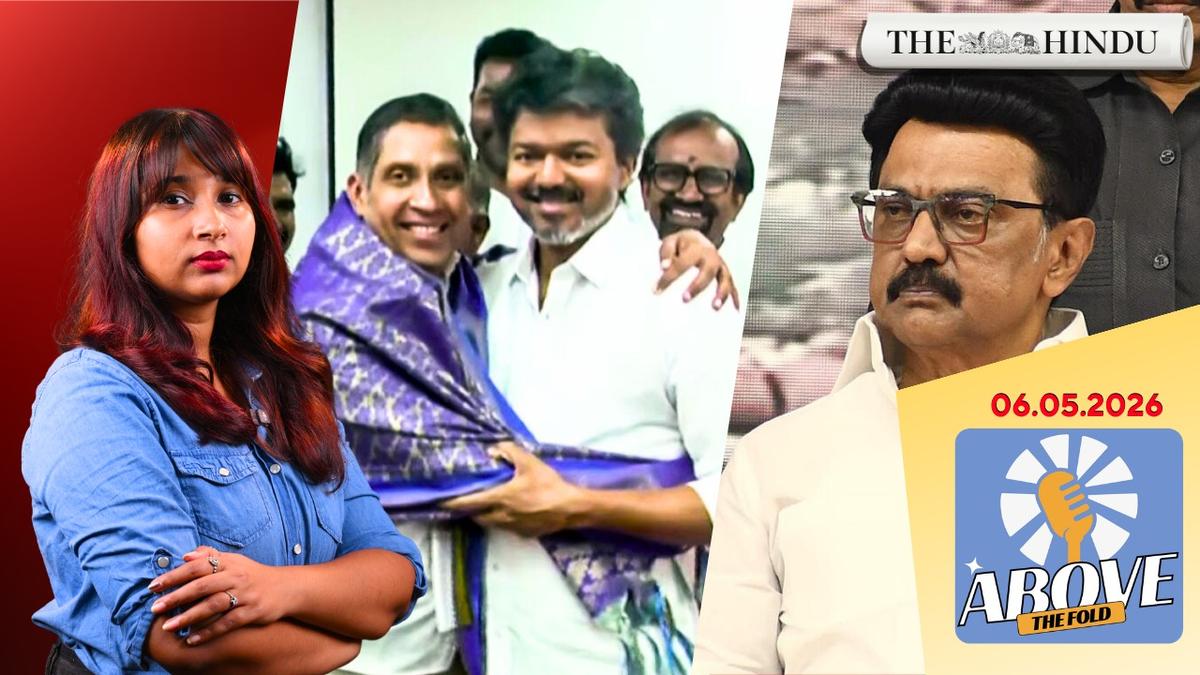
The political architecture of Tamil Nadu, a rigid structure that remained largely unshaken for over half a century, collapsed on Wednesday. By formally extending support to actor-politician Vijay’s Tamilaga Vettri Kazhagam (TVK), the Congress party did more than just swap allies; it effectively ended its twenty-year marriage with the DMK and signaled the arrival of a new era. The DMK’s immediate outcry of "backstabbing" is not merely a complaint about a broken pact. It is the sound of a legacy power realizing that its traditional levers of control have finally snapped.
The numbers from the 2026 Assembly election tell a story of total disruption. Vijay’s TVK secured 108 seats, falling just short of the 118 needed for a majority in the 234-member house. The incumbent DMK was relegated to 59 seats, while the AIADMK managed 47. In this fractured environment, the five seats held by the Congress became the kingmaker’s gold. By choosing to back the newcomer over the established Dravidian giant, the Congress has made a cold, calculated bet that the future of the state no longer belongs to the old guard.
The Mathematics of Betrayal
The DMK’s fury is grounded in a sense of ownership. Party spokespersons were quick to point out that the Congress’s five seats were won solely on the back of the DMK’s organizational machinery. They argue that without the "Rising Sun" symbol and the local DMK cadres, the Congress would have likely drawn a blank. To the DMK leadership, this move is a violation of political ethics.
However, the Congress leadership in New Delhi sees it differently. For years, the party has felt stifled as a junior partner in Tamil Nadu, forced to accept a handful of seats while the DMK dictated terms. By aligning with Vijay, the Congress is attempting to reclaim its identity. They are no longer a satellite orbiting a Dravidian sun; they are now a foundational pillar of a nascent government. AICC in-charge Girish Chodankar made the intent clear by demanding an "appropriate share" in the government—a demand they never dared to make under M.K. Stalin.
Vijay’s Gamble and the Youth Mandate
Vijay’s victory is not a fluke of celebrity worship. It is the result of a meticulously planned vacuum-filling exercise. Since the deaths of J. Jayalalithaa and M. Karunanidhi, the state has been searching for a singular, charismatic figure who could transcend the baggage of the two major Dravidian parties. Vijay positioned the TVK as a "secular and progressive" alternative, siphoning off the youth vote that felt alienated by the DMK's perceived stagnation and the AIADMK's internal fractures.
The TVK chief’s outreach to the Congress was a masterstroke in pragmatism. By bringing a national party into his fold, he gains a layer of protection against the central government’s investigative agencies and adds a veneer of national legitimacy to his regional experiment. It also forces the hand of other smaller players. With the Congress on board, the CPI and other Left parties are already being courted, potentially isolating the DMK in the very opposition benches it thought it would never inhabit.
The National Ripple Effect
While the DMK fumes in Chennai, the implications for the national political stage are significant. The DMK has been a cornerstone of the INDIA bloc, often acting as the ideological anchor for secular politics. The Congress’s decision to dump them at the state level risks fracturing the national opposition.
However, Congress insiders suggest this is a "contained fire." They believe they can maintain a working relationship with the DMK in New Delhi to oppose the BJP, while simultaneously building a new power base in Tamil Nadu. It is a dangerous tightrope walk. If the DMK decides to retaliate by withdrawing support for the Congress on the national stage, the entire opposition alliance could begin to unravel.
The High Price of Governance
The incoming TVK-Congress government will face an immediate reality check. Vijay has run on a platform of "clean politics" and "social justice," but he is inheriting a state with complex fiscal challenges and a bureaucracy accustomed to the old ways of doing business. Furthermore, the Congress’s support is conditional. They have demanded that the TVK keep "communal forces" out of the alliance, a clear warning against any future dalliance with the BJP or its affiliates.
Governing with a razor-thin majority and a partner that has shown it can walk away from a twenty-year-old alliance will be Vijay’s first real test. He is no longer reading from a script; he is the executive in charge of one of India's most economically vital states. The honeymoon will be short, and the DMK, now a wounded and angry opposition, will be waiting for the first sign of a stumble.
The shift we are seeing is more than a change in personnel. It is the disintegration of a duopoly that has defined Tamil politics since 1967. The "backstab" the DMK laments is simply the inevitable outcome of a political market that has finally decided to move on. Whether this new alliance can actually build something more stable than the structure it just tore down remains the unanswered question.