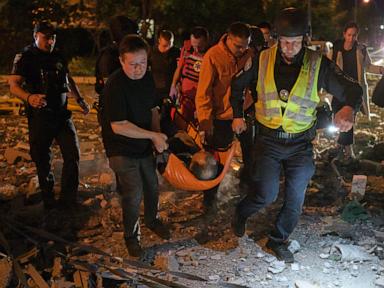
Russia’s recent wave of missile and drone attacks across Ukraine, which killed at least 22 civilians and wounded dozens more in a single day, represents far more than a tragic spike in casualties. It marks a systemic shift in Moscow's air campaign designed to completely deplete Ukraine's Western-supplied air defenses. By launching complex, multi-layered barrages that mix slow-moving Iranian-designed Shahed drones, subsonic cruise missiles, and hypersonic ballistic weapons simultaneously, Russian forces are exploiting critical shortages in Ukraine's surface-to-air missile stockpiles. The strategy is working, forcing Kyiv to make agonizing choices about which cities, power plants, and military assets to protect.
To view these strikes as indiscriminate acts of terror is to misread the grim tactical calculus at play. Moscow has refined its targeting cycle. The primary objective is no longer just immediate destruction, but the systematic exhaustion of Ukraine’s defense infrastructure ahead of wider ground offensives.
The Geometry of Exhaustion
The mechanics of a modern Russian air assault reveal a sophisticated understanding of Western radar and missile limitations. A typical strike package does not arrive all at once or from a single direction.
Instead, the attack begins hours before the main missile salvos with wave after wave of low-cost Shahed-136 loitering munitions. These drones are slow, loud, and relatively easy to shoot down. That is precisely why they are sent first. They force Ukrainian air defense teams to activate their radars, revealing their positions, and expend expensive ammunition.
The Cost-Asymmetry Trap
A single Shahed drone costs Moscow roughly $20,000 to produce. To shoot it down, Ukraine frequently relies on NASAMS, Iris-T, or Patriot interceptors.
- Shahed-136 Drone: ~$20,000
- Western Interceptor Missile: $1 million to $4 million per shot
This economic imbalance is unsustainable over a prolonged war of attrition. While Ukraine has successfully integrated mobile fire teams using trucks equipped with searchlights and heavy machine guns to preserve high-end missiles, Russia has adapted.
Recent strike data shows Moscow is now painting Shahed drones black, using carbon fiber materials to reduce their radar cross-section, and changing their flight paths to follow riverbeds and deep valleys where terrain masking hides them from ground-based radar until the last second.
Slicing the Defensive Shield
Once the drones have saturated the airspace and forced Ukrainian commanders to commit their resources, the second wave begins. This phase utilizes Kh-101 and Kalibr cruise missiles. These weapons are highly maneuverable, programmed to change direction multiple times mid-flight to bypass known air defense pockets.
Finally, just as the defense network is fully engaged, Russia fires its heavy armor: Iskander-M ballistic missiles and Kh-47M2 Kinzhal hypersonic missiles. Traveling at extreme speeds on quasi-ballistic trajectories, these weapons leave Ukrainian operators with less than a few minutes of reaction time from the moment of launch detection to impact.
The Fragmented Sky
The geography of the latest 22-casualty strike illustrates how Russia exploits gaps in Ukraine's uneven defensive umbrella. While the capital city of Kyiv remains heavily defended by a dense concentration of Patriot and SAMP/T systems, secondary and tertiary cities like Kryvyi Rih, Dnipro, and Kharkiv are dangerously exposed.
"We are forced to choose between protecting a thermal power plant that provides electricity to hundreds of thousands of people, or protecting a residential district," a Ukrainian air defense commander noted off the record during a recent briefing. "Every successful interception in one region means a vulnerability has been created in another."
This uneven distribution allows Russian planners to pick apart Ukraine’s industrial base. By striking logistics hubs and manufacturing facilities far from the front lines, Moscow hampers Ukraine's domestic drone and ammunition production. The civilian toll is a predictable, calculated byproduct of this strategy. When an interception does occur over a major city, the falling debris of both the missile and the interceptor often inflicts severe damage on high-rise apartment buildings below.
Western Supply Lines and the Production Bottleneck
The fundamental bottleneck in Ukraine’s ability to withstand these regular barrages is not a lack of launch platforms, but the sheer volume of interceptor production in the West.
The United States and its European allies have delivered a patchwork of systems since 2022. While these systems are highly capable, their supply chains were never designed for a high-intensity, industrial-scale artillery and missile war.
| Air Defense System | Primary Supplier | Target Profile | Stockpile Status |
|---|---|---|---|
| Patriot (PAC-2/PAC-3) | United States / Germany | Ballistic & Hypersonic Missiles | Critically Low |
| IRIS-T SLM | Germany | Cruise Missiles & Drones | Steady Production, Low Volume |
| NASAMS | US / Norway | Aircraft & Cruise Missiles | Dependent on AMRAAM Stocks |
| S-300 (Soviet-era) | Ukraine Legacy / Slovakia | General Air Threats | Near Total Depletion |
For decades, Western military doctrine relied heavily on air superiority, meaning the US Air Force was expected to clear the skies before ground forces engaged. Consequently, the West underinvested in land-based, surface-to-air missile manufacturing.
Now, defense contractors are rushing to expand production lines for PAC-3 MSE interceptors and AMRAAM missiles, but factory retooling takes years, not months. Russia, meanwhile, has moved its economy to a total war footing, running missile production facilities on three shifts, 24 hours a day, while supplementing its domestic output with ballistic missiles procured from external suppliers.
The Strategic Choice Facing Kyiv
As the winter months approach and the targeting of Ukraine’s energy grid intensifies, the leadership in Kyiv faces a grim calculus. To prevent the complete collapse of the civilian infrastructure that keeps cities habitable, air defense units must be pulled back from the front lines.
This creates a massive opportunity for the Russian Air Force (VKS). For the first eighteen months of the war, Russian fighter-bombers were largely kept at bay by Ukraine’s robust forward air defenses. They were unable to operate freely over Ukrainian trenches.
With those defenses thinned out to protect civilian centers, Russian Su-34 jets are now executing thousands of devastating glide-bomb attacks against Ukrainian defensive fortifications with near impunity. These cheap, heavy bombs, weighing up to 3,000 kilograms, obliterate concrete bunkers and trench networks, allowing Russian infantry to advance along the Donbas front.
Kyiv's desperate push for Western F-16 fighters and Mirage 2000 jets is directly tied to this crisis. These aircraft are not intended to engage in cinematic dogfights. They are desperately needed as mobile, airborne air defense platforms that can intercept cruise missiles and drones before they reach Ukraine's borders, relieving the immense pressure on the ground-based battery network.
Yet, the integration of these western fighters is slow, hampered by pilot training timelines, maintenance complexities, and vulnerable runways that are themselves frequent targets of Russia’s long-range strikes. The 22 lives lost in the latest bombardment are a stark reminder that in an attrition campaign, the side that cannot match its opponent’s production volume is forced to pay for the deficit in blood.