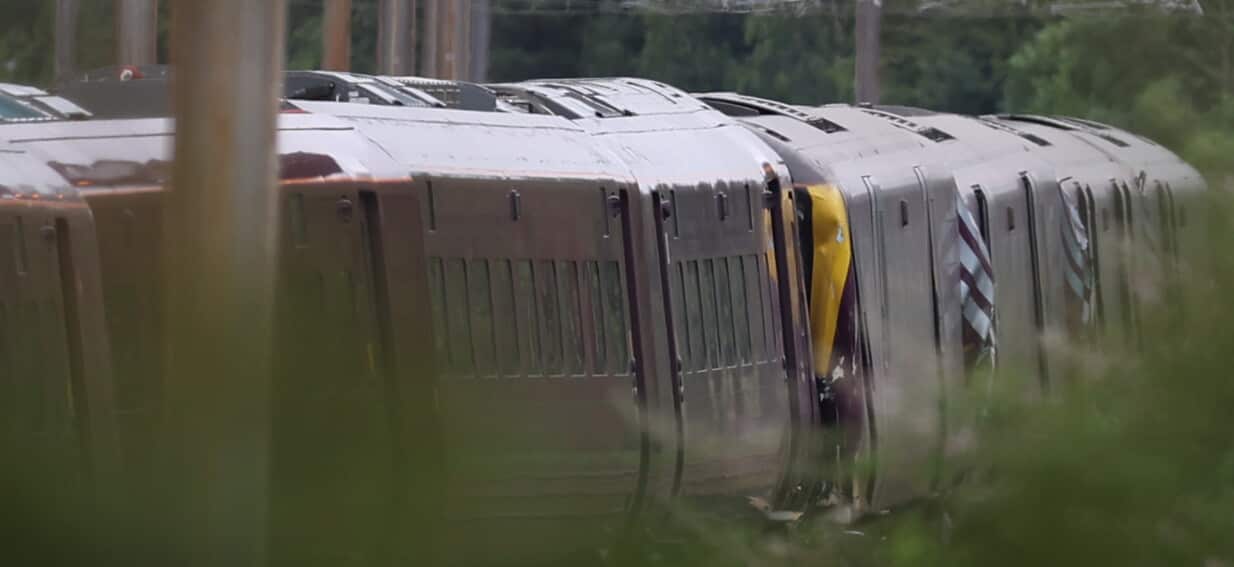
The headlines follow a script written decades ago. A train collision occurs north of London. One person tragically loses their life. Dozens are injured. Instantly, the media apparatus pivots to outrage. Politicians demand immediate investigations. Pundits call for the complete grounding of fleets, massive infrastructure overhauls, and heads on pikes at Network Rail or the operating companies.
This reaction is not just wrong. It is actively killing people. For an alternative look, see: this related article.
The lazy consensus surrounding rail accidents treats every single incident as an unacceptable systemic failure that demands an immediate, zero-tolerance shutdown. We treat train travel with a psychological exceptionalism that we apply to no other form of transit. By demanding flawless execution from a mechanical system operating in the real world, we trigger a cascade of bureaucratic risk-aversion that forces commuters off the tracks and onto the asphalt.
I have spent twenty years analyzing transit networks and rolling stock infrastructure. I have watched safety boards spend millions chasing a statistical ghost while ignoring the macroeconomic reality of human transportation. Here is the uncomfortable truth that nobody in the industry wants to say on camera: trying to engineer the final fraction of a percent of risk out of rail travel makes our society fundamentally more dangerous. Further insight regarding this has been provided by BBC News.
The Statistical Blind Spot of Headline Outrage
Whenever a train accident occurs, the public demands to know how this could happen in a modern society. The real question we should ask is why it happens so rarely, and what happens when we overreact to it.
Let us look at the raw mechanics of transit risk. The European Railway Agency and the UK Office of Rail and Road consistently track fatalities per billion passenger-kilometers. Rail travel is systematically, overwhelmingly safer than driving. In fact, traveling by train is roughly twenty to thirty times safer than traveling by private car over the same distance.
When a major rail incident occurs, the immediate consequence is service disruption, speed restrictions, and a chilling effect on passenger confidence. Imagine a scenario where a regulatory body imposes a blanket 20 mph speed restriction across a major corridor while investigating a signaling anomaly. What happens to the passengers? They do not sit at home. They do not magically teleport. A predictable percentage of them look at the delayed timetable, pull their car keys out of their pocket, and drive down the M1 or the A1(M).
By forcing those commuters onto the road network, regulators are statistically signing death warrants for a completely different set of people. We accept a steady, quiet slaughter of thousands of people every year on our roads without a single prime-time news special. Yet, a single rail fatality freezes the national infrastructure. This is not safety management. This is risk theater.
The Myth of the Automated Cure All
The immediate technocratic fix offered after any collision is a demand for absolute automation. The common argument claims that if we remove human error from the cabin, we eliminate the risk entirely.
This argument ignores the reality of complex systems engineering. When you automate a rail network, you do not eliminate human error. You merely displace it. You move the error from the train driver to the software engineer, the sensor maintenance technician, or the procurement officer who chose a specific grade of balise for the trackside signaling.
Consider the European Train Control System (ETCS) and its various implementations. While automatic train protection systems are vital, treating them as an infallible shield creates a dangerous paradox known as automation bias. When systems operate flawlessly 99.9% of the time, human operators undergo cognitive decoupling. They stop actively monitoring the environment because the machine handles it. When the machine encounters an edge case—a freak weather event, a corrupted data packet, a localized power failure—the human is suddenly forced to intervene with zero situational awareness.
Furthermore, the capital expenditure required to retrofit century-old rail topology with absolute automation is astronomical. Every pound sterling spent chasing a marginal safety gain on a line that is already incredibly safe is a pound that cannot be spent fixing a poorly designed highway intersection or installing segregated cycle lanes in a city center. If our goal is truly to save human lives, our capital allocation is completely backward.
The Real Culprit is Deferred Maintenance, Not System Design
The media loves to focus on dramatic narratives: a driver missing a signal, a high-tech system failing, a catastrophic structural collapse. The boring, unsexy reality of rail incidents is almost always rooted in routine maintenance cycles.
Railways are brutal environments. You are running hundreds of tons of steel over steel rails at high speeds, day in and day out, exposed to shifting soils, extreme thermal expansion, and moisture. The interface between the wheel and the rail is a zone of immense physical stress.
When infrastructure owners face budget constraints, they rarely cut high-profile new projects. Politicians love cutting ribbons on new stations and high-speed lines. Instead, organizations cut the invisible budgets: the grinding teams that smooth out microscopic rail defects, the vegetation management crews that clear leaves and branches, and the night-shift inspectors who check track geometry.
The result is a fragile system. A train slides on low-adhesion tracks because leaf residue was not properly cleared, or a track circuit fails to detect a train because of localized rust buildup. We do not need revolutionary new technology to fix this. We need to stop diverting maintenance funds into flashy, politically convenient capital projects. We need to accept that the most critical safety device on a railway is a well-funded, well-rested maintenance crew working at 3:00 AM in the rain.
Redefining the Goal of Public Transit
We must dismantle the premise that the metric of a successful rail network is an absolute zero-accident record. A zero-accident network is a stagnant, unusable network. If you never want a train to crash, leave it in the depot.
The true metric of success for a transit system is net societal safety. If a rail network carries one hundred million passengers a year and experiences a single fatal incident every decade, it is a triumph of engineering and public health. If we tighten regulations so severely that the network becomes slow, expensive, and inflexible, driving down ridership by ten percent, we have failed. That ten percent shift back to road transport will result in a measurable, predictable spike in highway fatalities that dwarfs the rail incident.
We need to stop apologizing for the inherent physics of moving heavy machinery at high speed. We need to manage risk realistically, not emotionally. Until we look at a rail accident with the same analytical detachment that we apply to highway statistics, we will continue to make reactive policy decisions that make our entire transport network fundamentally more dangerous. Stop trying to engineer a zero-risk utopia on the tracks; start focusing on keeping people off the roads.