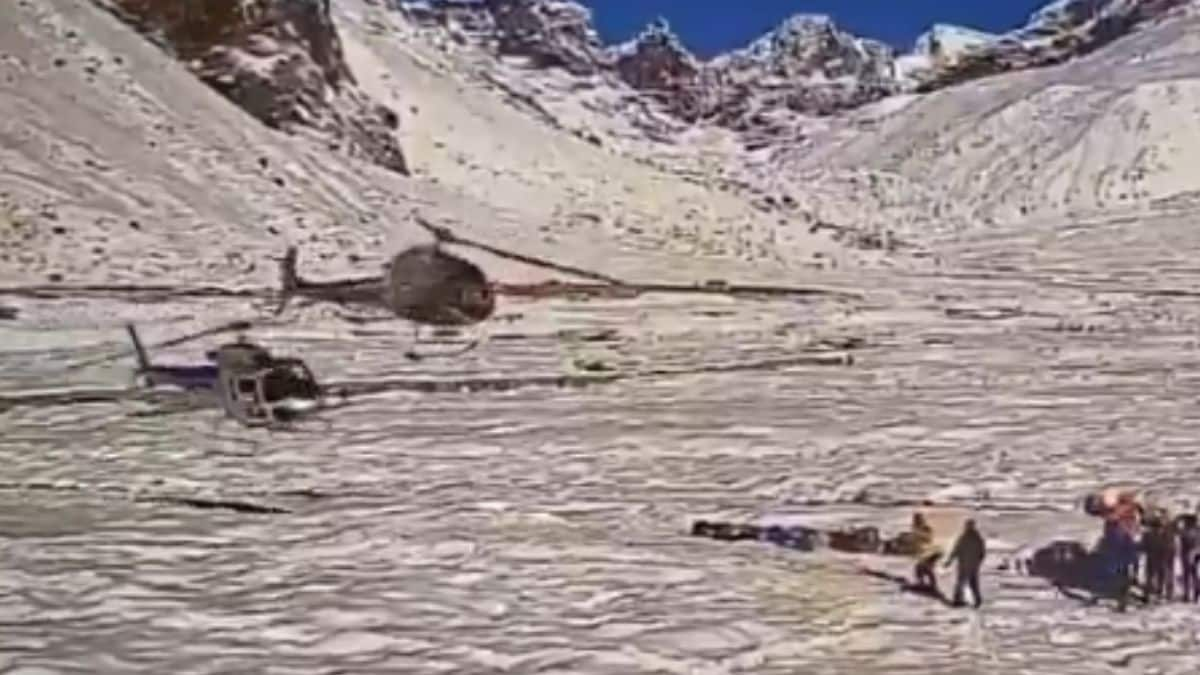
An Indian national was killed when two commercial helicopters collided during a landing attempt near a high-altitude base camp in Nepal. The fatal crash exposes an urgent, systemic crisis in Himalayan aviation. Extreme altitudes, shrinking landing zones, and aggressive commercial scheduling have turned Nepal’s premier trekking and mountaineering corridors into unregulated aerial traffic jams where split-second miscalculations prove fatal.
Aviation accidents in the Himalayas are rarely the result of a single mechanical failure. They are almost always the predictable outcome of compounding environmental and commercial pressures. When two aircraft make contact during an approach at high elevation, it points directly to a breakdown in visual separation, ground coordination, and airspace management in one of the most unforgiving flight environments on earth.
The Physics of High Altitude Flight
Flying a helicopter at 14,000 feet or higher bears little resemblance to operating at sea level. The air is thin. That simple atmospheric reality changes everything about how a rotorcraft behaves, how much weight it can carry, and how quickly a pilot can recover from an unexpected gust of wind.
Helicopter rotors generate lift by pushing air downward. At extreme elevations, air density drops significantly, meaning the rotor blades have far fewer air molecules to grab onto with every revolution. To compensate, the aircraft requires substantially more engine power just to maintain a hover. At the same time, the turbine engines themselves lose efficiency because they are ingesting less oxygen.
This creates a razor-thin margin for error known in aviation as the power-to-weight ceiling. When a pilot approaches a base camp helipad, the aircraft is often operating near its absolute performance limit. There is no reserve power available to rapidly climb out of trouble if another helicopter suddenly enters the approach path or if a sudden downdraft pushes the aircraft toward the terrain.
Vortex Ring State and Sudden Loss of Lift
During a steep, slow landing approach—the exact profile required to drop into a narrow mountain clearing—helicopters become vulnerable to a deadly aerodynamic trap called vortex ring state (often referred to as settling with power). If a pilot descends too quickly with low forward airspeed, the helicopter essentially falls into its own turbulent downwash.
Instead of generating lift, the air simply recirculates around the blade tips. Pulling up on the collective pitch control to arrest the descent only makes the problem worse, feeding more energy into the vortex and accelerating the fall. At high altitudes, where recovery altitude is scarce and engine response is sluggish, entering a vortex ring state near another aircraft leaves zero room for evasive action.
The Anatomy of a Base Camp Traffic Jam
To understand why two helicopters ended up occupying the same airspace during a landing attempt, you have to look at the geography of Himalayan base camps. Whether at Everest, Annapurna, or Manaslu, usable flat ground is exceptionally rare. Landing zones are often little more than cleared patches of glacial moraine or packed snow, frequently accommodating only one aircraft at a time.
During peak spring and autumn trekking seasons, dozens of flights converge on these tiny pads within a narrow morning window. Weather in the high mountains deteriorates rapidly after mid-morning as warm air rises from the valleys, forming thick clouds and violent katabatic winds. Pilots know they have a strict cutoff time, usually between 6:00 AM and 10:30 AM, to complete their rotations.
This creates a relentless rush hour in the sky. Operators race to maximize daily payloads—ferrying trekkers, climbing gear, oxygen bottles, and emergency medical evacuations before the clouds roll in.
Blind Spots and Radio Chaos
In controlled airspace around major international airports, air traffic controllers use radar and strict separation protocols to keep aircraft miles apart. At remote Himalayan base camps, that infrastructure does not exist. There is no radar coverage below the mountain peaks. There is no dedicated air traffic control tower clearing pilots to land.
Instead, pilots rely entirely on see-and-avoid principles and a common VHF radio frequency to broadcast their positions. The system sounds workable on paper, but it fractures under real-world pressure.
- Terrain Masking: Towering granite ridges and icefalls block VHF radio signals. A helicopter descending into a glacial valley often cannot hear the radio transmissions of another aircraft approaching from the opposite side of a ridge until both are seconds away from the landing pad.
- Visual Clutter: Spotting a small helicopter against a blinding backdrop of white snow, dark rock, and shifting cloud shadows is notoriously difficult. A pilot focused intensely on a rocky, uneven landing zone has a severely narrowed field of vision.
- Cockpit Workload: During the final thirty seconds of a high-altitude landing, a pilot is monitoring engine temperature limits, wind socks, ground personnel, and treacherous terrain simultaneously. Adding another aircraft into that immediate visual bubble overwhelms human cognitive capacity.
Consider a hypothetical scenario that plays out regularly during peak season. Pilot A is on a slow, power-limited final approach into a single-pad camp, committed to landing because a go-around requires maximum engine torque. Pilot B approaches from a blind valley angle, misinterprets a garbled radio call, and initiates a descent toward the same clearing. By the time the rotor blades enter each other's peripheral vision, neither aircraft possesses the aerodynamic agility to bank sharply away without risking a tail-rotor strike against the surrounding terrain.
Commercial Pressures vs. Aviation Safety
The transformation of Himalayan mountaineering into a high-volume commercial industry has fundamentally altered how helicopters are used in Nepal. Twenty years ago, rotorcraft in the high mountains were primarily reserved for genuine life-or-death rescues and heavy expedition logistics. Today, helicopter flights are a standard luxury travel product.
Wealthy trekkers routinely book helicopter shuttles to skip multi-day hikes, bypass altitude acclimatization schedules, or return quickly to Kathmandu after reaching base camp. This surge in demand has fueled rapid fleet expansion among Nepali private helicopter operators.
More helicopters chasing a finite number of fair-weather flying hours inevitably drives up operational tempo. Pilots face immense unspoken—and sometimes explicit—pressure to complete flights rather than turn back. A canceled flight means refunded tickets, disrupted itineraries for high-paying international clients, and lost revenue for operators carrying heavy financing costs on expensive European-built turbine helicopters.
| Operational Factor | Commercial Airport Standard | Himalayan Base Camp Reality |
|---|---|---|
| Air Traffic Control | Active radar tracking and mandatory clearance | Uncontrolled airspace; pilot self-announcement |
| Landing Infrastructure | Paved, marked pads with clear approach corridors | Uneven glacial rock/snow with steep terrain obstacles |
| Weather Reporting | Automated real-time wind and visibility sensors | Visual estimation and informal ground crew updates |
| Separation Minimums | Strictly enforced horizontal and vertical buffers | Visual judgment in high-glare, low-contrast terrain |
| Engine Power Margin | Substantial reserve power for aborted landings | Near-maximum torque limits due to thin air |
This imbalance creates a culture where pushing limits becomes normalized. When a pilot successfully lands in marginal visibility or squeezes into a congested camp without incident, the behavior is rewarded by keeping the schedule on track. Over time, the industry drifts closer to the edge of the safety envelope until an inevitable collision or crash resets the clock.
The Regulatory Blind Spot in Kathmandu
Nepal’s aviation sector has spent over a decade under intense international scrutiny. The European Union placed all Nepali airlines on its Air Safety List back in 2013, effectively banning them from European airspace due to persistent oversight failures by the Civil Aviation Authority of Nepal (CAAN).
While much of the public attention focuses on fixed-wing turboprop crashes—such as the devastating Yeti Airlines disaster in Pokhara in 2023—the helicopter sector operates with even fewer structural safeguards.
A core structural flaw lies in the dual role of the regulator. Historically, CAAN has functioned both as the safety oversight body and as the airport service provider managing commercial aviation infrastructure. Critics, including international aviation auditors from the International Civil Aviation Organization (ICAO), have repeatedly pointed out that combining regulatory enforcement with commercial revenue generation creates an inherent conflict of interest.
Enforcement Gaps on the Ground
Even when Kathmandu issues strict directives—such as limiting the number of daily flights to certain base camps, mandating two-pilot crews for high-altitude operations, or banning sling-load operations alongside passenger flights—enforcement in the remote Khumbu or Annapurna regions remains weak.
There are rarely aviation inspectors stationed at 15,000 feet to verify weight-and-balance manifests before takeoff. Operators know that once a helicopter leaves the Kathmandu valley or Lukla airport, oversight drops to near zero. Logbooks can be massaged, weight limits quietly stretched, and safety briefings rushed when commercial demand peaks.
Furthermore, ground marshaling at temporary base camp helipads is frequently handled by trekking guides or camp staff who lack formal aviation training. A guide waving arms to direct a helicopter may not recognize the signs of an unstable approach, a hazardous tailwind, or a second aircraft closing in from behind a ridge.
The Human Cost of Unchecked Expansion
When an Indian tourist or trekker boards a helicopter in Nepal, they reasonably assume they are stepping into a regulated, professionally managed transportation system. They see modern aircraft, uniformed pilots, and slick promotional brochures promising effortless panoramic views of the world's highest peaks.
They do not see the lack of radar coverage. They do not understand that their aircraft is operating at the ragged edge of its aerodynamic lift capability, sharing a narrow mountain canyon with half a dozen other machines driven by the same tight weather window.
The death of an Indian national in a mid-air or landing collision is a tragedy for a family, yet it also represents a massive reputational threat to Nepal’s tourism economy. India is consistently one of Nepal’s largest sources of international visitors, with hundreds of thousands traveling north each year for pilgrimage, trekking, and adventure tourism. High-profile aviation fatalities directly undermine confidence in the country's ability to protect its guests.
What Meaningful Reform Actually Requires
Fixing Himalayan helicopter safety does not require inventing new aerospace technology. The physics of thin air cannot be changed, and the mountains cannot be leveled. What can—and must—change is how humans manage the risk.
Mandatory Ground Control at High-Traffic Hubs
During peak climbing and trekking seasons, major base camps like Everest and Annapurna cannot continue operating as unregulated wild-west airstrips. Aviation authorities and operator associations must fund and deploy certified, full-time flight-following officers at primary high-altitude landing zones.
Equipped with reliable satellite communications, weather instruments, and high-gain VHF radios, a dedicated ground controller can sequence incoming traffic, enforce strict holding patterns outside blind valleys, and physically clear landing pads before allowing the next aircraft to begin its final descent.
Strict Slot Allocation and Daily Caps
If a single landing pad can safely handle only four aircraft per hour with adequate separation buffers, the industry cannot be allowed to schedule twelve. Regulatory authorities must implement hard daily flight caps and strict time-slot allocations for commercial sightseeing and shuttle flights during peak months.
Emergency medical evacuations must always retain absolute priority, with commercial tourist shuttles immediately ordered to hold at lower elevations or return to base whenever a rescue flight enters the sector.
Transparent Black Box and Flight Data Monitoring
Modern turbine helicopters are capable of recording detailed engine and flight parameters. Regulators should require operators to participate in mandatory Flight Data Monitoring (FDM) programs, where anonymized flight data is reviewed regularly to catch unsafe trends—such as excessive descent rates, over-torque events, or dangerously close proximity to other aircraft—before they culminate in a fatal crash.
Without independent enforcement, strict slot limits, and trained ground controllers managing the chaos at high altitude, the next collision over the Himalayas is not a question of if, but when.