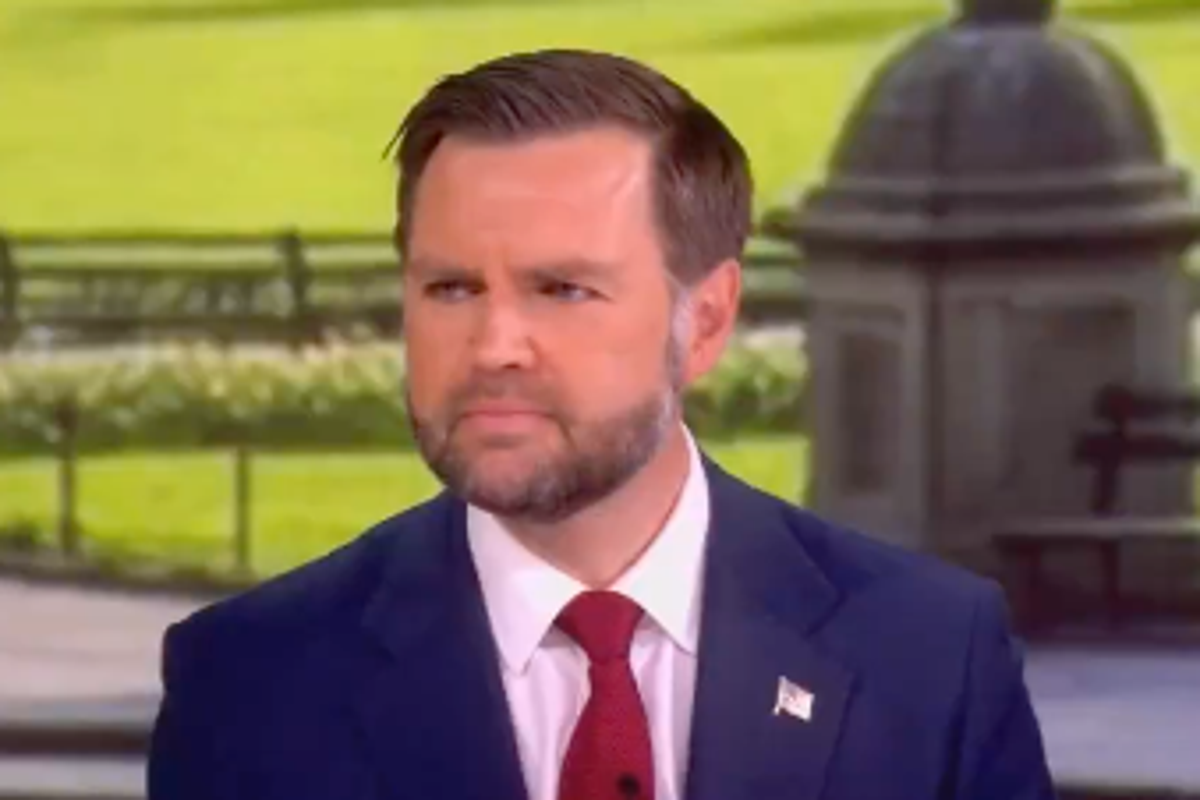
The green room of a network television studio is a strange, synthetic purgatory. It smells of expensive hairspray, neutralized coffee, and the quiet, vibrating panic of people who are about to be judged by millions of strangers through a glass lens. For a politician, it is a staging area. You check your tie. You review your talking points. You assume that because you have debated Ivy League intellectuals and survived hostile press scrums, you are ready for whatever happens when the red light goes live.
That is the first mistake.
The daytime talk show is not a press conference. It is a Colosseum disguised as a living room. When JD Vance stepped onto the set of The View, he wasn't just walking into a media appearance. He was walking into a finely tuned cultural ecosystem governed by rules that do not exist in Washington committee rooms.
Politics operates on the logic of the filibuster and the pivot. Daytime television operates on the law of the living room. In a living room, if you are perceived as evasive, condescending, or fundamentally untruthful, the people sitting across from you do not ask a polite follow-up question. They cut you off.
The Chemistry of the Semi-Circle
Every daytime talk show set is designed to mimic intimacy. The chairs are curved inward. The coffee mugs are prominent. The studio audience sits mere feet away, acting as a live barometer for every smirk, every hesitation, and every sharp intake of breath.
To understand what happened to Vance, consider a hypothetical viewer named Sarah. She is fifty-two. She watches the show while folding laundry or answering emails during a hybrid work shift. She has spent decades reading people—her kids, her bosses, her neighbors. She does not need a political science degree to detect when a man is trying to slide a fast one past her. She knows the exact tone someone uses when they are trying to minimize a mistake.
When the co-hosts opened the segment, the atmosphere shifted instantly from hospitality to a trial. The questioning did not start with policy white papers. It started with words. Specifically, Vance’s own past words regarding American families, women who do not have biological children, and the leadership of the country.
Vance attempted the standard political maneuver. Smile. Soften the posture. Lean into a joke. He tried to reframe his previous controversial remarks as mere rhetorical flourishes, hyperbole from a different chapter of his life.
It failed completely.
The co-hosts did not allow the reframe to land. Whoopi Goldberg’s silence alone can occupy an entire room. Joy Behar’s skepticism is a physical force. Sunny Hostin approaches a conversation with the precise, methodical sharpness of a federal prosecutor. When Vance tried to explain away his "childless cat lady" comments as a critique of the Democratic party rather than an attack on individuals, the table revolted.
They didn't argue the statistics of American birth rates. They argued the human reality. They spoke for every aunt, every stepmother, every woman who struggled with infertility, and every person who chose a different path in life. They transformed a political debate into a moral defense of their audience's lived choices.
The Mirage of the Friendly Debate
Politicians often perform well in hostile environments when the hostility is overt. A shouting match on a cable news network allows a candidate to look like a warrior fighting for their base. The anger is predictable. The talking points fit neatly into the conflict.
But The View is different. The hostility there is wrapped in bright daytime lighting and punctuated by commercial breaks for fabric softener. It confuses the political instinct. Vance found himself caught between trying to appear likable and trying to hold his ground. Every time he attempted a standard political pivot—shifting the conversation toward inflation or border security—the co-hosts pulled him back to the specific, uncomfortable things he had said on tape.
Consider what happens next in that dynamic. The politician realizes the charm offensive isn't working. The smile tightens. The tone grows slightly more defensive. On high-definition cameras, that micro-expression is fatal. The audience watches the confidence drain out of a performer in real-time.
Political Logic:
Statement -> Deflect -> Introduce New Topic -> Victory

Daytime Television Logic:
Statement -> Confrontation -> Emotional Accountability -> Verdict
Vance’s defense relied heavily on the idea that the media willfully misunderstands him. He argued that his comments were taken out of context, stripped of their nuance, and weaponized by political opponents.
But nuance is a luxury that vanished from the public square long ago. When you give a microphone a memorable, biting phrase, that phrase becomes your shadow. It follows you into every room you enter. You cannot ask an audience to read a three-page explanatory essay regarding a ten-second soundbite. The soundbite wins every time.
The Invisible Stakes of the Living Room
Why does an appearance on a daytime talk show matter more than a major policy address? Because of the nature of attention.
People watch Sunday morning political shows with their armor on. They know they are watching a partisan contest. They have already decided which side they support. The language used in those spaces is code, understood by insiders and ignored by the vast majority of the country.
Daytime television catches people with their guard down. It is the background track to daily American life. When a politician stumbles there, it isn't viewed as a tactical error in a campaign strategy. It is viewed as a character flaw.
The co-hosts did not merely disagree with Vance’s policy positions. They challenged his empathy. They asked, implicitly and explicitly, if he truly understood the lives of the people he wished to govern. When Hostin pressed him on his views regarding reproductive rights and the exceptions for rape and incest, the conversation stopped being about legal philosophy. It became about the terrifying realities of human trauma.
Vance stuck to his script. He spoke of the sanctity of life. He spoke of supporting families. But the words sounded clinical against the raw, personal testimonies of the women sitting across from him. The contrast was stark. On one side of the table was a man executing a strategy. On the other side were women reacting from instinct, experience, and an acute awareness of their viewership.
The Long Shadow of the Studio Lights
By the time the final segment wrapped and the show went to a commercial break, the damage was done. The clip was already being chopped up into fifteen-second segments for social media feeds across the globe.
The political commentators will look at the tape and debate whether Vance shored up his base or if he lost moderate suburban voters. They will analyze the cross-tabs of the next poll to see if the unfavorable ratings ticked up a point or two among women over forty.
But that analysis misses the deeper truth of what transpired in that studio.
The true takeaway from Vance’s appearance is not about policy, or polling, or political strategy. It is about the illusion of control. In the modern media ecosystem, politicians believe they can micro-target their way to power, controlling every narrative through curated podcasts, friendly influencers, and tightly scripted rallies.
Then they step into a room they do not own.
They sit at a table with people who do not care about their titles, their credentials, or their talking points. And under the unforgiving heat of the studio lights, the carefully constructed persona melts away, leaving behind only the stark, unvarnished reality of who they are when they are cornered.
The cameras stop rolling. The audience applauds on cue. The guest is escorted out the back door toward a waiting SUV. But the silence in the green room afterward is deafening, filled with the sudden, sharp realization that some audiences cannot be managed, some rooms cannot be won, and some words can never be taken back.