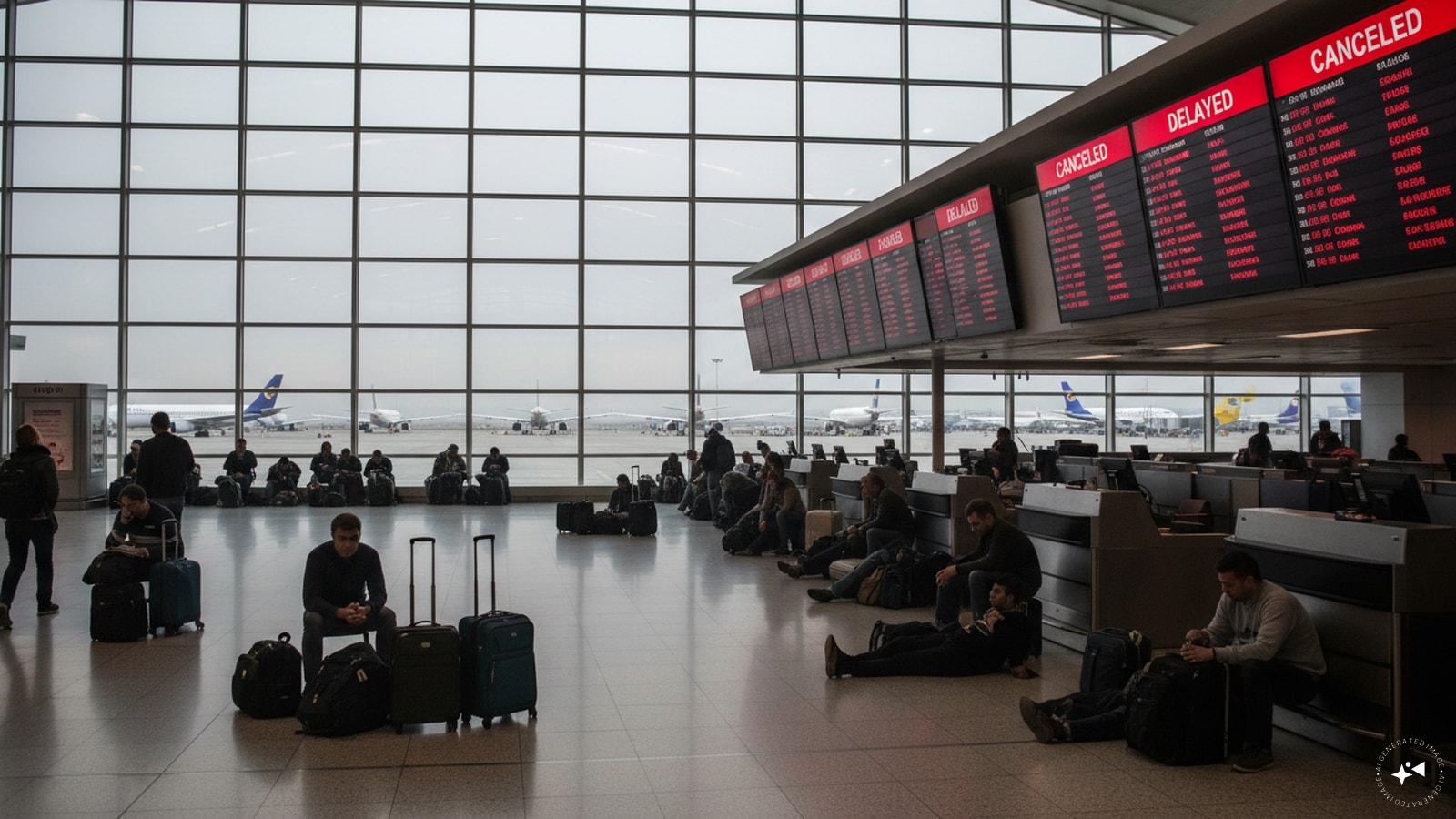
At 4:12 in the morning at Chicago O’Hare, the departure boards did not flicker or fade. They simply froze.
Terminal 1 smelled like burnt espresso and wet wool. Gate agents stood behind podiums staring at monitors that had turned a flat, indifferent shade of azure, each screen displaying the same cryptic white text about a system crash. Around them, thousands of people—nurses heading home after double shifts, fathers clutching garment bags for weddings, toddlers asleep on rolling suitcases—waited for someone to explain why an invisible wall had just dropped across the sky.
Silence.
That is what strikes you first when modern infrastructure stops working. Not explosions, not sirens, just the sudden, eerie absence of movement. A jet bridge stays retracted. A baggage carousel hums to a halt. A gate agent picks up a landline phone, listens to dead air, and sets it back down with a hollow clack.
When a single flawed software update from cybersecurity firm CrowdStrike collided with Microsoft Windows in July 2024, it did not merely inconvenience travelers or delay quarterly earnings reports. It pulled back the curtain on a fragile, hyper-connected architecture we have spent thirty years building without a manual override. Grounded US flights and stalled corporate networks sparked immediate fears of a wider breakdown—not because the glitch itself was malicious, but because it proved how easily an entire civilization can trip over a single line of code.
The Architecture of Invisible Dependency
Consider a hypothetical traveler—let’s call her Elena—standing in line at Atlanta’s Hartsfield-Jackson airport that morning. Elena is a pediatric surgical coordinator trying to reach Boston before noon. She does not care about kernel-level drivers or cloud server redundancy. She cares about a boarding pass that suddenly refuses to load on her phone, and a gate agent who has to write seat assignments on sticky notes with a ballpoint pen.
To understand why Elena was stranded, you have to stop thinking of the internet as a cloud and start picturing it as a stack of dominoes standing on a glass table.
At the bottom sits the operating system—predominantly Microsoft Windows, which powers roughly 70 percent of desktop computers and countless enterprise servers worldwide. Directly on top of that operating system, running with the highest possible level of security clearance, sits endpoint protection software. Think of cybersecurity tools like CrowdStrike’s Falcon sensor as armed guards stationed inside the vault of a bank, holding the master keys to every door. To catch sophisticated hackers in milliseconds, those guards need permission to inspect every file, every memory allocation, and every network packet before the computer even finishes booting up.
That speed comes at a terrifying price. Because the security software operates at the deepest layer of the machine—known as the kernel—a single corrupted instruction inside an update file does not just crash one application. It forces the entire computer to shut down to protect itself from catastrophic data corruption.
The result is the infamous Blue Screen of Death. Multiply that blue screen across 8.5 million Windows machines simultaneously, and you get what happened when a routine configuration update pushed out by CrowdStrike contained a logic error. Within minutes, airlines lost access to crew scheduling and weight-and-balance calculators. Hospitals cancelled non-urgent surgeries because patient records and pharmacy dispensing systems went dark. 911 call centers in several US states lost their automated dispatch screens, forcing operators to scribble emergency addresses onto legal pads.
It was not a cyberattack. Nobody hacked the grid. A trusted guard simply locked the vault from the inside and swallowed the key.
Why One Glitch Paralyses Everything
People often ask why airlines, banks, and hospitals cannot simply switch to a backup system when primary servers go down. The uncomfortable truth is that for most modern enterprises, there is no offline backup left to switch to.
Thirty years ago, if a regional airline’s computer terminal died, a supervisor walked over to a filing cabinet, pulled out a laminated load-sheet chart, and calculated fuel weight with a pocket calculator. Today, those filing cabinets are gone. Efficiency demanded that every step of physical logistics—from fueling a Boeing 737 to routing an ambulance—be fused directly into real-time cloud software. We traded resilience for optimization.
When Delta Air Lines, American Airlines, and United requested nationwide ground stops during the outage, the problem was not that the airplanes could not fly. The engines worked. The pilots were awake. The runways were clear. The paralysis happened because modern aviation cannot legally or safely dispatch a commercial jet without digital verification of crew duty hours, maintenance sign-offs, and passenger manifests. When the crew-tracking software crashed, the airline literally lost track of where its pilots and flight attendants were standing.
You cannot improvise a global flight schedule with whiteboards. Every cancelled flight creates a cascading wave of displaced crews, timed-out shifts, and planes parked at the wrong airports—a logistical knot that takes days of grueling manual untangling even after the computers reboot.
| Sector | Immediate Failure Point | Human & Operational Impact |
|---|---|---|
| Commercial Aviation | Crew scheduling, check-in kiosks, weight-and-balance dispatch | Over 5,000 global flights cancelled in 24 hours; days of stranded passengers |
| Healthcare Systems | Electronic health records, lab routing, imaging workstations | Delayed cancer treatments, cancelled surgeries, manual paper charting |
| Financial & Retail | Point-of-sale terminals, payroll processing, ATM networks | Cash-only transactions at major grocers, frozen wire transfers |
| Emergency Services | Computer-aided dispatch (CAD) consoles | 911 operators forced to relay addresses via radio and handwritten notes |
Watching that domino effect unfold in real time is deeply unsettling, even if you spend your life working in technology. We like to believe that critical infrastructure is protected by layers of fail-safes, watched over by engineers who have anticipated every edge case. Living through a synchronized global outage strips away that comfort. It forces you to confront how much of your daily survival—your groceries, your paycheck, your flight home, your hospital visit—depends on a handful of private software vendors pushing updates while you sleep.
The Monoculture Trap
Walk through any agricultural valley and a farmer will tell you what happens when you plant the exact same genetic strain of corn across ten thousand acres. For years, yields soar. Everything grows at the same height, ripens on the exact same week, and harvests with uniform machinery. Until a single blight arrives that the crop has no resistance against—and wipes out the entire harvest in a weekend.
In technology, we have built a digital monoculture.
Because training staff, maintaining compliance, and integrating tools across thousands of offices is prohibitively expensive, Fortune 500 companies and government agencies converge on the exact same software stack. Microsoft for productivity and operating systems. CrowdStrike or a small handful of rivals for endpoint defense. Amazon Web Services or Azure for cloud hosting.
This consolidation makes tremendous financial sense right up until the moment something breaks. When every major carrier, hospital network, and freight railroad runs the identical software configuration, a single bug becomes a systemic shock.
But the real problem lies elsewhere. It is not just that we rely on a few giant companies; it is that we have allowed software updates to bypass basic staged deployment protocols in the name of speed.
In a disciplined engineering environment, a new update never goes to every customer at once. It rolls out in concentric rings: first to internal test machines, then to 1 percent of external users, then 10 percent, watching for crashes at every stage before touching mission-critical servers. In cybersecurity, however, vendors face relentless pressure to push threat definitions instantly so customers are protected against zero-day attacks. Speed became the ultimate virtue. Caution looked like negligence—until speed itself caused more damage than most ransomware attacks ever have.
The Myth of the Easy Reboot
Perhaps the most infuriating detail of the Microsoft-CrowdStrike breakdown—and the reason recovery dragged on for days—was how deceptively simple the technical fix actually was.
To restore a crashed machine, an IT administrator simply had to reboot the computer into Safe Mode, navigate to a specific CrowdStrike directory, delete a single corrupted file matching a specific timestamp, and restart the system. On a single laptop sitting on your kitchen table, that process takes roughly ninety seconds.
Now picture doing that across forty thousand machines scattered across hundreds of airport gates, hospital basements, and retail backrooms—many of which are locked with BitLocker encryption, requiring a unique 48-character recovery key stored on a server that is also currently blue-screened.
You cannot fix a dead computer over the internet when the computer will not boot far enough to connect to the internet.
Suddenly, the most advanced corporations on earth were relying on exhausted technicians walking miles of terminal hallways with USB drives and printed spreadsheets of recovery keys, kneeling on dirty carpet behind ticket counters to type forty-eight digits into one machine at a time.
It was a humbling collision between the virtual world and physical reality. Software scales infinitely at the speed of light; human beings still have to walk through doors, unscrew panels, and type with their fingers.
Building Resilience Without Turning Back the Clock
Nobody is going back to paper ledgers and rotary phones, nor should we. Digital automation has made air travel safer than at any point in human history, slashed medical errors, and connected global commerce in ways that lift millions out of poverty. The answer to a fragile system is not abandoning technology—it is demanding that our critical infrastructure be built to bend without shattering.
First, regulators and enterprise buyers have to force an end to simultaneous global rollouts for kernel-level software. If an update touches the core operating system of an airline, hospital, or utility, mandatory canary deployments—testing on small, isolated batches of machines over hours rather than seconds—must become non-negotiable.
Second, operating system architects like Microsoft are already facing mounting pressure to lock third-party security vendors out of the kernel altogether, moving them into user-mode spaces where a crashed security tool can restart cleanly without taking the entire computer down with it. Apple made this architectural shift on macOS years ago, which is why Mac fleets sailed through the July outage completely untouched.
Third, organizations running essential public services must maintain genuine, air-gapped fallback procedures—and actually drill them. Not dusty binders sitting in a closet, but quarterly simulations where staff practice running basic operations when the screens go dark.
Late that evening at O’Hare, long after the news anchors had moved on to debating stock price drops and liability clauses, a small crowd finally began moving down the jet bridge of Gate B14.
The boarding passes were wrinkled printouts. The gate agent’s voice was hoarse from twelve hours of apologizing for a mistake made in a server room a thousand miles away. Inside the cabin, passengers stowed their bags quietly, buckled their seatbelts, and looked out the scratched plexiglass windows at the wet tarmac gleaming under sodium lights.
Below the wing, a ground crew member in a neon vest unplugged the heavy black power cable from the fuselage, coiled it over his shoulder, and walked back toward the terminal. Inside the cockpit, two pilots ran through a printed checklist by hand, flipping physical switches one by one before pushing back into the dark.