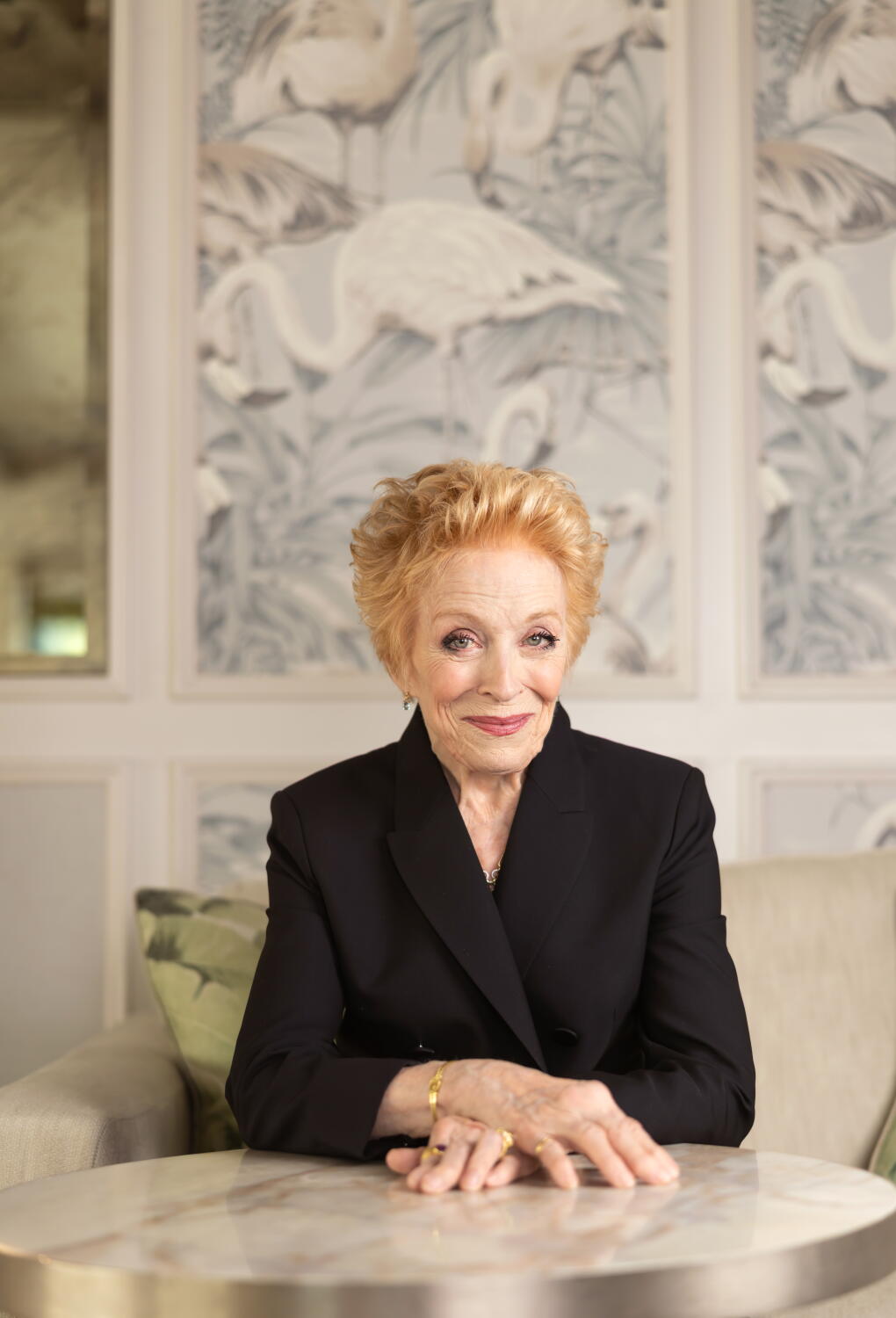
The script calls for a grandmother.
On paper, she is eighty-one years old. She has silver hair, a soft cardigan, and a history of baking pies while dispensing gentle wisdom to the younger, louder characters who actually drive the plot. In the rigid, unforgiving casting rooms of Los Angeles, that is the ceiling. Once an actress crosses fifty, the parts shrink. By seventy, she is essentially furniture—a warm, decorative fixture placed in the corner of the frame to remind the audience that the protagonist has a family. Also making waves recently: How *The Greatest* Exposes the Business and Politics of Muhammad Ali's Reinvention.
Then Holland Taylor walks onto the set of Brothers, the 2024 action-comedy starring Josh Brolin and Peter Dinklage, and sets fire to the cardigan.
She does not play a grandmother. She plays a force of nature with a sharp tongue, an unapologetic libido, and the terrifying poise of a woman who knows exactly where every body is buried because she helped dig the holes. Watching her share the screen with two of Hollywood’s most notoriously intense leading men feels less like a polite generational handoff and more like a hostile takeover. Within seconds of her arrival, the center of gravity in the room shifts entirely toward her. More details on this are covered by Rolling Stone.
We have a terrible habit of praising veteran actresses for their "grace." It is a polite, suffocating word. Grace implies quietness. It implies stepping aside. Holland Taylor has spent over five decades refusing to step aside, weaponizing her patrician cheekbones, her velvet-and-bourbon voice, and a wicked, unblinking sense of humor to prove that desire, ambition, and sheer comedic menace do not have an expiration date.
The Myth of the Invisible Woman
To understand why Taylor’s turn in Brothers feels so electric, you have to understand the quiet humiliation baked into the standard Hollywood career arc.
Consider a hypothetical actress—let us call her Evelyn. Evelyn spends her thirties playing the supportive wife and her forties playing the harried mother. By fifty-five, her phone stops ringing. When it finally does ring, the audition sides are three lines long, usually involving a hospital bed or a concerned look through a kitchen window. The industry treats aging in women not as an accumulation of power, but as a slow fade to black.
I remember sitting in a screening room years ago, watching an audience react to a trailer for a major studio comedy. Every time a young actor delivered a crude joke, the room chuckled. When an older actress delivered a line with a hint of sexual agency, the laughter shifted—it became nervous, almost defensive, as if the crowd didn't quite know how to process an older woman claiming space as a desiring, desirable human being. We are conditioned to view female sexuality and sharp wit as the exclusive property of youth.
Holland Taylor looked at that unwritten rule and decided it was beneath her notice.
Born in Philadelphia in 1943, Taylor came up through the rigorous, unforgiving world of New York theater before transitioning to television and film. She earned her stripes on stage, where a performer cannot rely on a sympathetic camera angle or a generous editor. On stage, you command the room through posture, breath, and absolute certainty. You learn that stillness is louder than shouting.
When she arrived in Hollywood, she brought that theatrical armor with her. While other actresses were scrambling to soften their edges to remain "likable"—that most fatal of Hollywood traps—Taylor leaned into the sharp corners. She realized early on that if the industry wanted to cast her as the authority figure, the judge, the mother, or the boss, she would play those roles with a subtext so rich and subversive that the audience wouldn't be able to look away.
The Architecture of a Scene Stealer
Watch her closely in Brothers, or reach back into the archive to her work in Two and a Half Men, The Practice, or Legally Blonde. There is a distinct, repeatable mechanics to how she dismantles a scene.
Most comedic actors work too hard. They telegraph the joke with raised eyebrows, frantic pacing, or vocal inflection that begs the audience to laugh. Taylor does the exact opposite. She treats the most outrageous, carnal, or ruthless dialogue as if she were reading the weather report at a country club luncheon.
Think of it like watching a master chess player against two frantic speed-chess amateurs. In Brothers, Josh Brolin and Peter Dinklage play twin criminals—one trying to go straight, the other pulling him back into the mud. Their energy is kinetic, bruised, and desperate. They sweat. They scramble. They yell. And right in the middle of their chaos sits Taylor, barely moving a muscle, delivering lines that cut straight through their bravado like a straight razor through silk.
She uses what theater directors call "high status." In any human interaction, status isn't determined by who has the gun or who yells the loudest; it is determined by who refuses to flinch. Taylor never flinches. Whether she is playing Judge Roberta Kittleson—a role that won her an Emmy on The Practice because she made a courtroom bench feel like a throne—or Evelyn Harper, the narcissist mother from hell on Two and a Half Men, she operates from a position of total, unbothered supremacy.
And then there is the sex appeal.
Let us be blunt, because Taylor certainly is. For decades, entertainment journalists have tiptoed around the fact that Holland Taylor is intensely, unapologetically sexy. Even in her seventies and eighties, she carries an erotic charge that makes actors half her age look timid. Why? Because real sensuality has nothing to do with collagen or lighting; it is entirely about self-possession. It is the aura of someone who knows what she wants, knows how to get it, and refuses to apologize for wanting it.
In Brothers, that energy isn't played as a cheap gag—the tired, insulting "look at the horny old lady" trope that lazy screenwriters have relied on since the 1970s. Instead, it is woven into her character's DNA. Her appetites—for money, for control, for pleasure—are treated as completely natural extensions of her survival instinct. She isn't a punchline. She is the apex predator in the room.
The Long Game of Refusing to Apologize
You do not arrive at eighty-one with this kind of cultural capital by accident. You earn it by surviving the lean years without compromising your instrument.
Before her mainstream television breakthroughs in the late 1990s, Taylor spent years as one of those "that woman" actors—the performer whose face you recognized instantly, even if you couldn't quite pull her name from memory. She played high-powered executives in Bosom Buddies, sharp-tongued editors in Romancing the Stone, and icy socialites in To Die For. In each of those roles, she was given minutes, sometimes mere seconds, of screen time.
A lesser actor treats a three-minute scene as a footnote. Taylor treated every three-minute scene as a one-act play.
Look at Legally Blonde (2001). On paper, Professor Stromwell is a standard academic obstacle—the tough law professor meant to intimidate Reese Witherspoon’s Elle Woods. The movie belongs to Witherspoon, and rightly so. Yet every single person who has seen that film remembers Stromwell’s cold, surgical dismantling of a student's weak argument, followed later by her quiet, devastatingly effective moment of mentorship. Taylor didn't need a tragic backstory monologue to make Stromwell human. She did it with the tilt of her chin and the sudden, surprising warmth in her eyes when she told Elle, "If you're going to let one stupid prick ruin your life, you're not the girl I thought you were."
That line became a cultural touchstone not just because it was well-written, but because Taylor delivered it with the lived-in authority of a woman who had clearly survived a few stupid pricks of her own.
The Courage of Visibility
There is another layer to Taylor’s late-career dominance that rarely gets discussed in standard celebrity profiles, yet it sits at the very heart of why audiences connect with her so deeply now.
In 2015, during a radio interview, Taylor casually mentioned that she was in a relationship with a woman—later revealed to be actress Sarah Paulson—and had lived most of her life in same-sex relationships. She didn't hold a press conference. She didn't write a tearful tell-all memoir. She simply answered a question truthfully, in her seventies, with the same unbothered grace she brings to everything else.
Think about the psychological weight of that. For generations, actors of Taylor’s era were told that keeping their private lives locked in a vault was the only way to preserve their careers, particularly if they wanted to play authority figures or romantic leads. To live openly was considered professional suicide.
By the time she spoke about her personal life, she wasn't asking for permission or validation. She had already built an unassailable fortress of talent. And something remarkable happened in the years that followed: her work grew even sharper, freer, and more fearless.
When an artist stops spending energy hiding who they are, all of that reclaimed fuel goes straight into the work. You can see it in her one-woman Broadway show, Ann, which she wrote and starred in, earning a Tony nomination for her portrayal of the legendary Texas governor Ann Richards. You can see it in Hollywood, Ryan Murphy’s revisionist Netflix series, where she earned yet another Emmy nomination playing Ellen Kincaid, a powerhouse studio executive navigating the ruthless machinery of 1940s cinema.
Ellen Kincaid was, in many ways, the spiritual ancestor of the woman we see in Brothers—a veteran survivor who understands that Hollywood is a brutal game, and the only way to win is to master the rules better than the men who wrote them.
Why We Need Her Now
We are living through a strange, anxious moment in entertainment. Studios are terrified of taking risks. Algorithms dictate casting choices based on social media follower counts rather than stagecraft. Young actors are often groomed to be brands first and performers second, smoothed out until there is nothing left to catch the light.
Against that sterile backdrop, Holland Taylor feels almost dangerous.
She cannot be replicated by an algorithm. You cannot manufacture fifty years of theatrical timing, the specific rasp of a voice shaped by decades of smoke, laughter, and stage projection, or the bone-deep confidence of a woman who has outlasted three generations of studio executives.
When she steps into a frame alongside Josh Brolin and Peter Dinklage in Brothers, she isn't there to provide nostalgic comfort. She is there to remind everyone—the actors, the director, and the audience—what real command looks like. She proves that age does not dull the blade; it hones it.
Watch her hands the next time she appears on screen. While younger actors fidget, cross their arms, or reach for props to hide their nerves, Taylor’s hands remain completely still until the exact millisecond she chooses to move them. She holds the frame hostage without raising her voice. She makes cruelty look hilarious, vulnerability look like steel, and desire look like a birthright that no calendar has the authority to revoke.
The credits roll on Brothers, the explosions fade, and the plot mechanics dissolve from memory. What stays with you is the sound of that unmistakable voice, leaning slightly forward, smiling like she knows a secret that would ruin your life if she bothered to tell it—and deciding, just for tonight, to let you live.


