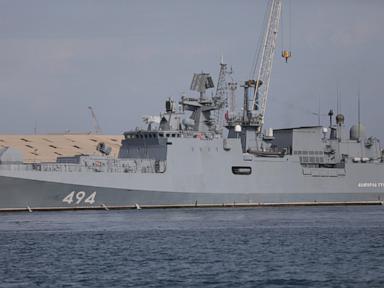
The sea has a way of swallowing sound, but it cannot drown out the sharp, mechanical crack of military deck guns.
On Tuesday morning, Jane Kelvey, 68, and her husband Alan, 70, were navigating the familiar, gray waters of the English Channel aboard their 40-foot sailing yacht, Bright Future. They were headed toward Cherbourg, France, enjoying the steady hum of a crossing they had likely planned with the meticulous care typical of experienced sailors. The Isle of Wight lay roughly 20 nautical miles behind them.
Then the horizon changed.
Emerging from the haze was the Admiral Grigorovich, a heavily armed Russian guided-missile frigate. Within moments, the silence of the open water was shattered. Explosive warning shots tore into the air.
Jane instinctively crouched down on the deck. The sheer absurdity of the moment competed with the sudden rush of adrenaline. When you are on a fiberglass sailboat, a 4,000-ton warship is not just a vessel. It is an indifferent, floating fortress. As the Kelveys managed to pull away from the area unharmed, they looked at one another, stunned.
What the hell just happened?
The Anatomy of an Echo
Geopolitics feels distant until it happens in your backyard. For decades, the English Channel has been treated as a busy maritime highway, a place for cargo ships, ferries, and weekend hobbyists. But the sudden presence of live ammunition near a British-flagged civilian yacht highlights how thin the barrier between peace and international friction has become.
Predictably, the explanations from both nations offered two entirely different versions of reality.
According to the Russian Defense Ministry, the crew of the Admiral Grigorovich acted in strict compliance with international maritime law. They claimed the Bright Future was on a dangerous approach, heading directly toward the warship under power. The Kremlin stated that the frigate attempted to contact the yacht, firing signal flares and sounding horns before resorting to warning shots to prevent a collision.
Alan Kelvey dismissed the official Russian statement with the blunt skepticism of someone who was actually there, calling the narrative "just normal lies." The couple maintained they were never on a collision course.
The British Ministry of Defence launched an immediate assessment to determine if this was a deliberate act of intimidation or something else entirely. The timing was highly suspicious. Just two days prior, British forces had taken the unprecedented step of seizing the Smyrtos, a tanker linked to Russia’s "shadow fleet"—the network of under-the-radar vessels used by Moscow to bypass Western sanctions on oil exports. Furthermore, a British court had just convicted two men of plotting an arson attack against property connected to Prime Minister Keir Starmer, an operation linked to an online handler with ties to Russia.
It seemed entirely plausible that the shots in the Channel were a calculated message.
A Giant Without a Rudder
But the official British analysis yielded a conclusion that was, in many ways, more unsettling than a direct threat.
Speaking from the G7 summit in France, Prime Minister Keir Starmer addressed the incident. He did not describe a calculated act of naval aggression. Instead, British defense officials concluded the Admiral Grigorovich was actually a drifting warship.
Consider the mechanics of that reality. A heavily armed, missile-carrying warship was floating through one of the busiest shipping lanes in the world, seemingly suffering from mechanical issues or poor navigation, its crew firing live rounds into the sky because they lacked the control or the communication protocol to handle a passing civilian sailboat cleanly.
Starmer labeled the crew's actions as reckless. But he explicitly chose not to call it sinister.
There is a distinct difference between a calculated adversary and a clumsy, heavily armed one. A calculated adversary follows a logic you can map out, negotiate with, or deter. A drifting giant with a nervous crew on deck is entirely unpredictable.
The Prime Minister’s deliberate use of the word "reckless" rather than "sinister" was a diplomatic choice designed to de-escalate. In the delicate language of statecraft, accusing a foreign military vessel of a deliberate attack on civilians can trigger clauses, deployments, and retaliatory cycles that nobody wants. By classifying the incident as an act of profound incompetence and poor seamanship rather than an act of war, the government effectively closed the door on a military escalation while still condemning the behavior.
Yet, downplaying the intent does not erase the broader environment. As the Royal Navy's offshore patrol vessel HMS Mersey moved in to shadow the Russian frigate and escort it out of the area, the underlying tension remained clear.
The Reality of a More Dangerous World
We often view international conflict through the lens of grand strategy, assuming that every move on the global chessboard is guided by a mastermind. The reality on the water is often far messier, driven by human error, equipment failure, and panic.
But these errors do not happen in a vacuum. They happen because the baseline level of global friction has risen dramatically. The war in Ukraine is now in its fifth year. Sabotage plots, cyber incursions, and shadow-fleet seizures are no longer hypothetical scenarios discussed in briefing rooms; they are part of the daily friction between East and West.
When a state-backed campaign of destabilization is active across Europe, every broken-down engine or miscommunicated radio call carries the weight of a potential international crisis. If a Russian crew is already on edge, operating in waters where their oil tankers are being actively seized by the host nation, their fingers will sit closer to the trigger.
The Kelveys returned to shore with an unbelievable story and a boat that was completely undamaged. They survived a brush with a geopolitical ghost. But their experience serves as a stark reminder of the current global climate. The true danger we face right now might not be a highly coordinated, sinister plot designed to spark a confrontation.
The real danger is that we are sharing a crowded room with a volatile, drifting giant, and it only takes one nervous sailor to pull a trigger.