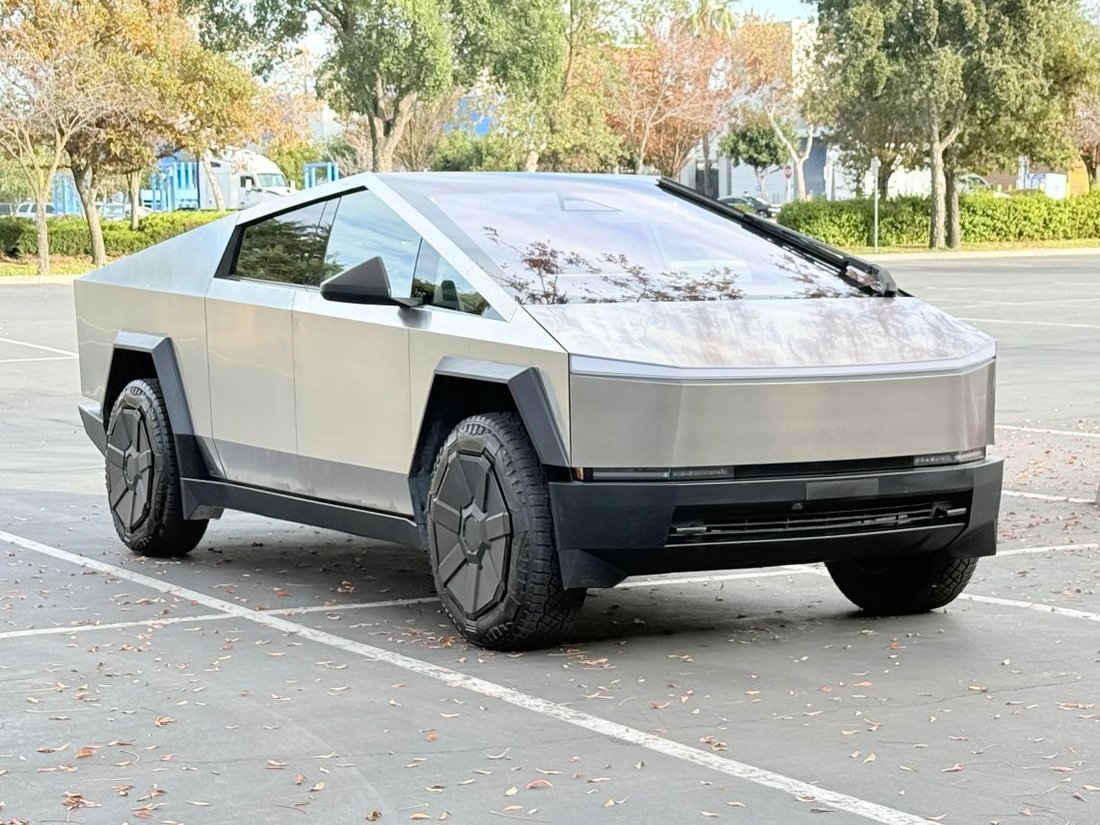
Wall Street analysts love a neat narrative. They want clean spreadsheets, predictable automotive margins, and a CEO who stays in his lane. So whenever rumors swirl that Elon Musk is pivoting Tesla entirely toward humanoid robotics and artificial intelligence, the financial press immediately reaches for the same lazy conclusion. They claim the Cybertruck is on the chopping block. They frame it as a bloated, stainless-steel distraction that Musk will quietly euthanize to fund his Optimus robot ambitions.
That take is completely backward. It fundamentally misunderstands how hardware engineering works at the bleeding edge, how Tesla actually funds its R&D, and what the Cybertruck truly is.
If you look at the Cybertruck as a consumer pickup truck competing against the Ford F-150 Lightning or the Rivian R1T, you are already asking the wrong question. You are judging a rolling research and development laboratory by the metrics of a suburban commuter vehicle. Killing the Cybertruck to focus on AI and robotics would not accelerate Tesla's future. It would amputate the very manufacturing and electrical engineering breakthroughs that make Tesla's robotics division possible in the first place.
The Myth of the Zero-Sum Pivot
The mainstream tech press treats corporate strategy like a game of musical chairs. According to their logic, if Tesla allocates capital and engineering brainpower to Dojo supercomputers, Full Self-Driving (FSD), and Optimus, it must cannibalize its vehicle lineup—starting with the weirdest, hardest-to-build vehicle on the lot.
I have spent over a decade watching hardware startups and legacy industrial giants blow hundreds of millions of dollars on this exact binary thinking. Executives panic when a flagship product hits production bottlenecks. They starve the hardware team of cash, pivot to "pure software" or "AI," and then act shocked two years later when their software has no viable physical body to inhabit.
In physical AI, you cannot separate the brain from the nervous system.
When Tesla engineers built the Cybertruck, they were not just bending cold-rolled 30X stainless steel. They were tearing up a century of automotive manufacturing dogma. Every single radical architecture decision inside that truck directly feeds the robotics and AI side of the house.
Consider what happens when you build a humanoid robot like Optimus. You need extreme actuator density, minimal wiring weight, high-voltage power distribution, and fault-tolerant compute. Where did Tesla solve those exact problems at commercial scale? On the Cybertruck assembly line at Giga Texas.
The 48-Volt Nervous System Nobody Talks About
Most commentators fixate on the Cybertruck's bulletproof exterior or its polarizing wedge shape. They completely miss the real story hiding under the skin. The Cybertruck is the first mass-produced vehicle to ditch the archaic 12-volt electrical architecture that Henry Ford standardized over a century ago, replacing it with a 48-volt low-voltage system.
To understand why this matters, look at basic physics: Power equals Voltage times Current ($P = V \times I$). By quadrupling the voltage from 12V to 48V, you reduce the current required to deliver the same amount of power by a factor of four. Lower current means drastically thinner copper wires. Thinner wires mean massive reductions in weight, cost, and assembly complexity.
Now, apply that exact engineering principle to a bipedal robot.
A humanoid robot cannot afford heavy, thick bundles of copper wiring running through its shoulders, elbows, and knees. Every gram of unnecessary weight in a robotic limb requires larger motors to lift it, which requires bigger batteries to power those motors, creating a vicious cycle of mechanical bloat. By forcing its supply chain to develop 48-volt components—from actuators and sensors to power converters—for the Cybertruck, Tesla effectively subsidized the component ecosystem required for Optimus.
If Tesla axed the Cybertruck tomorrow, who would buy the millions of 48-volt subcomponents needed to keep those Tier-1 suppliers profitable? Certainly not the low-volume early production runs of a humanoid robot. The Cybertruck provides the manufacturing volume necessary to drive down the unit economics of next-generation electrical architectures.
Steer-by-Wire and the Death of Mechanical Linkages
The same logic applies to the Cybertruck's steer-by-wire system. For over a hundred years, turning a steering wheel mechanically turned a metal shaft connected to a rack and pinion. The Cybertruck severed that physical connection entirely. When you turn the squircle wheel, redundant electric motors send digital signals to actuators on the front and rear axles.
Why would an AI company care about removing a steering column?
Because an autonomous vehicle—or a humanoid robot—does not have hands to turn a mechanical wheel. When an AI neural network controls a physical machine, every mechanical linkage is a point of latency, friction, and failure. Steer-by-wire transforms vehicle control into pure digital actuation. The latency between the AI's decision and the physical execution drops to milliseconds.
Furthermore, the Cybertruck serves as the ultimate real-world stress test for redundant actuator reliability. If a steer-by-wire actuator fails on a highway at 75 miles per hour, people die. Therefore, Tesla had to engineer triple-redundant power and signal pathways capable of surviving extreme heat, freezing cold, mud, and brutal vibration. Once you validate that level of actuator reliability in hundreds of thousands of heavy trucks beating themselves up on gravel roads, deploying those same control principles into a factory robot becomes vastly simpler.
Giga Castings and Structural Batteries
Let us look at the manufacturing floor. Traditional automakers stamp out hundreds of individual sheet-metal parts and use thousands of spot welds to assemble a chassis. It is slow, expensive, and requires massive factory footprints.
Tesla pioneered single-piece Giga Castings on the Model Y, and pushed the technology to its absolute limits on the Cybertruck. Using massive 9,000-ton Giga Presses built by IDRA, Tesla casts the entire front and rear underbodies of the Cybertruck as single chunks of aluminum alloy. Simultaneously, the structural battery pack—utilizing 4680 cells—acts as the floor of the vehicle, providing torsional rigidity rather than dead weight.
Think about what this means for robotics and future autonomous platforms like the Cybercab.
Building a robot or an autonomous pod cheaply enough to flood the market requires eliminating assembly steps. You cannot profitably manufacture ten million robots a year if humans or robotic arms have to bolt together five hundred distinct structural brackets per unit. The metallurgical formulas Tesla developed to cast giant aluminum structures without heat treatment are proprietary intellectual property forged in the fires of Cybertruck production.
Sandy Munro, the veteran automotive teardown expert who has spent decades analyzing manufacturing costs for the world's largest OEMs, pointed out repeatedly during his Cybertruck teardowns that the vehicle's true value lies in its manufacturing innovations, not its body panels. Legacy automakers are still trying to figure out how to copy the Model Y's castings. Tesla is already three iterations ahead because of the Cybertruck.
Dismantling the "People Also Ask" Fallacies
When retail investors and tech enthusiasts search for news about Tesla's future, the same flawed questions dominate the search results. Let us dismantle them with hard reality.
Is the Cybertruck a financial failure for Tesla?
People ask this because early production ramps of radically new hardware always bleed cash. In manufacturing, this is known as "production hell," and it is entirely normal. When you invent a new alloy, a new 48-volt supply chain, a new battery cell format, and a new assembly process simultaneously, your initial gross margins will be negative.
To call the Cybertruck a financial failure during its initial volume ramp is like calling a rocket a failure while it is still sitting on the launchpad burning fuel to build thrust. By late 2024, Tesla had already achieved positive gross margin on the Cybertruck, making it one of the best-selling electric trucks in North America despite a high starting price. You do not kill a product line right after you finish paying the astronomical fixed costs of tooling the factory and right as it begins generating positive cash flow.
Will Elon Musk abandon cars to become an AI company?
This question assumes a false dichotomy. Tesla is not transitioning away from cars to become an AI company; Tesla is turning cars into AI robots.
Every Tesla vehicle on the road today—Model 3, Model Y, Model S, Model X, and Cybertruck—is a data-collection node equipped with high-resolution cameras and inference computers. Tesla's end-to-end neural networks require billions of miles of edge-case video data to solve real-world autonomy. A stationary server farm in Texas cannot generate real-world edge cases on its own. You need millions of vehicles driving through snowstorms in Norway, chaotic intersections in Vietnam, and construction zones in California.
The Cybertruck, with its updated Hardware 4 (AI4) camera suite and bumper-mounted low-angle camera, provides unique spatial data that smaller sedans cannot capture. Killing vehicles starves the AI of its primary sensory input.
Why wouldn't Tesla just focus exclusively on the Cybercab?
The dedicated autonomous Robotaxi—the Cybercab—is designed to be built using Tesla's "unboxed" manufacturing process. That process relies heavily on the lessons learned from the Cybertruck's structural battery pack, 48-volt architecture, and steer-by-wire systems.
Imagine a scenario where Tesla scrapped the Cybertruck in 2022 to go straight to the Cybercab. Without the Cybertruck serving as a high-margin, low-volume proving ground, Tesla would have attempted to deploy unproven 48-volt components and steer-by-wire systems directly into a mass-market, low-cost autonomous fleet with zero driver controls. One systemic actuator flaw would have grounded the entire fleet and bankrupted the program. The Cybertruck absorbed the engineering risk so the Cybercab could scale safely.
The Real Threat to the Cybertruck
To be intellectually honest, the contrarian view must acknowledge real vulnerabilities. The Cybertruck is not invincible, and there are genuine reasons why its long-term volume might remain capped compared to the Model Y.
First, global regulatory friction is a massive hurdle. The Cybertruck's rigid stainless-steel exoskeleton and sharp angular geometry face brutal pedestrian safety regulations in Europe and parts of Asia. Modifying the chassis to pass European crash standards would require a costly redesign that could dilute its core structural identity. That naturally limits its total addressable market largely to North America and select international regions.
Second, 4680 battery cell scaling remains an ongoing grind. While Tesla has made massive strides in dry-cathode manufacturing processes to cut battery costs, hitting the theoretical energy density targets originally promised at Battery Day has taken longer than expected. If battery pack costs do not continue their downward trajectory, the Cybertruck will struggle to hit the lower price tiers needed to capture mass-market truck buyers from Ford and Chevrolet.
Third, brand polarization is a measurable commercial headwind. Unlike the sleek, minimalist Model Y—which blends seamlessly into any suburban driveway—the Cybertruck is a rolling political and cultural statement. Some commercial fleet buyers and conservative truck traditionalists simply will not buy it, regardless of how superior the underlying engineering is.
Acknowledging these constraints does not validate the rumor that Tesla will axe the truck. It simply defines the Cybertruck's actual role in the portfolio: a high-tech, North American halo product and engineering testbed that pays for its own R&D while subsidizing the rest of the company.
How to Actually Analyze Tesla's Strategy
If you want to understand where Tesla is going over the next five years, stop reading breathless headlines predicting the death of its hardware lines. Instead, track the flow of engineering DNA across its divisions.
- Follow the components, not the press releases. Whenever Tesla introduces a new subsystem—like the Cybertruck's 48V architecture, ether-loop communication harness, or custom silicon—look for where that exact subsystem reappears 18 months later. You will find it inside the Optimus hand actuators and the Cybercab chassis.
- Watch capital expenditure allocation, not rumors. Look at Tesla's quarterly shareholder decks. Pay attention to where the gigawatt-hours of battery production and the square footage of factory floor space are going. As long as Giga Texas is expanding its 4680 lines and Cybertruck casting capacity, the vehicle is central to the master plan.
- Separate narrative from physics. Financial media thrives on drama—heroes, villains, sudden pivots, and abandoned projects. Industrial engineering thrives on compounding iteration. You do not throw away the hardest-won manufacturing breakthroughs in modern automotive history just because Wall Street wants to value you as a pure-play software stock.
The Cybertruck is not a distraction from Tesla's AI and robotics future. It is the physical anvil upon which that future is being hammered into shape. Anyone telling you Musk is about to melt it down for scrap doesn't understand how machines are built.