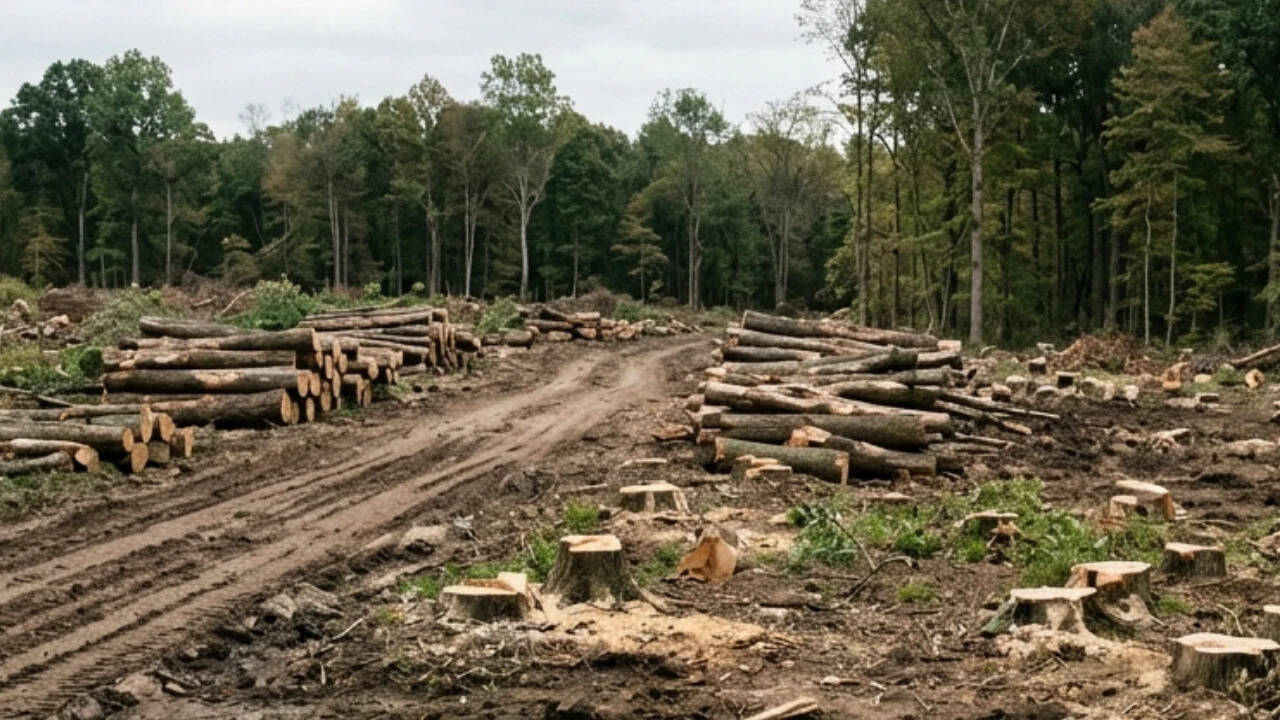
Two hundred and fifty trees. Gone. And now the price tag sitting on the table in an Ohio courtroom is $3.3 million.
When people hear about Ohio residents seeking $3.3 million over 250 trees cut from a protected forest, their first reaction is usually shock at the math. Over $13,000 per tree? It sounds absurd until you actually look at how property law, ecological valuation, and timber trespass statutes work in the United States. Most folks assume a tree is just a pile of firewood or a few hundred bucks at a local nursery. They couldn't be more wrong. Meanwhile, you can read related events here: What the Moscow Car Bomb Attack on a Former Ukrainian Aide Actually Tells Us.
In real estate and environmental law, mature timber isn't priced like lumber at a hardware store. When someone clears protected woodland without permission—whether out of negligence, boundary confusion, or deliberate encroachment—courts don't just look at the raw market value of the wood. They look at replacement costs, ecological loss, aesthetic damage, and statutory multipliers designed specifically to punish illegal clearing.
Let's break down why a lawsuit over 250 trees hits the multi-million-dollar mark, how Ohio law handles unauthorized tree removal, and what happens when conservation protections collide with private disputes. To understand the bigger picture, we recommend the excellent article by NBC News.
How 250 Trees Turn Into a $3.3 Million Legal Claim
Do the quick division on $3.3 million across 250 trees, and you get $13,200 per tree. If you've ever bought a six-foot sapling from a garden center for $150, that number feels disconnected from reality.
It isn't.
In legal disputes involving mature woodlands, plaintiffs don't calculate damages using nursery prices for baby trees. You can't replace a 70-year-old oak or hickory with a twig in a plastic pot and call it even. Forensic arborists—certified tree appraisers who testify in court—use standardized valuation methods established by the Council of Tree and Landscape Appraisers (CTLA).
Their formula accounts for trunk diameter, species rarity, overall health, and location. A single mature hardwood with a 24-inch trunk diameter can easily appraise for $5,000 to $15,000 on its own before a lawyer even adds punitive damages. Multiply that across 250 mature trees, and you're already staring at millions in base replacement value.
Then comes the legal hammer.
Under Ohio Revised Code Section 901.51, anyone who recklessly cuts down, destroys, or injures trees on another person's land without permission faces treble damages. That means whatever actual value the court assigns to the destroyed trees gets automatically multiplied by three.
Think about that math for a second. Even if an arborist values 250 trees at $1.1 million, Ohio's statutory multiplier instantly pushes the claim to $3.3 million. The law is written that way on purpose. Without triple damages, wealthy developers or reckless neighbors could treat illegal logging as a simple cost of doing business—cut down a neighbor's view-blocking woods, pay a cheap fine, and enjoy the upgraded property value. Treble damages exist to make sure nobody profits from stealing or destroying someone else's trees.
What Makes a Protected Forest Different From Regular Property
When the trees in question sit inside a protected forest or conservation easement, the legal stakes climb even higher.
Regular private property belongs solely to the deed holder. If your neighbor cuts your backyard maple, it's a civil dispute between two landowners. Protected forests operate under an entirely different set of rules. Land placed under a conservation easement, deed restriction, or community land trust carries binding legal obligations that permanently limit development and timber harvesting.
You can't just clear-cut protected land because you want a better sightline, extra yard space, or timber revenue.
In Ohio, conservation easements are governed by Ohio Revised Code Sections 5301.67 through 5301.70. These agreements strip away certain development and clearing rights forever, transferring enforcement power to land trusts, government agencies, or designated community associations. Even if a property changes hands ten times over a century, the protection stays glued to the dirt.
When 250 trees vanish from a protected area, the harm extends beyond one person's yard:
- Erosion and watershed disruption hit neighboring properties immediately once root systems die off and stop holding topsoil in place.
- Wildlife corridors collapse, particularly in fragmented Midwest woodlots where migratory birds and native mammals rely on continuous canopy cover.
- Stormwater runoff spikes, pushing water onto adjacent lots and overwhelming local drainage systems during heavy Ohio spring rains.
- Invasive species flood the clearing, with honeysuckle, multiflora rose, and garlic mustard taking over exposed soil within a single growing season.
Because those harms ripple outward across an entire neighborhood or watershed, affected residents often have legal standing to sue—not just for the wood itself, but for the loss of buffer zones, privacy, flood protection, and property value tied directly to living next to preserved woods.
The Appraisal Process Behind Tree Lawsuits
If you ever find yourself involved in a timber trespass case—either as the landowner whose trees were cut or as someone accused of crossing a property line—you'll quickly learn that guesswork doesn't survive in court. Judges throw out rough estimates.
Certified arborists use specific methodologies recognized across North American courts:
- The Trunk Formula Method calculates the cost of replacing a large tree by measuring its cross-sectional area at breast height (4.5 feet off the ground) and scaling up from the largest locally available nursery stock.
- Replacement Cost Valuation applies when trees are small enough to actually source, transport, and plant with heavy equipment, factoring in crane rentals, soil preparation, and multi-year survival guarantees.
- Ecological and Remediation Costs cover stump grinding, debris hauling, soil stabilization, erosion control matting, and replanting native understory vegetation to prevent invasive takeover.
Here's a detail most people miss. Even after the trees are gone, forensic arborists can calculate exact values just from the stumps left behind. By measuring stump diameter, identifying wood grain and bark rings, and comparing the spacing against neighboring intact forest, an expert witness can reconstruct an entire vanished woodland down to the species and approximate age of every single tree.
I've seen property owners assume that hauling away the logs erases the evidence. Honestly, it barely slows an experienced arborist down. Aerial satellite imagery from Google Earth, county GIS records, and leftover stumps tell the entire story with brutal accuracy.
Common Mistakes That Trigger Multi-Million-Dollar Tree Disputes
Nobody wakes up intending to get sued for $3.3 million over trees. Almost every massive timber trespass lawsuit starts with one of three preventable mistakes.
Relying on Old Fences or Assumptions Instead of Surveys
In rural and suburban Ohio, people treat old wire fences, tree lines, or mowed grass edges as gospel property boundaries. Half the time, those markers are off by ten, twenty, or fifty feet. If a landowner hires a clearing crew and points vaguely toward the woods saying, "Clear everything up to that ridge," any mistake falls squarely on the person who ordered the work. Ignorance of the exact boundary line rarely shields someone from liability when they fail to hire a licensed land surveyor first.
Assuming Conservation Rules Don't Apply to Edge Clearing
Property owners bordering protected reserves often treat the perimeter like an extension of their own backyard. They clear brush, drop dead ash trees, or cut down healthy oaks to open up views or build trails. Under strict conservation easements, cutting even deadwood or understory saplings without written authorization from the easement holder counts as a direct violation.
Hiring Uninsured or Informal Tree Crews
Legitimate, bonded tree services demand proof of property boundaries before dropping 250 trees near a neighbor's line or a protected reserve. Fly-by-night operators take cash, ask zero questions, and leave the hiring landowner holding the entire legal bag when subpoenas arrive. Under Ohio law, both the person who swung the chainsaw and the person who directed the cutting can be held liable.
Why Courts Take Timber Trespass So Seriously
Some critics look at a $3.3 million lawsuit over 250 trees and call it excessive litigation. That perspective misses the bigger picture of how environmental and property rights actually function.
A mature forest takes 60 to 150 years to grow. You can't write a check and buy a replacement forest next Tuesday. Even if a court awards millions of dollars and the residents spend every cent replanting native oaks, maples, and hickories, nobody alive today will live long enough to see that canopy return to its original height.
Money is an imperfect substitute for lost time. Courts know that. Statutory treble damages and strict conservation enforcement exist because without severe financial consequences, protected land is just a suggestion on paper.
If you own property bordering protected woods, or if you live near a conservation area and notice unauthorized clearing happening along the boundary, document everything immediately. Take timestamped photos of stumps, tire tracks, and equipment from your side of the line, pull your county auditor's parcel map, and contact the local land trust or conservation authority before the evidence gets hauled away. Once a mature forest hits the ground, the only leverage left is what you can prove in court.