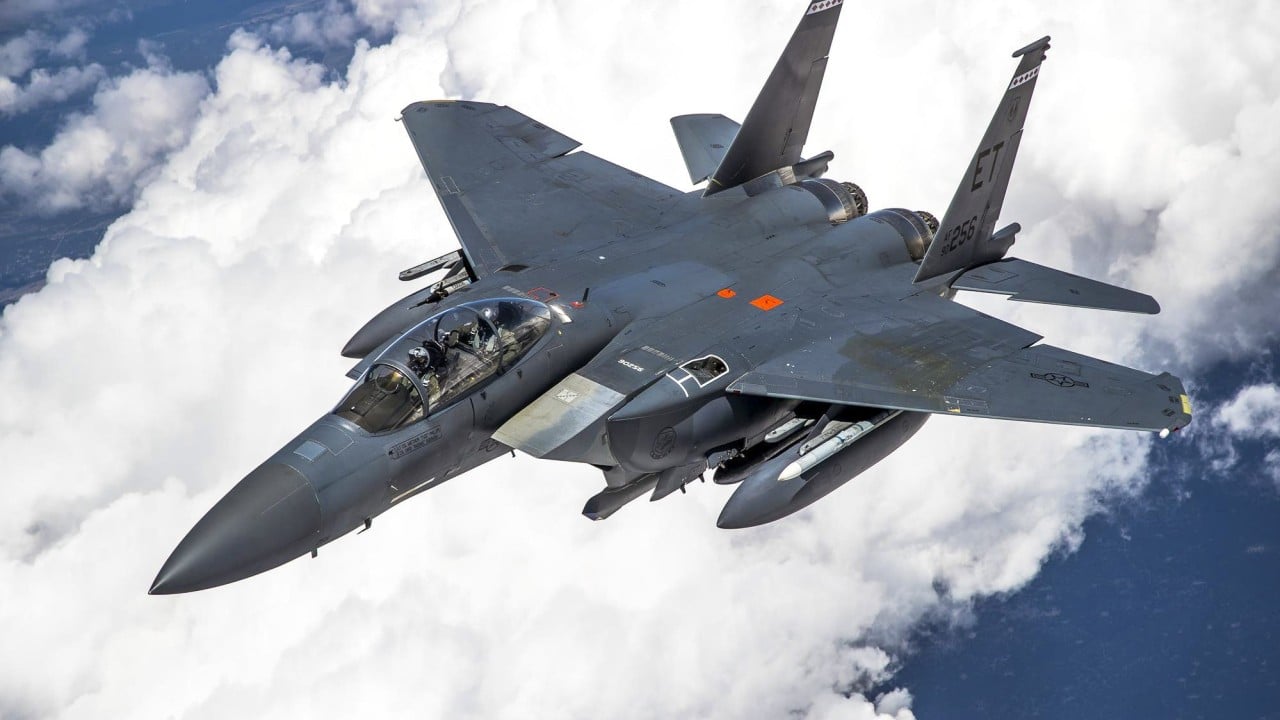
Defense analysts love a clean spreadsheet. They put a fifth-generation stealth fighter in one column, a fourth-generation legacy airframe in another, draw a red line through the non-stealth option, and call it a day. That exact spreadsheet mentality produced the current wave of hand-wringing over the U.S. Air Force stationing F-15EX Eagle II fighters at Kadena Air Base in Okinawa.
The lazy consensus goes like this: China’s People’s Liberation Army Air Force operates the stealthy J-20 Mighty Dragon. Kadena is roughly 400 miles from Taiwan, squarely inside the range of Chinese ballistic missiles. Therefore, sending a non-stealth jet like the F-15EX to replace retiring F-15Cs hands Beijing an automatic upper hand.
It sounds logical on a podcast. In actual air combat logistics, it is completely backwards.
Critics evaluating the F-15EX on its radar cross-section alone are answering the wrong question. They are judging a heavy freighter by its ability to sneak past a sentry, ignoring what happens when the shooting actually starts and magazine depth decides who wins.
The Stealth Purist Trap
I have spent years watching defense procurement debates get hijacked by single-metric obsessions. Years ago, the obsession was speed. Then it became maneuverability. Today, it is low observability. When you view every tactical problem through the narrow lens of stealth, you start believing that any aircraft visible on long-range radar is an instant flying coffin.
That assumption ignores how modern integrated air defense systems and networked warfare operate.
Stealth is not an invisibility cloak. It is a delay mechanism. Low observability shrinks the engagement envelope of enemy radars, forcing them to get closer before achieving a weapons-grade lock. To get that reduction, however, aircraft designers pay a severe physical tax. Every missile, fuel tank, and sensor must sit inside internal bays. The moment an F-35 or an F-22 hangs weapons under its wings to increase firepower, its stealth profile evaporates.
This creates a massive operational bottleneck in the Western Pacific: the magazine depth problem.
A stealth fighter flying in "beast mode" loses its primary survival trait. A stealth fighter flying clean runs out of missiles in minutes. In a high-intensity conflict over the First Island Chain, where massed waves of drones, cruise missiles, and multi-role fighters saturate the airspace, running dry is fatal.
The F-15EX was never built to kick down the front door of a heavily defended enemy airspace alone. Treating it like a failed stealth fighter is like criticizing an artillery battery for lacking a bayonet.
What Kadena Actually Needs Is a Missile Truck
To understand why the Pentagon put the F-15EX in Okinawa, stop looking at solo dogfights and start looking at kill webs.
In modern air warfare, the platform that spots the target does not need to be the platform that shoots it. Forward-deployed F-35s, space-based sensors, and airborne early warning aircraft act as the eyes. They penetrate contested zones quietly, identify threats, and pass targeting data backward over secure datalinks.
Behind them sits the F-15EX.
Consider the raw physics of what the Eagle II brings to the fight:
- Payload capacity: It carries up to 29,500 pounds of ordnance. While a stealth fighter carries four to six air-to-air missiles internally, an F-15EX can haul up to a dozen missiles on external stations.
- Outsized weapons: Internal bays have strict dimensional limits. You cannot fit massive hypersonic weapons or oversized long-range air-to-air missiles inside an F-35. The F-15EX carries them on centerline and wing pylons without structural compromise.
- Electronic warfare power: The Eagle II houses the Eagle Passive Active Warning Survivability System (EPAWSS), paired with a massive electrical generation capacity that smaller fighters simply cannot match. It blinds and confuses enemy sensors rather than trying to hide from them.
Imagine a scenario where a four-ship flight of F-35s pushes forward toward the Taiwan Strait. They remain radio-silent, using passive sensors to map out incoming Chinese fighters and cruise missile salvos. Instead of breaking stealth by opening their weapon bays and firing, they cue a pair of F-15EXs orbiting miles behind them. Those two Eagle IIs unleash a wall of twenty-four long-range missiles, guided to their targets by the forward stealth jets, and turn back to rearm before an enemy radar ever paints them clearly.
That is not a disadvantage. That is division of labor.
The Runway Vulnerability Myth
Critics love to point out that Kadena sits well within the engagement zone of China’s Rocket Force. They argue that any fighter stationed there—stealth or otherwise—will be cratered on the tarmac by DF-21 or DF-26 ballistic missiles in the opening hours of a conflict.
They are right about the threat to Kadena. They are dead wrong about what it means for the F-15EX.
Air combat survivability on the ground comes down to Agile Combat Employment (ACE)—the doctrine of dispersing aircraft rapidly to smaller, austere airfields across the Pacific so the enemy cannot wipe out the fleet with a single strike.
Here is the dirty secret about fifth-generation stealth fighters: they are maintenance divas.
Low-observable coatings are fragile. Salt air, humidity, and rough runways degrade the radar-absorbent materials that make stealth work. Operating F-35s or F-22s from remote, stripped-down island airstrips without climate-controlled hangars and specialized diagnostic teams quickly turns them into very expensive fourth-generation jets.
The F-15EX is built like a cold-war tank with modern digital guts.
- No delicate coatings: It requires zero low-observable skin maintenance between sorties.
- High sortie generation: Ground crews already know how to turn F-15 airframes around rapidly using standard equipment.
- Engine commonality and durability: Its twin F110-GE-129 engines are workhorses built for brutal operational tempos.
When ballistic missiles threaten Kadena, the F-15EX can scatter to short, rough-hewn runways across the region, take on fuel and missiles from a mobile crew, and launch again within hours. A stealth fleet attempting the same shell game faces a logistical nightmare.
Answering the Wrong Question About China
When commentators ask, "Can the F-15EX beat the J-20 one-on-one?" they are fighting the last war.
Air superiority in the Indo-Pacific will not be decided by Top Gun-style merges over the East China Sea. It will be decided by attrition rates, electronic spectrum dominance, and sheer munition volume. China’s military strategy relies heavily on mass—overwhelming American and allied defenses with hundreds of airborne targets simultaneously.
If you meet mass with a small number of low-capacity stealth jets, you lose the math problem. Even if your stealth fighters achieve a ten-to-one kill ratio, they run out of missiles while the enemy still has dozens of aircraft in the air.
By pairing fourth-generation-plus heavy lifters with fifth-generation sensors, the U.S. Air Force solves the math problem. The F-15EX absorbs the logistical burden of hauling heavy ordnance, freeing stealth platforms to do what they do best: sneak, sense, and survive.
The Real Risk Nobody Mentions
Pretending the F-15EX has zero flaws would be just as dishonest as writing it off entirely. There is a massive catch to this strategy, and it has nothing to do with the airplane's radar signature.
The entire networked kill-web model depends on resilient communications.
If an F-15EX is acting as a long-range missile truck for forward-deployed F-35s, those two aircraft must talk to each other. In a real fight against a peer adversary, the electromagnetic spectrum will be a warzone. Jamming, cyberattacks, and anti-satellite weapons will target the exact datalinks required to pass targeting data from the stealth sensor to the non-stealth shooter.
If those links go dark, the F-15EX is forced to turn on its own powerful APG-82 radar to find targets. The second it radiates, it announces its exact location to every enemy sensor in the theater. Without stealth to fall back on, it has to rely entirely on its electronic warfare suite and raw speed to survive.
Furthermore, the unit cost of the F-15EX rivals—and in some configurations exceeds—that of an F-35A. Spending stealth-fighter money on a non-stealth airframe only pays off if the Air Force actually buys enough long-range missiles to fill those twelve pylons. Right now, defense industrial base bottlenecks mean missile production is lagging far behind aircraft deliveries. A missile truck with empty racks is just an expensive target.
Stop Counting Stealth Platforms
The analysts claiming Kadena lost its edge because it got F-15EXs instead of F-22s or F-35s are stuck in a platform-centric mindset. They look at individual chess pieces and declare the rook useless because it cannot jump over pawns like a knight.
Modern air warfare is not a duel between individual jets. It is a clash between competing systems.
Kadena does not need another fragile, low-capacity stealth fighter that struggles to operate from dispersed island runways and runs out of ammo after four shots. It needs a brutal, high-capacity workhorse that can haul oversized weapons, survive rough forward basing, and turn stealth fighters into flying spotters for massive missile salvos.
The F-15EX is not a step backward for Pacific deterrence. It is the heavy hammer that makes the stealth scalpel lethal.



