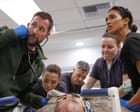
A Los Angeles Superior Court judge has ruled that the lawsuit pitting Michael Crichton’s estate against Warner Bros. Television over the medical drama The Pitt will move forward. The decision denies the studio's attempt to dismiss the case early, establishing that the Max series shares enough substantial similarities with the iconic 1990s hit ER to warrant a jury's scrutiny. For Hollywood executives, this ruling is a cold shower. It signals that slapping a real-time format onto a beloved legacy property—and bringing back its star and showrunners without paying the original creator's estate—will not automatically shield a studio from breach of contract and copyright claims.
To understand why this case survived a demurrer, you have to look past the surface-level differences in camera work and pacing. Warner Bros. built its defense around the idea that The Pitt is an entirely separate beast from ER. They argued that setting a medical show in a Pittsburgh emergency room, stripping away the musical score, and structuring a 15-episode season around a single 15-hour shift created an original work. For a deeper dive into similar topics, we recommend: this related article.
The court disagreed. Judges look at the DNA of a creative property, not just its wardrobe. When the same creative architects—executive producer John Wells, showrunner R. Scott Gemmill, and star Noah Wyle—assemble to make a show about an overwhelmed urban trauma center, the burden of proving independence becomes extraordinarily heavy.
The Anatomy of an Alleged Reboot
The legal battle traces back to 2020, when Warner Bros. began exploring a direct revival of ER. Negotiations with Sherri Crichton, who manages the late author’s estate through Roadshow Entertainment, eventually collapsed. The estate demanded proper credit and compensation, invoking the ironclad contractual protections Crichton secured when he originally sold ER to Warner Bros. in the early 1990s. For broader details on the matter, in-depth reporting can be read on Deadline.
In 1994, Crichton held immense leverage. Fresh off the massive success of Jurassic Park, he negotiated a deal that gave him a "created by" credit and frozen creator rights—meaning Warner Bros. could not produce any sequels, spinoffs, or remakes without his estate's consent and financial participation.
When talks broke down in 2022, Warner Bros. allegedly pivoted. Instead of paying the Crichton estate, the studio moved forward with Wells, Gemmill, and Wyle on a new project for its streaming platform, Max. The location shifted from Chicago's County General to the fictional Pittsburgh Trauma Medical Center. Wyle's character was renamed from Dr. John Carter to Dr. Michael "Robby" Robinavitch.
On paper, the studio executed a classic Hollywood maneuver. Rename the characters, change the city, tweak the format, and call it an original series.
Yet the court's ruling highlights a glaring vulnerability in that strategy. In entertainment law, implied-in-fact contract claims—often referred to as Desny claims in California—do not require word-for-word copying. They hinge on whether a party took an idea or property under circumstances where payment was expected, and then used the core elements of that property without paying. Furthermore, the estate's lawsuit leans heavily on breach of contract, arguing that The Pitt is, in practical and creative terms, the exact ER reboot they were negotiating just months prior.
Why Hollywood's Favorite Workaround Just Hit a Wall
Studios rely on derivative works. Wall Street demands predictable intellectual property, while corporate balance sheets demand lower overhead. Combining the two often tempts executives to strip-mine their own libraries for parts without paying the original builders.
Usually, studios get away with it. Medical procedurals, police dramas, and legal thrillers operate under the legal doctrine of scènes à faire—elements so standard to a genre that no single creator can own them. Nobody owns the concept of a stressed-out chief resident, a chaotic trauma bay, a difficult hospital administrator, or a brilliant medical student making a rookie mistake. If The Pitt had been created by strangers, Warner Bros. would have had a slam-dunk motion to dismiss.
The involvement of Wells, Gemmill, and Wyle changes the legal math entirely.
When the exact creative team behind a flagship series attempts to mount a reboot, fails to reach a deal with the rights holder, and immediately produces a nearly identical show in the same genre with the same lead actor, courts view the "coincidence" with deep skepticism. Discovery in this lawsuit will now force Warner Bros. to hand over internal emails, pitch documents, and early drafts of The Pitt script.
If a single email from a studio executive reads, "Since we couldn't close the Crichton deal, let's just change Carter's name and set it in Pittsburgh," the studio's defense evaporates. Even without a smoking gun, a jury will be asked to compare the trajectory of the abandoned ER revival with the birth of The Pitt.
The Financial Stakes Behind the Credits
This fight is not merely about ego or a vanity card in the opening credits. It is about tens of millions of dollars in backend participation, syndication rights, and streaming residuals.
Legacy television deals from the 1990s were structured for a completely different economic era. When ER dominated Thursday nights on NBC, it generated billions of dollars in advertising revenue and syndication fees. Crichton's estate still collects substantial royalties from those legacy broadcasts and streaming licensing deals.
Modern streaming economics, however, are designed to limit backend payouts. Studios prefer "cost-plus" models or flat buyouts that keep long-term profits inside the conglomerate. By launching The Pitt as a brand-new Max original rather than an ER spinoff, Warner Bros. effectively wiped the slate clean of Crichton's 1994 contract terms. They kept the built-in audience appeal of Noah Wyle returning to scrubs without paying the legacy tax to the estate.
Sherri Crichton’s legal team recognized this immediately. Allowing a studio to bypass a creator's frozen rights simply by changing a character's name would render every legacy contract in Hollywood worthless. If Warner Bros. wins this argument at trial, every major studio will immediately dust off shelved reboots, swap out the character names, hire the original showrunners, and cut the original creators out of the profits.
What Happens in Discovery
Surviving a motion to dismiss is not the same as winning a verdict. At this stage of litigation, the judge is required to view the facts in the light most favorable to the plaintiff—the Crichton estate. The court is simply saying that the allegations, if proven true, constitute a valid legal claim.
Now comes the painful part for Warner Bros. Discovery opens the vault.
Lawyers for the Crichton estate will depose John Wells, R. Scott Gemmill, Noah Wyle, and top executives at Warner Bros. Television and Max. They will subpoena every version of the ER revival pitch from 2020 to 2022 and lay them side-by-side with the earliest treatments for The Pitt.
Consider a hypothetical example of how this plays out in a deposition. Suppose an early treatment for the ER reboot featured an aging Dr. John Carter struggling with PTSD from the COVID-19 pandemic while mentoring a new crop of interns over a grueling shift. If the pilot script for The Pitt features Dr. Michael Robinavitch struggling with pandemic-induced trauma while mentoring interns over a grueling shift, the structural overlap becomes undeniable. The real-time format—where each episode covers one hour of a 15-hour shift—would look less like an independent artistic breakthrough and more like a cosmetic veneer applied to disguise a stolen premise.
Warner Bros. will argue that the real-time mechanic fundamentally alters the storytelling. In ER, storylines stretched across weeks and months, complete with personal soap-opera arcs outside the hospital walls. The Pitt traps the viewer inside the emergency room for a single day, utilizing a documentary-style shooting method with no musical score. The studio's lawyers will tell the jury that these stylistic choices prove The Pitt is an evolution of the genre, not a copy of Crichton's work.
The Collateral Damage to The Pitt
The timing of this legal setback could not be worse for Warner Bros. The Pitt has been a critical and commercial bright spot for Max, drawing strong viewership and praise for its gritty, grounded depiction of post-pandemic healthcare. A second season is already in the works.
Now, a dark cloud hangs over the production. While judges rarely issue injunctions that pull popular television shows off the air—courts generally prefer financial damages over censoring creative works—the litigation threatens to drain the profitability out of the series.
If the case reaches a jury in Los Angeles, Warner Bros. faces a notoriously unpredictable venue. Los Angeles juries tend to sympathize with individual creators and their families when pitted against massive media conglomerates, especially when the creator in question is a beloved figure like Michael Crichton. Furthermore, the optics of a studio aggressively fighting the widow of the man who built one of its most profitable franchises is a public relations nightmare.
The Precedent for IP in the Streaming Era
The entertainment industry is watching this docket closely because the line between "homage," "spiritual successor," and "unlicensed derivative" has never been blurrier.
For decades, television producers have created spiritual successors to dodge rights issues. When producers couldn't get the rights to certain properties, they filed off the serial numbers and made something adjacent. Yet those efforts rarely involved the exact same lead actor playing the exact same archetype, written by the exact same showrunner, produced by the exact same studio that owns the original IP.
Warner Bros. tried to have it both ways. In its marketing and press tours, the studio leaned heavily on nostalgia, subtly reminding audiences that the team behind ER was back together to save the medical drama. In court, however, those exact same executives argued that The Pitt has nothing to do with ER.
You cannot sell nostalgia to the public on Tuesday and deny lineage to a judge on Wednesday.
As the discovery process begins, the leverage in this dispute has shifted dramatically toward Sherri Crichton. Warner Bros. must now decide whether to open its internal communications to public scrutiny and risk a massive jury verdict, or write a check large enough to give Michael Crichton's estate the credit and compensation it demanded four years ago.