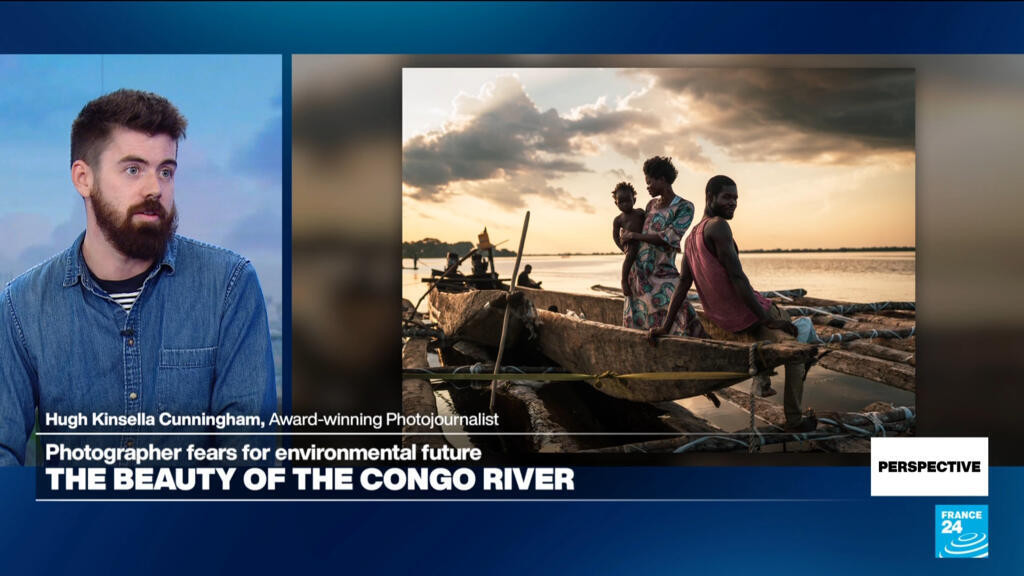
The world’s second-largest rainforest isn't just a collection of trees or a backdrop for a nature documentary. It’s a massive, pulsing lung that’s currently gasping for air. While most of the global conversation about deforestation focuses on the Amazon, the Congo Basin is quietly hitting a breaking point. It’s a crisis that photojournalist Hugh Kinsella Cunningham has spent years documenting, and his work reveals a reality that’s far grittier than the polished statistics provided by international NGOs.
The Congo Basin stretches across six countries, but its heart lies in the Democratic Republic of the Congo (DRC). This isn't a pristine wilderness untouched by man. It's a battleground. For decades, the region has been defined by a brutal intersection of armed conflict, industrial greed, and a desperate need for basic survival. When you look at Cunningham’s photography, you don't just see green canopies. You see the faces of people caught between protecting their home and feeding their families.
The Myth of the Untouched Wilderness
People often talk about the Congo as if it’s an empty space on a map waiting to be saved. That’s a mistake. The basin is home to over 75 million people. For them, the forest isn't a "carbon sink"—it's a supermarket, a pharmacy, and a graveyard.
The tipping point we’re talking about isn't some far-off mathematical projection. It’s happening now because the traditional ways of living in harmony with the forest are being shredded. Conflict in the eastern DRC has forced millions of people to flee their homes. When people are displaced, they move into protected areas. They cut down trees for charcoal because they have no electricity. They hunt bushmeat because they have no farms.
Cunningham’s work highlights this tragic irony. The very people who should be the stewards of the land are often forced to be its "destroyers" just to stay alive another day. If we don't address the human poverty and the relentless war in the region, talking about "conservation" is just a luxury for people in the West.
Why the World’s Peatlands are a Ticking Time Bomb
One of the most terrifying aspects of the Congo Basin is something most people have never heard of: the Cuvette Centrale peatlands. This is a massive area of swampy forest that stores about 30 billion tons of carbon. To put that in perspective, that’s equivalent to three years’ worth of global fossil fuel emissions.
As long as those peatlands stay wet, the carbon stays in the ground. But the basin is drying out. Temperatures are rising, and rainfall patterns are shifting. If these peatlands dry out, they will start releasing that carbon back into the atmosphere. It would be an environmental catastrophe that no amount of electric cars or carbon offsets could fix.
The threat isn't just climate change. It's also the search for "black gold." The DRC government has recently moved to auction off oil and gas blocks, some of which overlap with these sensitive peatlands and protected parks like Virunga. The argument from Kinshasa is simple: Why should a country with massive poverty leave billions of dollars in the ground to save the world's climate when the wealthy nations aren't paying up? It’s a fair question that the international community hasn't answered yet.
The Failure of Top Down Conservation
For a long time, the model for protecting the Congo was "fortress conservation." You draw a line on a map, hire some rangers with guns, and tell the locals to stay out. It doesn't work. In fact, it often makes things worse.
When you criminalize the people who live in the forest, you turn them into enemies of conservation. They become more likely to collaborate with illegal loggers or poachers because they have no stake in the "protected" land. Cunningham’s photos often show the complex relationship between communities and the land. He’s documented how indigenous groups, like the Mbuti, are being pushed out of their ancestral homes in the name of "green" initiatives.
Expert groups like Rainforest Foundation UK have long argued that the only way to save the Congo Basin is to grant legal land rights to the communities living there. Data shows that forests managed by indigenous peoples are often better preserved than state-run national parks. They have a generational interest in the forest’s health. They aren't looking for a quick payout; they’re looking for a future.
Industrial Loggers and the Paper Trail of Destruction
While a displaced family cutting wood for charcoal is a problem, it pales in comparison to industrial logging. High-value timber like African Teak and Iroko are hauled out of the jungle on massive trucks, destined for markets in Europe, China, and the US.
The oversight is a joke. Corruption is baked into the system. Logging companies often promise to build schools or clinics for local villages in exchange for cutting rights. Years later, the trees are gone, the trucks have left, and the "school" is just a half-finished concrete shell without a roof. This isn't just an environmental crime; it’s a human rights violation.
The logging roads also act as veins of infection. They open up deep parts of the forest that were previously inaccessible, allowing poachers and illegal miners to move in. Once a road is built, the "heart" of the forest is effectively gone.
What You Can Actually Do
Most people read about the Congo and feel a sense of distant pity. They think it's too big, too far, and too broken to fix. That's exactly the kind of apathy that allows the destruction to continue.
Start by looking at what you buy. The demand for cheap tropical timber and minerals like cobalt—essential for the very "green" batteries we're told will save us—often starts in the Congo. Demand transparency from tech companies and furniture retailers. If they can't prove their supply chain is clean, don't buy from them.
Support organizations that focus on community-led conservation rather than paramilitary "protection." Groups like the International Union for Conservation of Nature (IUCN) are increasingly recognizing that without the local people, the forest is lost.
Pressure your own government to fulfill its climate finance promises. At COP26, world leaders pledged $1.5 billion to protect the Congo Basin. Much of that money is still tied up in bureaucracy while the forest continues to burn. We need to stop treating the Congo as a secondary priority. It's the front line of the climate crisis. If the Congo Basin crosses that tipping point, there’s no coming back.
The next time you see a photo by someone like Hugh Kinsella Cunningham, don't just admire the lighting or the composition. Look at the reality of a world that’s being pushed to the edge. We’re all connected to those trees, whether we like it or not.
Verify the source of any "mahogany" or "exotic wood" products you purchase. Use the FSC (Forest Stewardship Council) database to check if the company has a history of violations in Central Africa. Don't take their marketing at face face value. Demand the paperwork.