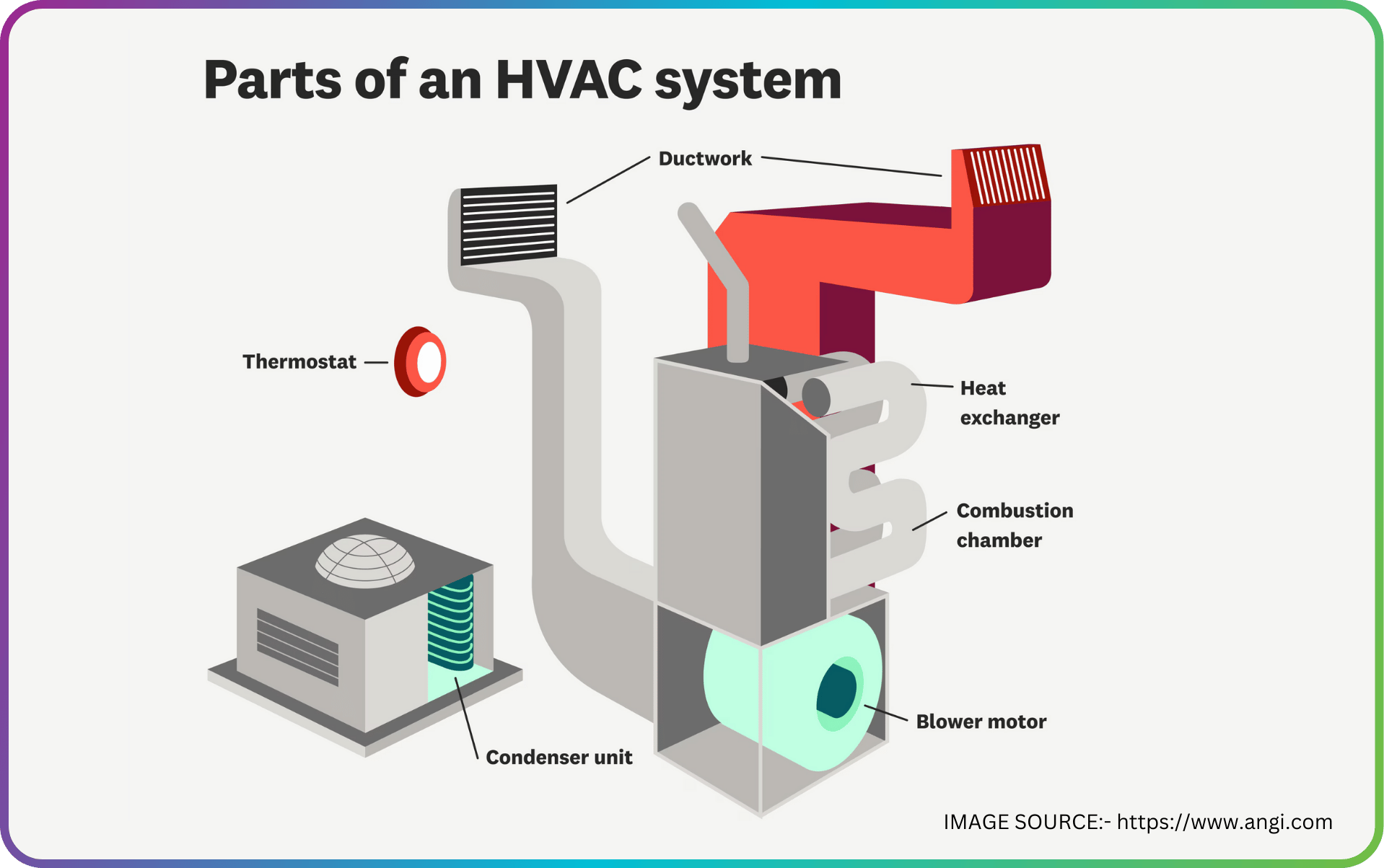
You’re sitting on the couch, sweating. The air coming out of the vents feels like a lukewarm whisper, and the hum from outside sounds more like a death rattle than a cooling cycle. Most people think their air conditioner is just one big "cold box," but honestly, it’s a high-stakes game of hot potato played with refrigerant. Understanding the different components of AC system builds isn't just for people in overalls; it's how you avoid getting ripped off when a $20 part fails and someone tries to sell you a $10,000 unit.
Air conditioning is less about "making cold" and more about "removing heat." Physics is funny that way. You can't actually create coldness. You just move energy from where you don't want it (your living room) to where you don't care about it (the driveway). To do that, your system relies on four heavy hitters and a few supporting characters that have to work in perfect sync. If one lags, the whole thing chokes.
The compressor is the heart (and the most expensive part)
Think of the compressor as the engine. Located in that big noisy unit outside, its job is to squeeze the refrigerant. Why? Because when you compress a gas, its temperature skyrockets. It seems counterintuitive to make something hot when you want to be cool, but you need that gas to be hotter than the outside air so it can shed heat.
If your compressor dies, you're usually looking at a massive bill. It’s the most common reason people decide to scrap their entire system. However, a "dead" compressor is sometimes just a bad start capacitor—a tiny cylindrical component that gives the motor the "kick" it needs to start. HVAC companies sometimes overlook this (or don't mention it) because selling a new unit is easier than soldering a $40 part.
There are different types, too. Reciprocating compressors use pistons, while scroll compressors—which are way more common now—use two interleaving spirals to pump the gas. Scroll units are generally quieter and more reliable because they have fewer moving parts. If you’re hearing a loud "clunk" every time the air turns on, your compressor might be reaching its twilight years.
The condenser coil sheds the load
Once that hot, high-pressure gas leaves the compressor, it heads into the condenser coils. These are the copper or aluminum fins you see on the outside unit. A large fan pulls outdoor air across these coils. Because the gas inside is hotter than the air outside, the heat naturally moves from the coils to the air.
As the heat leaves, the refrigerant cools down and turns back into a liquid. This is basic thermodynamics.
The biggest enemy here is dirt. If your condenser coils are caked in lawn clippings, spider webs, or "cottonwood fluff," the heat can’t escape. Your AC will run longer, your electric bill will jump 20%, and eventually, the compressor will overheat and fry itself. Seriously, just spraying your outside unit with a garden hose once a month can save you thousands of dollars over the life of the machine. Don’t use a pressure washer, though. You’ll bend the delicate fins and ruin the airflow.
The expansion valve: The unsung hero
This is the "brain" of the operation. After the refrigerant leaves the condenser as a high-pressure liquid, it hits the expansion valve. Think of this like the nozzle on a spray paint can. It takes that high-pressure liquid and forces it through a tiny opening, turning it into a low-pressure mist.
When pressure drops suddenly, so does temperature.
This is the component of AC system setups that actually creates the cooling effect. It regulates exactly how much refrigerant enters the indoor evaporator coil. If it lets in too much, the coil freezes over. Too little, and the system runs "starved," never actually getting the house cool. It’s a delicate balance. Some older systems use a simple "fixed orifice" (basically a tiny hole), but modern high-efficiency units use a Thermal Expansion Valve (TXV) that adjusts in real-time based on how hot your house is.
The evaporator coil and the "ice block" problem
Now we’re inside. The cold, low-pressure refrigerant flows into the evaporator coil, which is usually hidden in your furnace or air handler. Your indoor blower fan sucks warm air from your house and blows it across these cold coils.
The refrigerant absorbs the heat from your indoor air, and—as a side effect—moisture in the air condenses on the cold metal. This is why AC doesn't just cool; it dehumidifies. That water drips into a drain pan and (hopefully) out of your house.
If you see ice on your indoor unit, something is wrong. Usually, it’s one of two things:
- Low refrigerant: Counterintuitively, less refrigerant makes the coil get too cold, freezing the moisture into ice.
- Bad airflow: If your air filter is clogged, there’s not enough "warm" house air hitting the coil to keep it from dropping below freezing.
Never ignore a frozen coil. If the ice builds up and reaches the compressor outside, it can "slug" the compressor with liquid refrigerant, which will kill it instantly. Compressors can pump gas, but they can't pump liquid.
The blower motor and the ductwork
The blower is the fan that actually moves the air through your house. In the old days, these were simple "on or off" motors. Today, many systems use ECM (Electronically Commutated Motors) which can vary their speed. They might run at 10% power just to keep air circulating and then ramp up to 100% when the thermostat screams for help.
Ductwork is often the most neglected part of the whole setup. You can have the most expensive components of AC system technology in the world, but if your ducts are leaky or undersized, you’re just cooling your attic. According to the Department of Energy, the average home loses about 20% to 30% of its conditioned air through leaks in the duct system.
Refrigerant: The lifeblood
It isn't a "part" you can hold, but it's the medium that makes it all possible. We’ve moved from R-22 (Freon), which was phased out because it eats the ozone layer, to R-410A (Puron). Now, the industry is shifting again to R-454B and R-32 to meet newer environmental standards.
Here’s the thing: Your AC system is a sealed loop. You should never need to "top off" your refrigerant. If a technician tells you that you need more gas every year, you have a leak. Period. Adding more is a band-aid that keeps you paying for service calls while the leak slowly gets worse.
The Thermostat and Control Board
The thermostat is the user interface, but the control board is the motherboard. It coordinates the timing. It ensures the fan keeps running for a minute after the compressor shuts off to wring out every last bit of "cool" from the coils. Modern "smart" thermostats can even communicate with the compressor to tell it exactly what capacity to run at, rather than just "all or nothing."
Actionable Maintenance Checklist
To keep these components from failing prematurely, there are three things you should do right now:
- Change your filter every 30-90 days: A $15 filter protects a $1,000 evaporator coil and a $600 blower motor. If you have pets or kids, go for the 30-day mark.
- Clear the perimeter: Make sure there are at least two feet of clear space around your outdoor condenser. No bushes, no tall grass, and definitely no "decorative" fences that block airflow.
- Check the primary drain line: Find the PVC pipe that leads away from your indoor unit. If you see it dripping while the AC is on, that’s good. If it stops dripping and you see water in the secondary pan underneath the unit, your drain is clogged. Use a wet/dry vac to suck out the gunk from the outside exit of the pipe.
Ignoring these small components of AC system health will lead to a "compounding failure." A dirty filter leads to a frozen coil, which leads to liquid slugging the compressor, which leads to a $6,000 replacement. Prevention is cheap; repair is not.