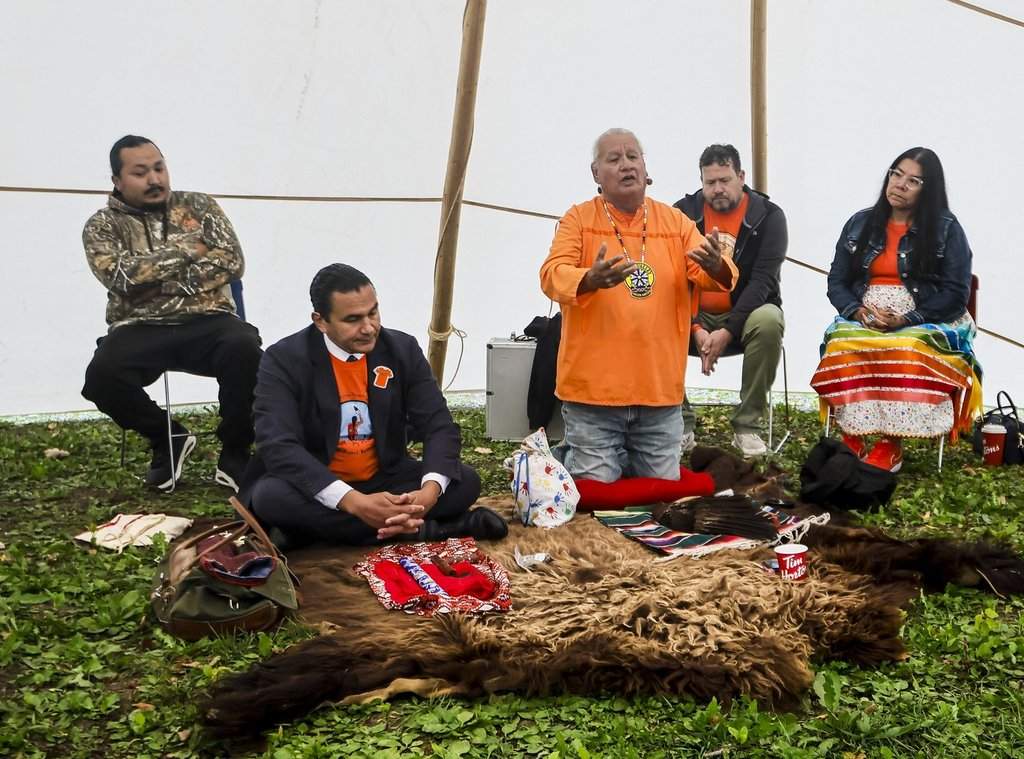
Every time a premier or prime minister stands at a residential school burial site with a solemn expression and a media pool in tow, the political class breathes a sigh of relief. Premier Wab Kinew sitting with First Nations leaders to honour children at these tragic grounds is framed as the pinnacle of reconciliation. Cameras capture the bowed head, the traditional tobacco offering, the respectful silence. It makes for powerful evening news. It projects national contrition.
It is also an absolute diversion from the structural violence destroying communities today.
We have perfected the art of mourning the dead while systematically underfunding the living. Ceremonial grief has become a substitute for governance. Politicians discover that shedding tears in front of cameras costs nothing, alters no tax codes, dismantles no bureaucratic chokeholds, and requires zero redistribution of actual power. Meanwhile, the communities bearing the generational trauma of these institutions are left to navigate housing crises, contaminated water, crumbling infrastructure, and youth suicide rates that would trigger national states of emergency if they occurred in downtown Toronto.
Let us stop pretending that symbolic proximity to historical trauma equals structural repair.
The Comfort of Collective Guilt
Collective guilt is an opiate for the state. When political leaders center themselves in acts of mourning, they shift the narrative from state accountability to emotional catharsis. The underlying message—subtle, pervasive, and profoundly damaging—is that reconciliation is an emotional journey we are all taking together.
It is not. Reconciliation is a legal, financial, and political debt.
When Wab Kinew sits with leaders at a burial site, the optics suggest a partnership of equals reckoning with history. But look past the ceremony to the balance sheets. Look at the chronic underfunding of First Nations child and family services, the jurisdictional ping-pong between federal and provincial bureaucracies that delays emergency housing repairs for years, and the resource extraction projects forced onto traditional territories without genuine, binding consent.
Ceremony without structural concession is just public relations. Worse, it co-opts Indigenous leadership into performing grief for an audience that wants absolution without sacrifice.
The Bureaucracy of Apology
For decades, the standard playbook for Canadian politicians confronted with Indigenous rights has followed a predictable script. Deny, stall, get caught, issue a tearful apology, fund a commission, and then quietly return to business as usual while fighting Indigenous communities tooth and nail in court.
We saw this during the Truth and Reconciliation Commission. We see it every September 30th on the National Day for Truth and Reconciliation. Millions of dollars flow into commemorative events, signage, educational modules, and committee meetings. Yet, basic human rights like clean drinking water advisories persist for years past promised deadlines.
Why? Because bureaucracy loves symbolism. A commemorative plaque requires no infrastructure budget. A moment of silence requires no renegotiation of revenue-sharing agreements. A high-profile visit to a burial site requires no surrender of Crown jurisdiction over land.
Every dollar spent on performative remembrance while communities lack basic health infrastructure is a deliberate political choice. It is a choice to prioritize how the country feels about its past over how Indigenous people survive its present.
Dismantling the Reconciliation Industry
An entire cottage industry has emerged around reconciliation consulting, trauma-informed workshops, and symbolic governance. Non-Indigenous institutions spend small fortunes hiring facilitators to tell them how to feel bad about history, while actual land defenders and community organizers fighting for water rights and housing get hit with injunctions and police raids.
This is the great contradiction of modern progressive politics. You can trend on social media for wearing an orange shirt while your government appeals court rulings ordering compensation for harmed children.
If you want to know where a government's priorities lie, stop listening to their speeches at burial sites and start auditing their court dockets. Check how many land claims are currently being dragged through expensive litigation by the Department of Justice. Check the per-capita spending on reserve infrastructure compared to neighboring municipalities. The numbers tell a brutal truth that no amount of traditional drumming can obscure.
What Real Accountability Looks Like
Real accountability is unglamorous. It does not photograph well.
It looks like unconditional land back—returning jurisdiction and ownership of ancestral territories to Indigenous nations without forcing them to mortgage their futures through predatory development deals. It looks like abolishing the Indian Act entirely, dismantling the paternalistic Department of Indigenous Services, and letting communities manage their own economies, health systems, and legal frameworks without Ottawa or provincial capitals acting as an eternal bottleneck.
It looks like wealthy provinces stopping their legal battles against Indigenous child welfare settlements. It looks like treating treaty rights not as historical relics to be interpreted by colonial judges, but as supreme law.
Wab Kinew is a capable politician who understands the weight of history. But as long as Indigenous leaders are forced to spend their time sitting on the grass with premiers performing rituals of grief instead of signing treaties that hand over real economic power, nothing changes.
The children buried at these sites did not die because people lacked empathy. They died because a state apparatus decided their lives were disposable in the pursuit of land and assimilation.
Until that state apparatus is dismantled piece by piece, all the solemn visits in the world are just a way of watching history repeat itself while everyone pretends to learn the lesson.