The dirt in San Martín de Tours is the color of dried blood. If you walk past the cemetery, toward the edge of the town where the pampa begins to swallow the houses, you will find Hector. He is sixty-four. His knuckles are swollen from decades of turning wrenches on broken tractors, but his knees are worse, ruined by eighty days in the freezing mud of Mount Longdon.
When Hector talks about 1982, his eyes do not wander. They lock onto yours. He describes the wind off the South Atlantic—a wind so sharp it felt like glass shaving his cheeks. He describes the taste of cold mutton grease. He describes the sound of British mortar fire, a rhythmic thudding that sounded, terrifyingly, like a giant heart beating beneath the peat.
"We were teenagers," Hector says, his voice flat, devoid of the theatrical patriotism found in television studios. "The English boys on the other side of the ridge were teenagers too. We died for a rock. They died for a rock."
He is referencing Jorge Luis Borges, the blind wizard of Argentine literature, who famously dismissed the Falklands War as "two bald men fighting over a comb". It is a beautiful, devastating metaphor. But it ignored a fundamental human truth: once blood is spilled on the comb, the comb ceases to be plastic. It becomes a relic.
Today, in Atlanta, those relics are being unpacked.
The Phantom on the Pitch
Soccer matches are often described as wars without the shooting. It is a lazy cliché, usually deployed by commentators who have never heard a rifle fire in anger. But when Argentina plays England in a World Cup semifinal, the metaphor becomes heavy, weighted down by forty-four years of ghosts, maritime exclusion zones, and the memory of a boy from Villa Fiorito who claimed he was assisted by the hand of God.
To the casual observer in the United States, watching from the climate-controlled comfort of a sports bar, the match is a mouthwatering athletic showcase. It is Lionel Messi, playing his final, desperate tournament, trying to drag an unstable, erratic Argentina to back-to-back world titles. It is England, organized under Thomas Tuchel, trying to break a sixty-year curse of near-misses and existential dread.
But look closer. Watch the faces of the traveling supporters from Buenos Aires.
They are singing. They are not singing about tactics. They are not singing about Scaloni’s midfield rotation. They are singing "Muchachos," a song that explicitly honors the "pibes de Malvinas," the boys of the Falklands, whom they promise never to forget.
This is not simple fandom. It is collective therapy disguised as sport.
The Anatomy of the Grudge
To understand how we arrived at this hot, humid afternoon in Georgia, we must understand that the rivalry is not a static monument. It is a living organism that molts and changes with every generation.
In 1966, it was about class and respectability. The English manager, Alf Ramsey, famously called the Argentine players "animals" after a brutal quarterfinal at Wembley. Argentina felt snubbed, treated as colonial subjects who didn't understand the rules of the gentleman's game.
In 1986, it was about vengeance. Diego Maradona did not play to win a match; he played to rewrite history. His first goal—the punch—was a street urchin’s theft, a middle finger to the British establishment. His second goal—the turn, the acceleration, the slaloming run that left Peter Reid and Terry Fenwick eating the grass of the Azteca—was art. It was proof that while Britain had the battleships, Argentina had the soul.
"It was as if we had beaten a country, not just a football team," Maradona wrote in his autobiography.
By 1998, the theater had shifted to Saint-Étienne. David Beckham, the golden boy of English pop culture, tripped Diego Simeone. A red card. A national hanging in the British press. The stakes had transitioned from military trauma to celebrity obsession, but the underlying tension remained the same: us versus them. The islanders versus the continental rebels.
Consider what happens next.
Lionel Scaloni, the current coach of Argentina, tried to throw cold water on the fire during his press conference.
"No, no, no," Scaloni said, shaking his head. "This is just a football match. Let’s not look for other stuff."
He is lying, of course. He has to. His job is to keep twenty-six young men from suffocating under the weight of an entire nation’s unresolved grief. He knows that if his players play with anger instead of intellect, Declan Rice and Jude Bellingham will pick them apart.
The Reality on the Grass
But the real problem lies elsewhere, far from the history books.
Argentina’s journey through this World Cup has not been a triumphant march; it has been a frantic, sweating scramble. They have lacked the serene control of their 2022 run. They were dragged into deep water by Switzerland. They had to recover from a two-goal deficit against Egypt. They are a team living on adrenaline, luck, and the fading, brilliant sparks of an aging deity.
England, by contrast, is a machine designed to minimize risk. Under Tuchel, they do not seek drama. They seek efficiency. They pass, they keep possession, they wait for Bukayo Saka or Anthony Gordon to isolate a defender, and they let Harry Kane do what he has done for fifteen years: find the corner of the net.
Yet, when the whistle blows, the tactics sheet has a way of dissolving.
A World Cup semifinal is a pressure cooker. When you add the historical tax of this specific fixture, the pressure rises to a level where logical structures crumble. The FBI, FIFA, and local police have designated this match as the highest-security event of the tournament. They are not worried about the players; they are worried about what happens when those two cultures, carrying forty years of baggage, collide in the stands.
The Last Stand
In San Martín de Tours, Hector will not be watching the match in a bar. He will watch it alone in his kitchen, with a small black-and-white television that occasionally loses signal when the wind picks up.
He does not hate the English. Not anymore. He tells a story about meeting a British veteran in Buenos Aires ten years ago. They didn't speak the same language, but they sat on a bench, shared a bottle of Malbec, and showed each other pictures of their grandchildren.
"We both had the same scars on our feet from the trench foot," Hector says, smiling slightly. "That is a language everyone understands."
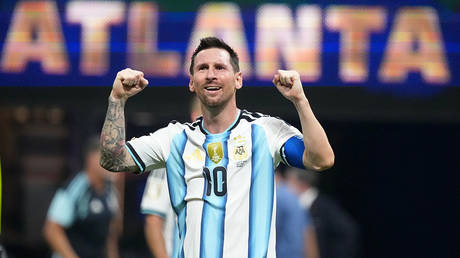
But when Lionel Messi walks out of the tunnel today, leading the blue-and-white shirts into the blinding southern heat of Atlanta, Hector’s chest will still tighten. He will lean forward. He will grip the edge of the wooden table until his white knuckles turn yellow.
He knows it is only a game. He knows that winning today will not bring back his friends who are buried under the cold, gray stones of Darwin Cemetery. It will not change the sovereignty of the islands. It will not lower the price of beef in Buenos Aires.
But for ninety minutes, on a patch of grass in Georgia, the bald men will stop fighting over the comb. They will run, they will bleed, and they will try to catch the wind.
The English and Argentine rivalry, explained offers a deep dive into the historical, political, and cultural layers that make this specific match the most volatile fixture in international soccer.