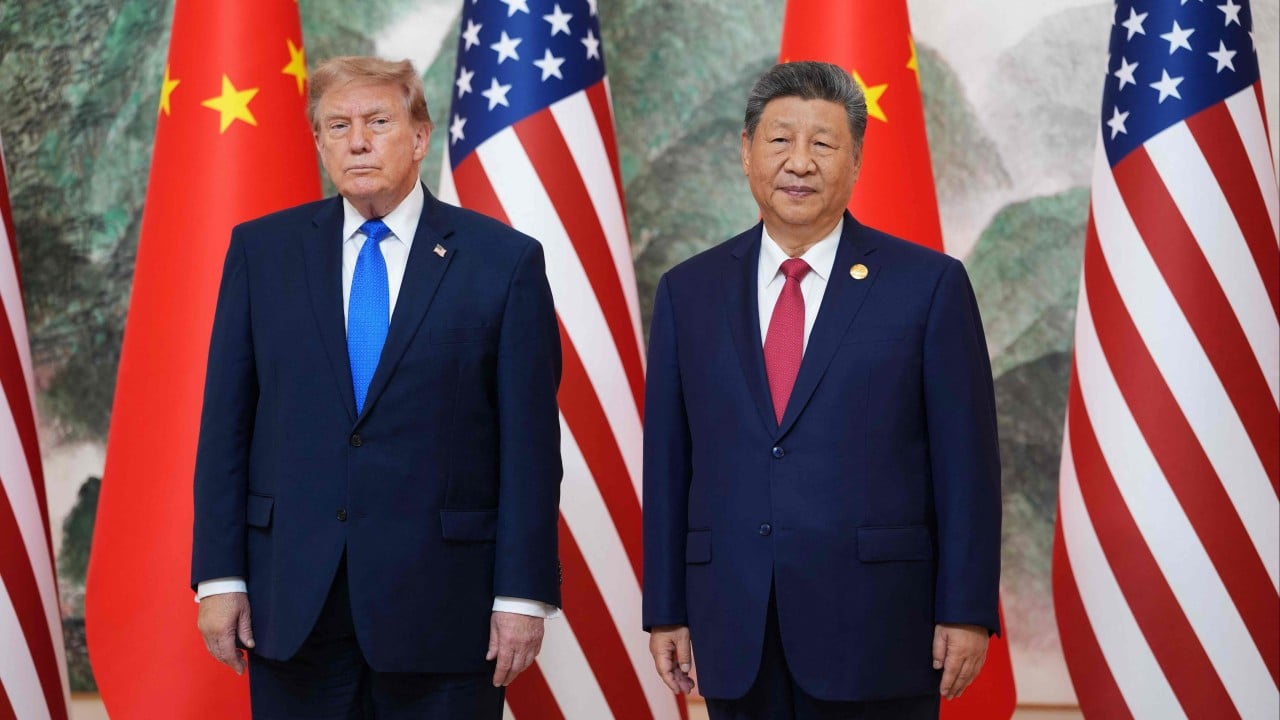
Diplomatic readouts between Beijing and Washington follow a predictable linguistic script that masks a structural collision of incompatible deterrence models. When Chinese President Xi Jinping tells U.S. President Donald Trump to "do the right thing" on Taiwan while urging both sides to manage differences constructively—as occurred during their bilateral talks on the sidelines of the November 2026 APEC summit in Shenzhen—mainstream coverage treats the exchange as routine diplomatic posturing. That surface-level reading misses the operational mechanics driving the Taiwan Strait toward an acute crisis. Beijing's phrasing is neither a plea for compromise nor an empty platitude; it is a calculated exercise in coercive signaling designed to shift the burden of escalation onto Washington while extracting tangible policy concessions, specifically the suspension of U.S. arms sales and diplomatic engagement with Taipei.
The Asymmetry of Compellence and Deterrence
Understanding the friction between Xi and Trump requires separating two distinct strategic mechanisms: deterrence and compellence. Deterrence is static; it aims to preserve the status quo by convincing an adversary that the costs of altering it outweigh the potential gains. Compellence, defined by economist and nuclear strategist Thomas Schelling, is dynamic; it uses the threat of future pain to force an adversary to reverse an existing policy or relinquish an established position.
Washington operates under a dual-deterrence framework codified through the 1979 Taiwan Relations Act, the Three Joint Communiqués, and the 1982 Six Assurances. Under this architecture, the United States deters Beijing from using force to annex Taiwan while simultaneously deterring Taipei from declaring formal independence. When Trump reiterates to Xi that the United States does not support Taiwan independence, he is executing the second half of that dual-deterrence formula.
Beijing, conversely, uses the language of "managing differences" to practice compellence. By framing Taiwan as the core red line upon which all bilateral cooperation depends—from counter-narcotics and repatriation agreements to artificial intelligence safety and trade stabilization—Xi establishes an asymmetric linkage system:
- Conditional Cooperation: Beijing offers tactical wins on secondary American priorities (agricultural purchases, fentanyl precursor controls, cyber-fraud crackdowns) only while Washington refrains from strengthening Taiwan's defensive capabilities.
- Escalation Dominance: Through daily People's Liberation Army (PLA) air and naval operations around Taiwan, Beijing establishes a baseline of continuous military pressure. Any U.S. arms package or high-level diplomatic contact is then framed by Beijing as a provocation that forces a retaliatory escalation.
- Normative Inversion: When Xi demands that Washington "do the right thing", Chinese statecraft attempts to redefine the status quo. Under Beijing's definition, maintaining existing U.S. security assistance to Taiwan constitutes an active disruption of bilateral stability, whereas halting that assistance is cast as mere compliance with baseline diplomatic norms.
The Structural Flaws in Transactional Linkage
A critical vulnerability emerges when a transactional American administration engages with an ideological, long-horizon Party-state. In business and deal-making, treating every asset as a variable on a single balance sheet maximizes flexibility. In grand strategy, linking non-negotiable security commitments to reversible commercial or administrative agreements creates a structural deficit.
Throughout 2026, diplomatic friction centered on two concrete flashpoints: congressional authorization of major arms packages for Taipei and the prospect of direct communication between Trump and Taiwanese President Lai Ching-te. Reports surrounding the administration's deliberations to delay weapons transfers until after major multilateral summits—such as the Shenzhen APEC meeting and the G20—illustrate the immediate friction caused by transactional linkage.
Consider the operational cost function of delaying or conditioning defensive arms transfers to secure near-term diplomatic calm:
- Time-Horizon Mismatch: Trade concessions, diplomatic summits, and law-enforcement cooperation can be suspended or reversed by Beijing within twenty-four hours. Defense procurement, weapons manufacturing, and asymmetric force integration in Taiwan require multi-year timelines. Trading a multi-year military capability for a short-term diplomatic pause yields a permanent loss of deterrence in exchange for a temporary reduction in friction.
- Erosion of the Six Assurances: The second of Ronald Reagan's 1982 Six Assurances explicitly states that the United States has not agreed to consult with Beijing regarding arms sales to Taiwan. Engaging in bilateral bargaining over the timing or volume of those sales—even implicitly to preserve summit optics—erodes a foundational guardrail designed to prevent Beijing from exercising a de facto veto over U.S. defense policy.
- Alliance Contagion: Regional treaty allies, particularly Japan and the Philippines, calibrate their own defense spending and basing access agreements based on the reliability of U.S. security commitments. If Washington signals that Taiwan's defense posture is negotiable in exchange for bilateral trade or counter-narcotics cooperation, regional partners will hedge by either accommodating Beijing or pursuing independent, destabilizing military capabilities.
The Myth of Constructive Management
Diplomatic coverage frequently accepts the premise that Washington and Beijing can "extend the list of cooperation and shorten the list of problems" without resolving the underlying sovereignty dispute. In systems theory, two complex systems can manage friction only if they share a compatible definition of equilibrium. Across the Taiwan Strait, no shared equilibrium exists.
For the Chinese Communist Party, the absorption of Taiwan is tied directly to regime legitimacy and Xi Jinping's political legacy, framed as an integral component of national rejuvenation. For the United States and its Indo-Pacific allies, a self-governing, democratic Taiwan is essential to maintaining the First Island Chain—the geographic barrier preventing the PLA Navy from projecting uncontested power into the central Pacific—and securing global semiconductor supply chains.
Because these objectives are mutually exclusive, "managing differences" does not move the two powers toward resolution; it merely shifts the arena of competition. When kinetic conflict is deterred, competition migrates into gray-zone domains:
- Lawfare and Diplomatic Isolation: Beijing systematically pressures multilateral forums and third-party states to downgrade ties with Taipei while using domestic legal frameworks to intimidate Taiwanese officials and citizens.
- Information and Cognitive Warfare: State-backed networks amplify narratives within Taiwan and the United States suggesting that Washington is an unreliable partner that will inevitably abandon Taipei in a grand bargain with Beijing.
- Economic Coercion and Supply Chain Friction: Selective tariffs, regulatory investigations, and export controls on critical minerals serve as low-cost instruments to punish political alignment without triggering a military response.
Limitations of Deterrence by Denial
Strategic analysts frequently prescribe "deterrence by denial"—hardening Taiwan with mobile anti-ship missiles, air defense systems, sea mines, and unmanned systems so that an amphibious invasion becomes prohibitively costly—as the definitive solution to cross-strait instability. While operationally necessary, deterrence by denial contains severe structural limitations that policymakers must account for:
- The Blockade Vulnerability: Hardening Taiwan against a D-Day-style amphibious landing does not neutralize Beijing's capacity to impose a maritime quarantine or air-and-sea blockade. Because Taiwan imports roughly 98 percent of its energy and the vast majority of its food, an extended quarantine tests American political will to break a blockade rather than Taiwan's capacity to repel an invasion force.
- Production Bottlenecks: The U.S. defense industrial base faces acute multi-year backlogs in munitions, air defense interceptors, and naval shipbuilding. Policy declarations regarding arms sales cannot materialize on the battlefield faster than physical supply chains allow, creating a dangerous window of vulnerability between political authorization and operational delivery.
- Escalation Spirals in Gray-Zone Scenarios: Asymmetric weaponry is optimized for high-intensity kinetic warfare. It provides limited utility against sub-threshold actions, such as cutting undersea fiber-optic cables, boarding commercial vessels, or conducting constant maritime militia incursions inside Taiwan's contiguous zone.
Operational Imperatives for Washington
To prevent Beijing's diplomatic framing from dictating the terms of Indo-Pacific security, Washington must decouple secondary bilateral cooperation from core deterrence obligations. The strategic response requires three immediate adjustments:
First, decouple arms transfers from summit calendars. Weapons deliveries under the Taiwan Relations Act must proceed on fixed logistical schedules dictated solely by threat assessments and industrial capacity, never delayed to optimize the atmosphere of bilateral meetings in Shenzhen, Beijing, or Washington.
Second, operationalize asymmetric stockpiling rather than relying on promise-based sales. Utilizing Presidential Drawdown Authority and pre-positioning munitions within the region compresses the timeline between political decision and battlefield readiness, neutralizing Beijing's ability to pressure Washington during lengthy congressional notification windows.
Third, shift diplomatic messaging from defensive reassurance to reciprocal conditionality. Rather than repeatedly affirming what the United States will not do regarding Taiwan's political status, Washington must explicitly tie tariff relief, technology access, and financial market integration to verifiable reductions in PLA air and maritime coercion around the island. Until Beijing faces a direct economic cost for its daily military pressure, calls to manage differences will remain an asymmetric tool for eroding Western deterrence.
For broader context on the diplomatic signaling surrounding these exchanges, review Xi Pushes Trump on the Status of Taiwan in Phone Call, China Says, which captures how Beijing frames its sovereignty claims directly to the White House.


