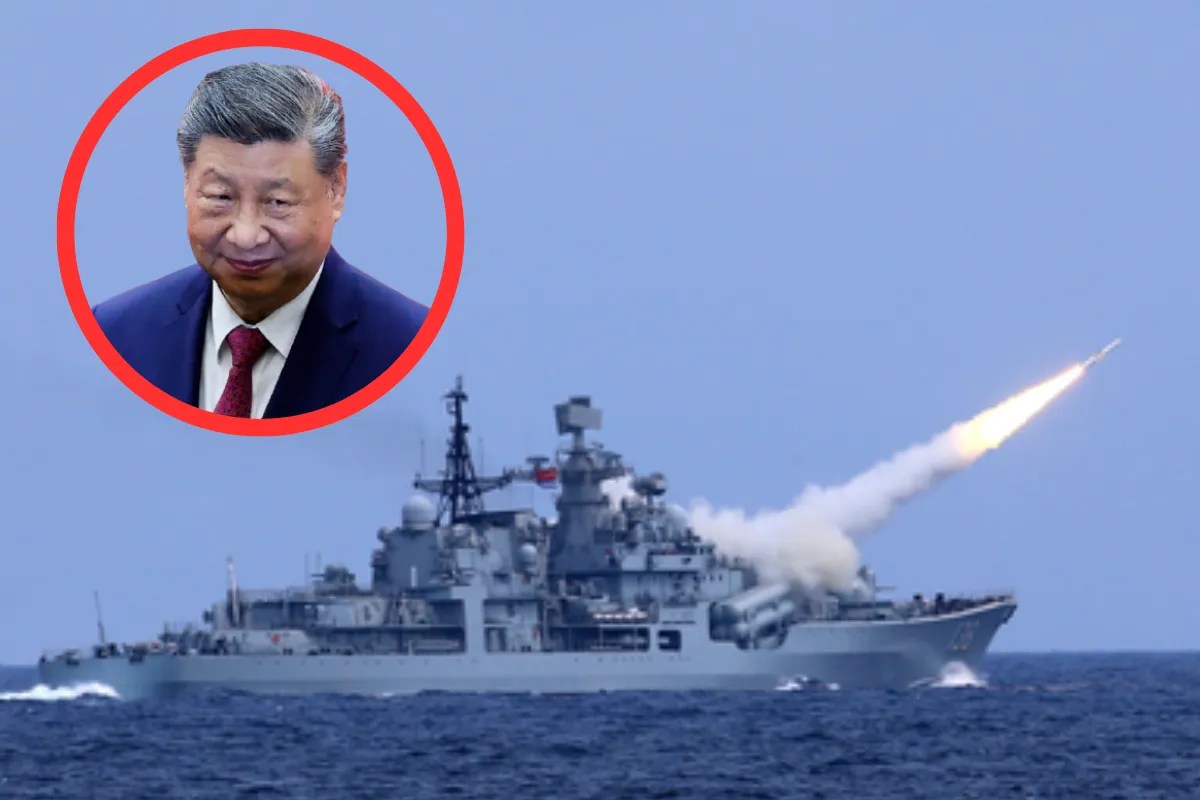
Beijing just sent another massive shockwave through the Pacific. Only a short while after a rare land-based intercontinental ballistic missile (ICBM) test flew past French Polynesia, the Chinese People's Liberation Army Navy followed up by launching a long-range strategic missile directly from a nuclear-powered submarine straight into the open ocean.
If you think this is just another regular military drill, you're missing the bigger picture. Beijing wants us to believe these launches are routine annual training exercises that comply with international law. Honestly, they aren't. Before these recent launches, China hadn't fired a strategic ballistic missile into international Pacific waters since 1980. Breaking a decades-long precedent twice in less than two years is a deliberate policy shift. It's a loud, clear display of a rapidly expanding nuclear triad.
Regional neighbors are understandably furious. From Wellington to Taipei, leaders are treating this as an escalation that fundamentally threatens the stability of the Indo-Pacific region.
The Secretive Trajectory and What China Was Really Testing
The latest test involved launching a submarine-launched ballistic missile (SLBM)—widely suspected by defense analysts to be either a JL-2 or the brand-new, top-of-the-line JL-3—from a nuclear submarine deep in the South China Sea. The missile carried a simulated training warhead across a flight path of roughly 7,300 kilometers, slicing over the Pacific before dropping precisely into designated international waters.
To monitor the impact, the Chinese military deployed tracking vessels deep into the South Pacific. While the land-based DF-31AG launch proved China could hit deep into the United States mainland from mobile launchers at home, this submarine test proves something far more dangerous. It showcases a sea-based strategic nuclear strike capability that can survive a first-strike attack.
Taiwanese government spokesperson Karen Kuo strongly condemned the launch, calling it a blatant attempt to intimidate the international community through unilateral military actions. Taipei knows exactly what this signals. If a conflict breaks out over the Taiwan Strait, a nuclear-armed submarine hiding in the deep trenches of the Pacific acts as a direct deterrent against outside intervention.
Why Pacific Nations Refuse to Accept the New Normal
The backlash from democratic nations across the region was immediate. New Zealand Foreign Minister Winston Peters was quick to express deep concern, explicitly stating that testing nuclear-capable weapons into the South Pacific is entirely inconsistent with regional stability. The Pacific has long prided itself on being an ocean of peace, protected in part by frameworks like the South Pacific Nuclear Free Zone Treaty. Beijing flying massive missiles through these skies ruins that dynamic.
Australia and Japan also voiced immediate disapproval. Australian Foreign Minister Penny Wong warned that these types of destabilizing acts create an environment ripe for miscalculation.
The notification process itself remains a major point of contention. Chinese state media, via the state-run Xinhua News Agency, emphasized that Beijing notified several regional powers shortly before the countdown. But a notification received just hours before a nuclear-capable missile tears through international airspace isn't transparency. It's an ultimatum.
China still refuses to ratify the Hague Code of Conduct against Ballistic Missile Proliferation (HCOC). By dodging standard international protocols, their advance warnings look less like responsible diplomacy and more like a tactical flex to ensure no foreign naval assets accidentally block the missile's path.
The Strategy Behind the Sudden Nuclear Flashing
Security experts look at this behavior and see a clear pattern. Military analyst Joseph Wen points out that Beijing appears to be establishing a new status quo where long-range tests in international waters become a regular occurrence. By systematically testing the land-based and sea-based legs of its nuclear delivery systems, the Chinese military is validating its entire attack profile under real-world conditions.
This isn't gear meant to be used against Taiwan or New Zealand directly. This is aimed squarely at the United States.
By proving its submarines can successfully launch intercontinental weapons that reach deep into the Pacific, Beijing is telling Washington that its secondary strike capabilities are fully operational. They want to ensure that if a localized conflict turns hot in the South China Sea, the threat of mutually assured destruction keeps global powers on the sidelines. The strategy is built entirely on creating leverage through a credible, survival-tested nuclear deterrent.
The Reality Regional Leaders Must Face
Don't expect Beijing to pack things up and go back to quiet simulations. Defense analysts are already predicting that the third leg of the triad—an air-launched strategic ballistic missile capable of being carried by H-6 bombers—could be tested in a similar fashion next.
For countries living in the shadow of this expansion, relying on standard diplomatic protests clearly isn't moving the needle. If you want to understand where regional security goes from here, keep your eyes on the shifting defense pacts. We're already seeing accelerated security agreements, like the recent mutual defense alignment signed between Australia and Fiji.
The immediate next step for Pacific nations isn't waiting for another last-minute launch notification from Beijing. It's the rapid normalization of joint maritime surveillance, tighter intelligence sharing among allied nations, and increased naval positioning to counter a military power that has decided the high seas are its personal testing ground.