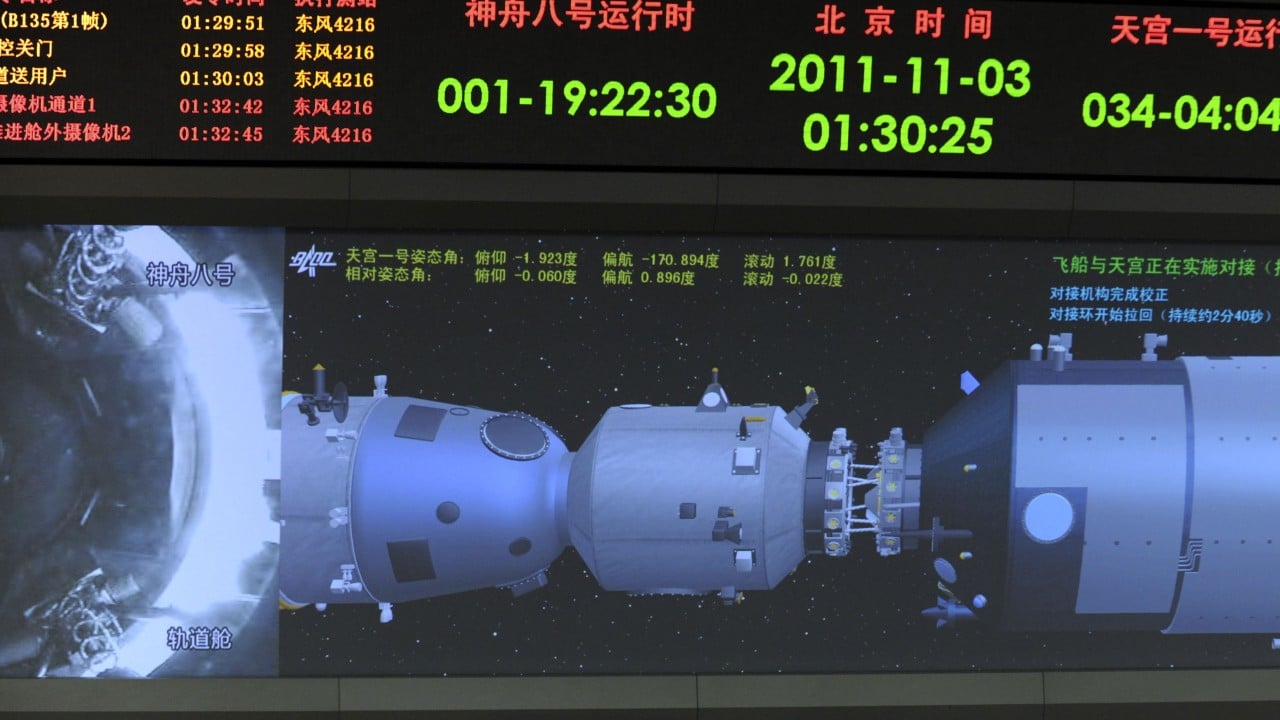
Two unmanned spacecraft moving at 28,000 kilometers per hour found each other in the dark above western China and locked together with millimeter precision. That happened on November 3, 2011. Most casual observers barely blinked at the time, treating it like just another incremental step in Beijing's space program.
They missed the point entirely.
When the Shenzhou-8 spacecraft linked up with the Tiangong-1 target module, China didn't just check a technical box. It became only the third nation in human history—after the United States and the Soviet Union—to master autonomous orbital rendezvous and docking. Without that specific capability, you can't build a space station. You can't refuel satellites in orbit. You can't mount deep-space sample return missions. Basically, without docking, your space program stays grounded in short-duration stunts.
The High-Stakes Ballet Above Earth
Docking two objects in low Earth orbit is nothing like parking a car. Both vehicles are screaming around the planet at roughly 7.8 kilometers per second. If their relative speed is off by even a fraction of a meter per second at contact, the collision will wreck both spacecraft and create a cloud of lethal space debris.
Before November 2011, China had launched astronauts into orbit—starting with Yang Liwei aboard Shenzhou-5 in 2003—and conducted its first spacewalk during Shenzhou-7 in 2008. Those missions proved China could put humans in capsules and bring them home alive. Yet a single capsule is cramped, runs out of power quickly, and limits what astronauts can actually accomplish.
To stay in space for months, you have to assemble modules in orbit. That meant solving the hardest navigation problem in aerospace engineering.
Tiangong-1 ("Heavenly Palace 1") launched first on September 29, 2011, atop a Long March 2F rocket from the Jiuquan Satellite Launch Center in the Gobi Desert. Weighing about 8.5 metric tons, it wasn't a full space station. Chinese engineers designed it as an orbital testbed—a pressurized target module equipped with docking mechanisms, solar arrays, and life-support systems to test whether crews could eventually live inside it.
Thirty-three days later, on November 1, Shenzhou-8 lifted off from the same desert launchpad. Both vehicles were completely uncrewed. The risk of a mechanical failure or guidance glitch during a first-ever docking attempt was simply too high to put taikonauts aboard.
How Shenzhou-8 Found Tiangong-1 in the Dark
After reaching orbit, Shenzhou-8 spent two days executing five precise orbital burns controlled from the Beijing Aerospace Control Center. Ground controllers guided the capsule until it sat about 52 kilometers behind Tiangong-1.
At that point, ground control stepped back. Autonomous sensors took over.
Shenzhou-8 relied on a suite of microwave radars, laser rangefinders, and optical cameras to track Tiangong-1's position and orientation. As the gap closed from 52 kilometers to 5 kilometers, then 400 meters, and finally 140 meters, the spacecraft performed four pre-programmed hold points. At each pause, onboard computers verified alignment before firing tiny thrusters to creep closer.
The final approach happened at a relative speed of just 0.2 meters per second.
At 1:36 a.m. Beijing time on November 3, the docking ring on Shenzhou-8 made contact with Tiangong-1's docking port at an altitude of roughly 343 kilometers. Twelve sets of mechanical latches snapped shut, pulling the two spacecraft together and forming an airtight seal. Power and data lines connected automatically.
They stayed locked together for twelve days. Then, on November 14, Shenzhou-8 undocked, backed away to 140 meters, and executed a second docking—this time in broad daylight to test how harsh solar glare affected its optical sensors. Both attempts worked on the first try.
What People Get Wrong About the Docking Mechanism
A persistent myth from 2011 claims China simply copied Russian docking hardware bolt-for-bolt. The reality is far more nuanced, and honestly, much more interesting from an engineering standpoint.
In the mid-1990s, China did purchase Russian docking technology and training to accelerate its human spaceflight program. The Chinese docking mechanism used on Shenzhou-8 shares conceptual DNA with Russia's APAS-89 (Androgynous Peripheral Attach System)—the same family of hardware developed during the 1975 Apollo-Soyuz Test Project and later used by NASA's Space Shuttle to dock with Mir and the International Space Station.
However, Chinese engineers at the Shanghai Academy of Spaceflight Technology didn't just slap a Russian part onto their capsule. They redesigned the internal electromechanical systems, built their own guidance sensors, and engineered an indigenous mechanism composed of more than 10,000 individual components and 600 specialized instruments. Because the Chinese design adheres to the international androgynous standard, it kept the door open—at least theoretically—for future docking compatibility with foreign spacecraft.
Why Washington’s Exclusion Backfired
You can't separate the 2011 docking from the geopolitics unfolding on the ground that exact same year.
In April 2011—just seven months before Shenzhou-8 launched—the U.S. Congress passed the Wolf Amendment, named after Representative Frank Wolf. That legislation prohibited NASA and the White House Office of Science and Technology Policy from using federal funds to cooperate bilaterally with China or Chinese-owned companies without explicit congressional authorization and FBI certification.
China had previously expressed interest in joining the International Space Station partnership. The Wolf Amendment slammed that door shut.
Instead of slowing Beijing down, the ban handed China's space agency an undeniable strategic mandate. If China couldn't visit the ISS, it would build its own orbital outpost from scratch. The November 2011 docking proved that exclusion wouldn't stop China from acquiring the exact capabilities needed to operate independently in low Earth orbit.
From a Single Testbed to a Permanent Outpost
Once Shenzhou-8 proved the hardware worked, China moved fast.
In June 2012, Shenzhou-9 carried three astronauts—Jing Haipeng, Liu Wang, and Liu Yang (China's first woman in space)—to Tiangong-1. They completed China's first crewed automated docking, and later undocked so Liu Wang could perform a manual docking using hand controllers, proving human pilots could take over if the computers failed. A year later, Shenzhou-10 docked with Tiangong-1 again, delivering a crew that spent 15 days in orbit and even broadcast a live physics lesson to millions of Chinese schoolchildren.
Every single milestone leading to the modern Tiangong Space Station—completed in late 2022 with the Tianhe core module and the Wentian and Mengtian lab modules—traces directly back to those twelve days in November 2011. Even the automated cargo deliveries by Tianzhou spacecraft and the robotic arm maneuvers used to relocate 20-ton station modules rely on the sensor architecture validated during Shenzhou-8.
What You Should Watch Next in Orbital Operations
If you follow aerospace developments or track how space infrastructure shapes global power, don't look at rocket launches alone. Anyone with enough propellant can lob mass into orbit. Look at rendezvous, proximity operations, and docking (RPOD).
When evaluating any nation's or private company's space capabilities today, pay attention to three specific metrics:
- Autonomous turnaround time. In 2011, Shenzhou-8 took two days to catch Tiangong-1. Today, China's Tianzhou cargo ships and crewed Shenzhou capsules routinely dock in just 6.5 hours—and have tested 2-hour fast-rendezvous profiles.
- Non-cooperative rendezvous. Docking with a cooperative target like Tiangong-1 uses transponders and visual markers. Servicing dead satellites or removing orbital debris requires approaching tumbling, uncooperative objects—a capability direct-descendant sensors from 2011 are now being adapted to perform.
- Standardized docking interfaces. Watch whether emerging commercial stations and international lunar gateways adopt the International Docking System Standard (IDSS) or split into incompatible regional ecosystems.
If you want to understand why China operates a fully staffed, modular space station today while other nations debate post-ISS replacements, start by examining the telemetry and mission logs from Shenzhou-8. Everything in modern Chinese spaceflight began the moment those twelve latches locked together in the dark.