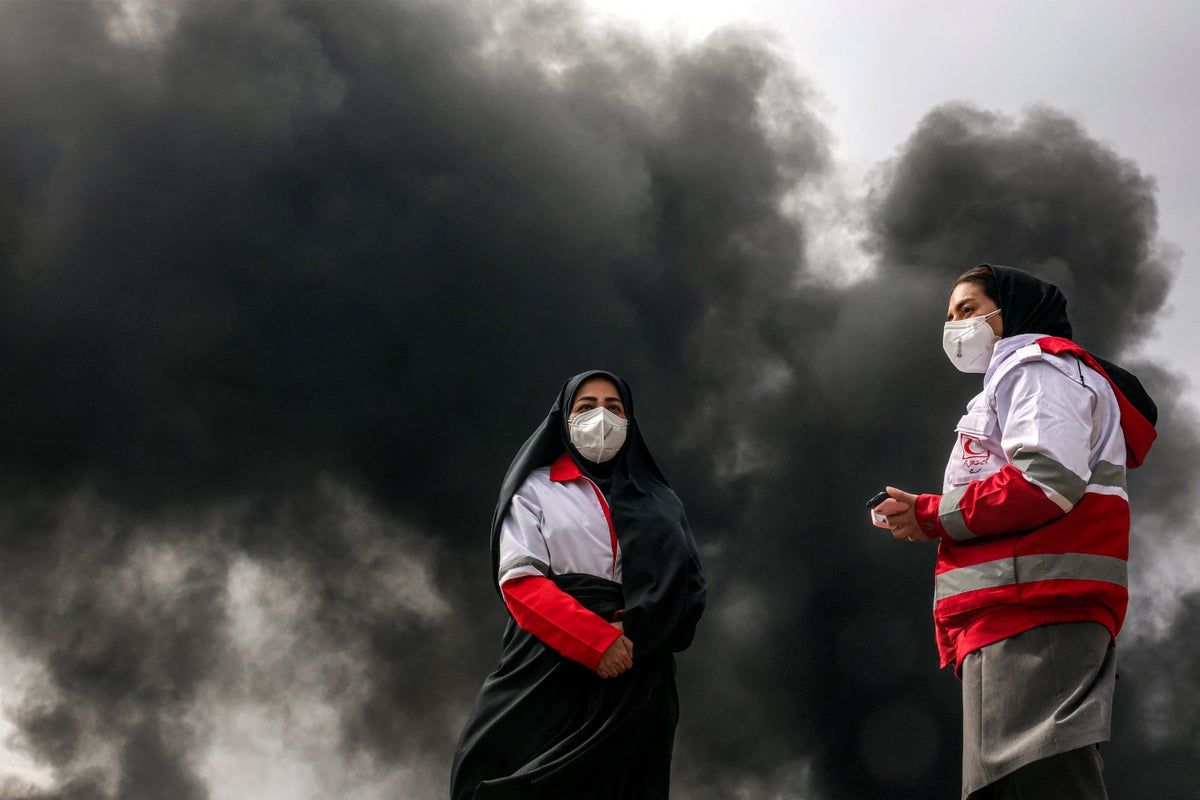
When the first autumn rains hit the Iranian province of Khuzestan, the local emergency rooms do not prepare for floods. They prepare for a mass influx of people who cannot breathe. This is the reality of a recurring respiratory crisis that has haunted southwestern Iran for over a decade, often mislabeled or oversimplified as a natural quirk of atmospheric chemistry. The truth is far more clinical and involves a lethal combination of industrial negligence, specific botanical choices, and a failure to address the shifting chemistry of the air.
While many observers point to "acid rain" as a convenient catch-all term, the medical and atmospheric reality in Ahvaz and Abadan is more complex. True acid rain usually takes years to degrade forests and dissolve marble statues. What happens in Khuzestan happens in hours. Thousands of people—sometimes up to 20,000 in a single week—suddenly lose the ability to draw a full breath. To understand this, we have to look past the rain itself and into what the rain is carrying.
The Pollutant Cockpit of Ahvaz
Ahvaz has frequently topped the World Health Organization’s list for the most polluted city on Earth. This isn't just because of cars or wood smoke. The city is a literal cockpit of industrial output, surrounded by aging oil refineries, petrochemical plants, and massive steel mills. These facilities vent nitrogen oxides and sulfur dioxide into an atmosphere that is already struggling with heavy dust loads from the Mesopotamian marshes and Saudi deserts.
When these gases meet moisture, they don't just sit there. They undergo a chemical transformation. Sulfur dioxide ($SO_2$) reacts with water vapor to form sulfuric acid ($H_2SO_4$). Nitrogen oxides ($NO_x$) turn into nitric acid ($HNO_3$). These are the ingredients for traditional acid rain, but in Khuzestan, they are interacting with a unique biological catalyst that turns a chronic environmental problem into an acute medical emergency.
The Conocarpus Paradox
For years, the Iranian government and local environmentalists have debated the role of Conocarpus erectus, an imported tropical shrub widely planted across Khuzestan to provide shade and greenery in an arid landscape. Critics call it a "biological pollutant." Supporters call it a scapegoat. The data suggests it is a crucial piece of the puzzle.
Conocarpus blooms twice a year, and its flowering season aligns perfectly with the first autumn rains. These plants produce massive amounts of pollen. On a dry day, the pollen grains are too large to penetrate deep into the human lung; they are caught in the nose and throat. But when the first rains fall, the moisture causes these pollen grains to swell and explode.
This process, known as osmotic shock, shatters a single pollen grain into thousands of tiny fragments. These fragments are small enough to bypass the body’s natural filters and lodge deep within the alveoli. When these fragments are already coated in the acidic pollutants from the nearby refineries, they become microscopic chemical delivery systems. The result is a surge in "thunderstorm asthma" that can overwhelm a hospital system in a single afternoon.
Industrial Immunity and the Regulatory Void
If you follow the money, you find the reason the air doesn't get cleaner. The industrial belt around Ahvaz is the economic lifeblood of the nation. These are state-owned or state-adjacent enterprises that operate with a level of immunity that private companies elsewhere could never dream of. Upgrading the scrubbers on a 40-year-old refinery is expensive. Shutting it down during high-risk weather patterns is even more costly in terms of lost production.
The regulatory bodies tasked with monitoring air quality often find themselves in a conflict of interest. When the choice is between the health of the local population and the output of a vital national industry, the industry usually wins. We see this in the delayed warnings issued to the public. Often, the "stay indoors" advisory comes after the emergency rooms are already full.
It is also important to look at the fuel quality. Because of international sanctions and economic isolation, Iran has struggled to modernize its refining processes. This results in the production and use of "mazut," a heavy, high-sulfur fuel oil. When power plants burn mazut to meet energy demands, they dump massive amounts of sulfur dioxide into the air. This isn't a secret; it's a documented survival strategy for an economy under pressure. But the cost is paid in the lungs of the Khuzestani people.
The Chemistry of the Dust
Khuzestan is also the front line of the regional dust crisis. Decades of dam building upstream in Turkey and Iraq, combined with the drainage of local marshes for oil exploration, have left the soil dry and loose. This dust is not inert. It is chemically reactive.
The dust particles act as surfaces for chemical reactions. In the high-heat, high-humidity environment of the Persian Gulf, these particles can adsorb acidic gases. When the rain falls, it doesn't just wash the dust away. It creates a suspension of acidic mud that stays in the air as an aerosol long after the rain has stopped.
Infrastructure at the Breaking Point
The acid rain doesn't just hurt people; it eats the city. The electrical grid in Khuzestan is famously fragile. In February 2017, the province experienced a total blackout because a combination of heavy dust and high humidity created a layer of "conductive mud" on the power insulators. When the light rain began, it turned that mud into a conductor, causing massive short circuits.
The acidic nature of the rain accelerates the corrosion of this infrastructure. Metal supports, transformers, and communication lines degrade at two to three times the normal rate. This creates a cycle of failure. The government spends its budget on emergency repairs rather than the long-term upgrades needed to reduce the emissions in the first place.
Why Simple Solutions Fail
There is a frequent call to rip out all the Conocarpus trees. While this might reduce the pollen load, it would also remove one of the few sources of shade and carbon sequestration in a region that regularly sees temperatures above 50°C. Removing the trees without replacing them with a less allergenic native species would likely lead to an increase in the "urban heat island" effect, making the air quality even worse by accelerating the formation of ground-level ozone.
Similarly, the solution of "switching to cleaner gas" is hampered by a lack of infrastructure and the immediate need for heavy fuels to keep the lights on. The transition requires capital that is currently tied up in geopolitical stalemates.
The Missing Data
One of the greatest hurdles to solving the Khuzestan crisis is the lack of transparent, real-time data. While there are air monitoring stations, the data is often centralized and sanitized before it reaches the public. Independent researchers frequently face hurdles when trying to map the exact chemical composition of the rain in different neighborhoods. Without hyper-local data, the response remains a blunt instrument—telling everyone to stay inside—rather than targeted industrial shutdowns or specific health warnings for the most vulnerable.
The Human Toll
The statistics of "thousands admitted to hospitals" don't capture the long-term degradation of life. We are seeing a generation of children in Ahvaz growing up with permanently reduced lung capacity. Chronic obstructive pulmonary disease (COPD) and asthma rates are skyrocketing. This isn't a "natural disaster" that happens once a decade. It is a seasonal siege.
The people of Khuzestan have become experts in a science they never wanted to learn. They know which way the wind blows from the refineries. They know how to seal their windows with plastic when the first dark clouds of autumn appear. They know that the rain, which should be a blessing in a desert land, has become a threat.
Solving this requires more than just planting different trees or issuing weather alerts. It requires a fundamental shift in how industrial output is prioritized against human life. It requires the installation of modern desulfurization units at every power plant and refinery, regardless of the cost. Until then, the sky over Ahvaz will remain a laboratory for a chemical reaction that the population is forced to participate in.
Check the wind direction today and keep your windows closed if the breeze is coming from the west.