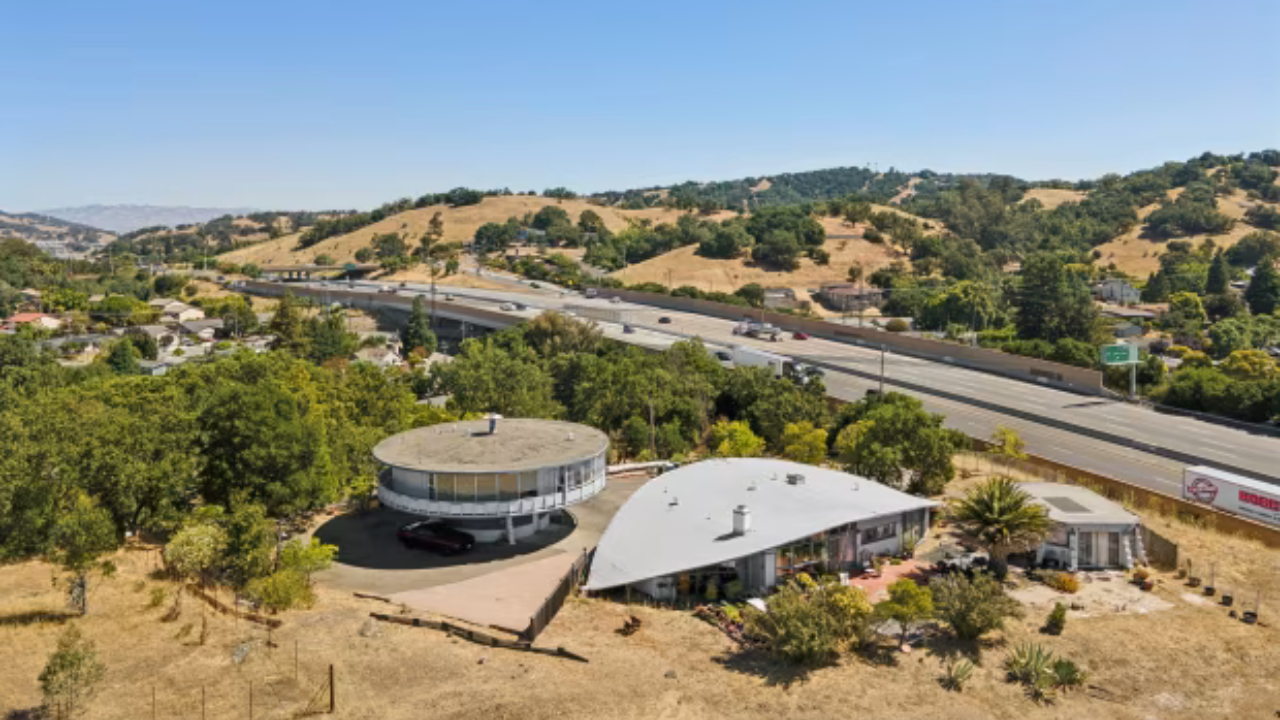
Most people think a house is just a static box. They’re wrong. In 1963, a self-taught builder named Sam Harkleroad decided that views shouldn’t be permanent. He didn’t just talk about it; he built a home in Novato, California, that actually turns. Yes, it spins 320 degrees on command.
You’ve probably seen standard real estate listings that claim a "panoramic view." That usually means you get to look at the same neighbor’s fence or the same stretch of freeway every single day. Harkleroad, a guy who grew up on a farm and never finished formal architectural training, wasn’t interested in the status quo. He found the "same old houses" boring. So, he built a 1,560-square-foot structure that lets you chase the sunset or wake up with the sunrise in a different room if you feel like it.
The Mechanics of the Spin
How do you make a house rotate without snapping the plumbing or killing the power? It’s not magic. Harkleroad designed the home around a central cylindrical pillar. This core houses the flexible gas, water, and sewage lines. These lines are engineered to move just enough to allow the house to rotate 320 degrees—or eight-ninths of a full circle—before the system hits its limit and needs to be spun back the other way.
The power for this mechanical marvel? Two standard washing machine motors.
It sounds like something you’d find in a DIY garage project, but it’s been working for over six decades. The structure sits on an inverted railroad track, moving smoothly enough that it doesn’t rattle the dishes off the table. It wasn’t designed to spin constantly like a ride at a carnival. It’s meant to be adjusted when you want a change of scenery.
Why This Matters for Modern Homeowners
The property recently hit the market for $3.3 million. It’s a 2.25-acre complex that includes the famous "Round House," the "Potato Chip House" (named for its hyperbolic paraboloid roof), and five other structures.
Some might look at this and see a relic. I see a masterclass in resourcefulness. Harkleroad was a guy who built things because he couldn’t afford to buy them. He used recycled materials, salvaged structures, and even secured corporate sponsorships to keep his costs down. He famously got Tappan to supply kitchen appliances in exchange for letting the public tour his creation.
This isn't just about a house that spins. It’s about the sheer audacity of building something that works better than industry standards. While modern architects obsess over computer-aided designs and complex simulations, Harkleroad was out there in Marin County with a bulldozer and a dream, figuring out how to make a building behave like a machine.
Lessons From the Frank Lloyd Wright of Marin
Harkleroad earned the nickname "The Frank Lloyd Wright of Marin County," and for good reason. He didn't just build the Round House. He constructed dozens of unusual homes using salvaged materials. His workshop even featured a homemade wind turbine made from steel oil drums.
If you're ever tempted to think that "building a home" means choosing from a catalog of cookie-cutter designs, look at what this guy did with a few washing machine motors and some leftover steel. He challenged the idea that housing must be rigid.
If you're looking at the real estate market today, it's easy to get discouraged by the prices of boring, generic boxes. This property, with its quirky history and mechanical ingenuity, is a reminder that personal expression and functional innovation aren't mutually exclusive. You don't need a massive R&D department to change how a home feels; you just need a better understanding of how the parts interact.
Practical Steps for Your Own Projects
If you're inspired by this kind of work, you don’t need to go out and build a rotating house tomorrow. However, you can adopt the mindset.
- Question the fixed elements: Look at your own living space. Is a wall really necessary, or is it just there because that’s how it was drawn on the floor plan? Can a piece of furniture be on casters to serve multiple rooms?
- Prioritize utility over aesthetics: Harkleroad didn't make his house look like a UFO just to be weird. He made it circular because it was the most efficient way to maximize the view. Design for function first. The beauty follows.
- Don't fear "unconventional": If you're building or renovating, don't let a contractor talk you out of a wild idea just because "nobody does it that way." Ask them to help you find a way to make it safe and functional.
- Learn basic mechanics: You’d be surprised what you can achieve with a basic knowledge of motors, gears, and structural support.
Whether this house ends up being preserved by a developer or bought by a tech mogul who just wants a conversation piece, its legacy is set. It proved that in the right hands, common materials can create something that defies expectations. Stop looking for the perfect house and start thinking about how to build one that actually does what you need it to do. Sometimes, all it takes is a different perspective—and maybe a motor or two.